The workers at the Ballard locks in Seattle used to use these because of some safety regs (for a short while). They all hated them because they jammed up all of the time.
Wish I knew the name of the mechanism they used, it looked interesting enough to get me talking to one of the workers about it.
How is the top curved portion (that "cable to mine" connects to) affixed to the gear and thus the other half of the cable? I can't tell from the picture. If it is simply connected to the gear axle, won't that block the sweep wire from passing through?
That's what I thought also. Wouldn't the amount of force pulling on the cable lead to some jamming as soon as the little spokes stopped spinning so freely?
"The device works by using a spoked, rimless wheel that allows cables to pass through as it rotates. The ends of the spokes are widened, and the cable is held together by a short curved sleeve through which these spoke ends slide."
Richard Feynman mentions these in Surely You're Joking, Mr. Feynman!:
> One mechanical engineer at Frankfort was always trying to design things and could never get everything right. One time he designed a box full of gears, one of which was a big, eight-inch-diameter gear wheel that had six spokes. The fella says excitedly “Well, boss, how is it? How is it?”
> “Just fine!” the boss replies. “All you have to do is specify a shaft passer on each of the spokes, so the gear wheel can turn!” The guy had designed a shaft that went right between the spokes!
> The boss went on to tell us that there was such a thing as a shaft passer (I thought he must have been joking). It was invented by the Germans during the war to keep the British minesweepers from catching the cables that held the German mines floating under water at a certain depth. With these shaft passers, the German cables could allow the British cables to pass through as if they were going through a revolving door. So it was possible to put shaft passers on all the spokes, but the boss didn’t mean that the machinists should go to all that trouble; the guy should instead just redesign it and put the shaft somewhere else.
Based on this model[1] with some modifications for printability. I've printed it in 6 parts and glued it together. It's barely holding though, because apparently super glue is not the best way to bond ABS ;)
EDIT: I just figured out that to use it as a shaft passer inside a wheel just like on the Wikipedia article, the rotor would need some plastic removed so that the shaft can get through without having to move up and down.
It is strange that the wikipedia article describes the shaft passer as hypothetical. They are widely used in yachting harnesses - it allows your safety harness to be connected to the life-lines and can roll over the stanchions as you walk past them.
Anyone who has done the bridge climb over Syndey Harbour Bridge has used one too. Unfortunately I couldn't find a good photo of the harness and connector.
A similar trick is done by Type II topoisomerases, which are molecular machines found in just about every living cell. Type II topoisomerases pass one piece of DNA through another. See https://en.wikipedia.org/wiki/Topoisomerase_II
Well, in fact the topoisomerase CUTS the second DNA and ligates it afterwards, so it is obvious it can pass through. I don't think it's similar at all.
Fun fact about Type II topoisomerase: even though it only has local information (the area where it acts) it manages to move in the correct direction (lower unknotting number) about 90% of the time. AFAIK, no-one knows how.
The spoke has been cut (by design) and the shaft passer sits at the cut, where the shaft passes through it. It cleverly does this "airlock-like" without falling apart and letting the two halves of the spoke separate. Similarly, the topoisomerase, after cutting the "spoke" DNA, becomes covalently bound to each side of the cut. Then the "shaft" DNA passes through the topoisomerase, without the topoisomerase falling apart or letting the two sides of the "spoke" DNA drift apart. Multiple "shaft" strands can pass before the "spoke" strand is religated and the enzyme detaches. So I think the principle is quite analogous.
This is similar to how "zipper organs" work in AK Dewdney's The Planiverse, they keep 2D creatures from being separated by their digestive system. The passage that covers this concept is on page 44 which is unfortunately out of the range allowed by the publisher -> http://books.google.com/books/about/The_Planiverse.html?id=w...
It seems so on a first glance, but if you think about how this 2D phagocyte can be formed (especially on a macroscopic scale) and how would it interact with other structures it becomes much less obvious.
IIRC Hero of Alexandria made a similar device 20 centuries ago: a horse statue that could had its head cut with a sword, without it falling down, with a set of gears that let the sword pass through the neck of the statue without letting the head go.
I've cut each stator into two parts vertically so it can actually be assembled by gluing them around the rotor, and I've also cut the rotor so it can be printer without support.
The quote from "Surely You're Joking Mr. Feynman" explains it better. This Wikipedia article is pretty bad.
  One mechanical engineer at Frankfort was always trying to
  design things and could never get everything right. One
  time he designed a box full of gears, one of which was a
  big, eight-inch- diameter gear wheel that had six spokes.
  The fella says excitedly "Well, boss, how is it? How is it?"

  "Just fine!" the boss replies. "All you have to do is
  specify a shaft passer on each of the spokes, so the gear
  wheel can turn!" The guy had designed a shaft that went
  right between the spokes!

  The boss went on to tell us that there was such a thing as
  a shaft passer (I thought he must have been joking). It was
  invented by the Germans during the war to keep the British
  minesweepers from catching the cables that held the German
  mines floating under water at a certain depth. With these
  shaft passers, the German cables could allow the British
  cables to pass through as if they were going through a
  revolving door. So it was possible to put shaft passers on
  all the spokes, but the boss didn't mean that the machinists
  should go to all that trouble; the guy should instead just
  redesign it and put the shaft somewhere else.
So, a shaft passer really does exist, and really has been used. But for this example, of someone designing a machine that has one axle going through another wheel, the better solution is just to move that axle, rather than trying to actually build a wheel with a shaft passer on each spoke.
I'd like to see a reliable source, and ideally a photo/video of the device in action. I won't say it's impossible, but it seems like it would be hard to make sure the gear rotates smoothly instead of binding, and "Feynman says that a guy he worked with heard about it" isn't as convincing as it might be.
The shaft passer shown here has never been used in real life. The mechanism that's on each of the spokes of the cog has been used in real life to allow cables to pass each other (just imagine one of the spokes and the obstructive shaft are actually cables).
I considered it; I've done a good bit of Wikipedia editing in the past. The problem is, I have a hard time figuring out how to phrase it better without just including the Feynman quote. That's the only source, and it seems that the Wikipedia page is merely trying to re-phrase what Feynman said; there really isn't anything to the page other than Feynman's quote and the diagrams. As such, it's hard to do a good job rephrasing it rather than simply quoting Feynman.
If you can find other sources than Feynman on the shaft passer (and blog posts and forum discussion that are merely discussing Feynman don't count), I'll consider updating it with an improved description and reference to the other sources.
It looks like it should work, but the tolerances and tensions required make it unlikely to ever actually work. For the model in the article to work, the inner gears (in red) need to be A) Loose enough that the blue shaft can pass between them B) tight enough to pass power from the interior of the wheel to the exterior. This is improbable, and, while the solution seems sound, it's never been shown to work; It maintains mythical status.
I don't know if tightness has anything to do with it. As long as the passer cannot escape its enclosure, it would pass power, because it is being dragged by the inner spoke. The real problem is the amount of force being placed on the passer and the probably impact of routinely passing the shaft through at high velocities.
Yeah, I think in practice, as drawn, the red wheels would simply jam up. And if they don't, the outer rim of the big wheel would not hold its place relative to the inner part. I dont see how the outer rim could be solid enough, relative to the inner hub, to do any useful job. The whole thing just breaks.
The mine application seems to be a subset version. If that is the best example any one has of this design in practice it suggests that its not possible to build a working version of the whole thing. A mechanically weak proof of concept might be possible, but a solid use-able version seems to me to be impossible.
Might work if the outer rim is supported or guided on some way. I still think loading is a problem though.
This is a really good analysis – I thought the design was simple at first, but now even the cable-passing-cable version linked in the wikipedia page looks liable to jam as teeth pass in and out of the top channel.
For something like this to even have a chance, it would probably need many more, thinner teeth than these diagrams illustrate.
EDIT: @analogwintermut I think this addresses your question.
In that situation the cable needs to be strong along its length but allow passing through orthogonally. Whereas a gear would need to be both strong and weak on the same axis.
I agree the implementation isn't sound, but there's nothing wrong with the concept of a shaft passer.
As an example of why it is conceptually feasible, remember that you could computationally (or mechanically) determine when a shaft is closing in and open a gap in that particular support at the right time, maintaining ability to pass torque through all other supports.
It's certainly possible to build. It's a joke because it should never need to be built. There are so many simpler ways to route power around the wheel rather than through it. If it ever became apparent that you needed such a device, it would indicate some seriously poor choices early in the design process. The joke revolves around the wheel/shaft problem, not the cable/cable problem.
Thank you guys for discussing my work. You created a huge traffic peak on my blog! I had to search a bit to find where it did come from as HN's links apparently aren't tracked by WordPress statistics (rel="nofollow" I guess)
Clearly the wheel would be extremely difficult to produce and to operate, especially if torque has to be transmitted. I intended to model a version with the german cable design, i.e. one of the half-spoke attached to the star wheel axle, but I leave this to the most fanatic of you ;-)
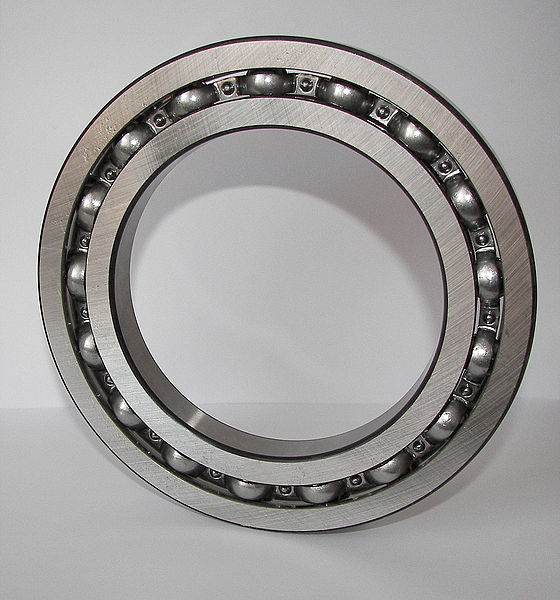
surely this would be technically feasible with a mechanism similar to a bearing [1] but with teeth on the inner and outer and cogs in place of the bearings (through which the shaft would pass)? the difficulty of course would be to tune the teeth so the outer turns at the same rpm as the inner..
..though i get the implication of design vs engineering
It seems to say that these were never used and then says that they were used in the world wars? I was under the impression that they had indeed been used successfully for mines. Is this not the case?
A shaft passer refers to a wheel that can rotate even if a shaft is held between spokes; the image in the wiki page shows one.
The device used in mines is somewhat similar in that it seems to allow solid objects to pass through each other, but it is not a shaft passer as it is not a wheel with "penetrable" spokes.



[1]http://drgoulu.com/wp-content/uploads/HLIC/849e60a7d99c30c2a...