Many people agree that there are many problems with first past the post voting. IMO, that's an artefact of voting districts. With modern technology, it's possible to make our representative democracy truly representative.
During an election, you give your proxy to anybody who is willing to be a representative. Each representative votes in Congress with a vote weighted by the number of proxies they received. The top 500 or so representatives get to sit in Congress. Those who didn't reach the threshold must pass their proxy on to another.
Nobody is no longer "represented" by somebody they didn't vote for. You can be represented by somebody who much more closely matches your interest. "Districts" will still be represented because many people will choose a local candidate, but everybody is free to choose someone who will represent them better if no local candidate does.
This won't eliminate political parties, but it will significantly weaken them as strong representatives will no longer be as dependent on the party machinery.
I'm curious: is there any otherwise "fair" voting system that is less representative than "first past the post voting"?
It's obvious it was chose for the US because they had ZERO knowledge of game theory and it was the best they could come up with at the time.
But given that we now know how to do representative democracy that's actually, you know, representative, it does make me wonder if the US is actually provably using the worst "fair" voting system we actually know how to build.
And if it is, you'd think it'd be possible to get the states to pass a constitutional amendment changing it (which would then go to congress – yes, it's in reverse, but the two-party system will NEVER vote themselves out without an overwhelming public display of opinion on the matter, IMO).
I like your idea, but given that the technology is in reach: why not just get rid of representation entirely? We need a method for generating new law proposals and then just people vote directly on those from their own homes rather than voting for some person who may or may not vote for you in the way they claim they will.
Ever heard how they do it in Switzerland? They have several national referenda each year, directly voting on issues of federal importance.
I'm afraid this works well only due to the small size of the country. OTOH their democracy is 800+ years old. Modern technology could scale popular voting to larger populations.
Liquid Democracy is basically direct democracy with a flexible proxy capability. My proposal is proxy only.
Liquid Democracy also does away with fixed election dates and embraces a continuous process. I deliberately didn't talk about that in my proposal. I think too many people get hung up on the continuous process part, which I think is much less important than proxy voting combined with the removal of districting.
IOW, my proposal is a toned down version of Liquid Democracy.
I feel like I can't contribute much further than Yglesias did,
>Political partisanship is kind of like representative democracy itself—a terrible mess, but clearly superior to the alternatives. After all, we don't need to guess at what representative democracy without political parties would look like. Just examine almost any American city council—be it New York, DC, Chicago, San Francisco, whatever—and you'll see a legislative body that's so overwhelmingly Democratic that partisan politics don't drive outcomes. The result of this isn't a utopia of good government and sound policy, it's an orgy of hyper-localism.
>Political parties are organized, for better and for worse, around clashing visions of what's better for America. The quest for partisan advantage is, among other things, a quest for the opportunity to build a better society. Absent parties you get a situation where instead of a clash of visions of what would be best for the city as a whole, council members give undue preference to strong local interests. In city government, that means NIMBYism. In Congress it would mean endless gobs of the much-derided pork barrelling.
This is all hot air punditry. A 'no party' system is clearly different to a 'one party' system. Most notably because those elected still have the fear of being voted out next year...
Also - do you really think having everyone independent would result in fewer 'clashing visions of whats better'? You are likely to have as many as you do candidates, not 2 that are hardly different.
Because you're only beholden to the people who live in your ward, you only really have the interests of those specific 10-50 thousand people (less in smaller cities, more in larger ones) in mind.
This, it turns out, really harms the capacity for governments to make decisions that make everyone better off on average but might make any given small region of people unhappy (say, by building a powerplant or a garbage dump).
Of course, there are benefits to this kind of representation, and some kind of mix is always desirable - but the gist of it is people are more willing to make regionally-disinterested decisions if their interests are aligned across ideological rather than geographical lines.
"This, it turns out, really harms the capacity for governments to make decisions that make everyone better off on average but might make any given small region of people unhappy (say, by building a powerplant or a garbage dump)."
Can you explain why? I don't understand this. I would have thought that, for example, given a country of 50 districts, and the decision is being made "shall we build this dump in district 1", you'll get 49 voting yes and the representative of district 1 voting no.
But District 1's representative is chair of a committee you need to sweet talk in two months, and is maybe a tie-breaking vote for that other thing you want.
It's a case study of power dynamics inside the city of Aalborg with respect to a specific project and shows the influences of counties, businesses, and political climate on the result.
Not sure why Amazon doesn't seem to have it anymore... :(
I'm not sure that was the best example. If you're talking about NIMBYism, there's generally some sort of veto power or capacity to obstruct involved.
The Congressional equivalent would be earmarks and pork. Not that we don't have quite enough of that already but the argument is that absent larger, more ideological themes and the parties' whips, it would be just about all we would have.
The other argument for this is that the ability to have better control of your immediate community/district is really useful in avoiding or stopping decisions that can destroy or permanently harm those neighborhoods. Local politics reflects really well the kind of struggles localities and communities go through, even if sometimes NIMBY kicks in and leaves everyone worse off.
I'm not sure your example is an especially good one. Better is town meetings, which we are common in New England. While they have desirable features, they have the weakness that a small group that is very interested in a given outcome can dominate a much larger population of individuals who have weaker feelings. (Not a universally bad feature but it makes it easier for activists on a given issue to dominate an agenda.)
#1 - We have two political parties in the USA because of our winner takes all form of elections. No matter how big the pie, two sides will each attempt to form the smallest winning coalition.
#2 - Anything that weakens the political parties strengthens the monied interests. The American experiment has always been wealth vs democracy. Bad as our parties are, plutocracy is worse.
This may change with the rise of issues-based political organizations.
#3 - In the USA, we vote on everything, and we are not homogeneous. My local Republicans would be considered Democrats else where.
#4 - Don't be distracted by the party politics. Reforms which would most improve our democracy, in order, are:
a) Fair redistricting, meaning maximal competitiveness, minimal incumbency protection.
b) Universal voter registration, just like every other western democracy.
c) Public financing of campaigns.
d) Restore the fairness doctrine.
That's pretty much it. A good start. Everything else is just rearranging the deck chairs on the Titanic.
(I've got a separate list for election integrity reform.)
There is an error in the paraphrasing, Sergey Brin is not calling for all politicians to abandon their political parties. He is suggesting the "victors" to withdraw from their party affiliation while they are governing. There is a big difference.
I think you are correct. Many people seem to not be bothering what he wrote. That being said, I don't really understand this post at all. He recognizes and dislikes the game mechanics involved in political brinkmanship, and then thinks somehow there is any competitive human endeavor that does not involve one? Why not use mathematics to find a better mechanic more suitable to a goal? For example, absolute or adaptive term limits.
Simply renouncing party affiliation leads to Bloomberg style manipulation of the electorate's party affiliations. Some people (most) prefer that the actions and abuses of one elected official will most likely reflect on the entire party in the next cycle. Complicated.
This is a good move from Brin in my opinion, even though he can do little more than speak about the matter. There's nothing more dangerous to a stable democracy than a two party system. In Britain with more prominent parties (Even though only two really get elected) I still feel like my politics aren't being represented.
I don't want politicians to denounce their political parties. Instead, I would rather see an adoption of elements of proportional representation into our political system.
For example, Party List PR[1] in the House of Representatives would provide an avenue for third parties to actually get elected on the national level. This may seem like an extreme example, in that it is highly unlikely to happen any time soon, but it is not an extreme system of voting. The German Bundestag, for example, combines a system of First Past the Post voting and Party List PR to achieve proportional representation in their legislature[2].
Even less extreme would be ditching the Electoral college, and moving to a Single Transferable Vote[3] for presidential elections. At least under these systems you're not "Throwing your vote away" when voting third party.
There is evidence that proportional systems of representation increase voter participation, and voter confidence. I would love to see prominent technologists espousing these sorts of changes.
I would also like to see the "Approval Voting" system being implement. It would make sure the politician that most people agree with the most, will get elected. It would also make it a lot easier for a 3rd party candidate to be elected president.
For example, if 45% would vote for Obama (Democrats), 45% would vote for Romney (Republicans), and each of those 2 factions would also vote for Gary Johnson in proportion of 30% each (out of total voters), then it would be Gary Johnson who would win the election, because he would have the support of 60% of the population, rather than 45% for Obama and 45% for Romney.
The reason this result would be more satisfactory for a larger portion of voters, is because more people actually approved of this candidate from both sides, instead of 45% approving Obama and absolutely hating Romney as a president, or 45% approving of Romney and absolutely hating Obama.
The winner would be the candidate that is liked or approved by the largest portion of the population, which leads to higher satisfaction for the voters after the election.
As an added bonus, because it creates more [viable] parties, it makes attack adds less effective: If you have one opponent, causing that opponent to lose a vote is just as good as gaining a vote for yourself. If you have two or more viable opponents then attacks against any individual opponent helps the remainder as much as you. And in that case, better to be positive about yourself than negative about the opposition.
I whole heartedly support replacing winner takes all with approval voting, which is easier to administrate, far more robust, and more fair. But that's a huge change. Fortunately, there are smaller, more beneficial changes we can do while working to replace winner takes all. (See other comment.)
It's worth nothing that this isn't necessarily a bad thing, depending on who you are. By that, I mean that if you're part of government, it's a very good thing, since fewer parties generally means more government stability. Of course, that's quite likely to be bad for the general population.
In Germany we have a multi-party system and it works a little better than in the US but it's not a silver bullet either. After each election, the elected representatives vote for our chancellor (similar to the American president). Because we have so many parties and the two largest parties usually get only 20% to 40% of the vote, they need to form alliances with the smaller parties in order to gain a governing majority.
Sometimes our conservative party will team up with the liberals, sometimes our social democratic party will have to team up with a right-leaning party and sometimes the two big parties will even form an alliance.
This works fairly well, especially because each state government has a different set of governing parties so there's not as much bitterness and more people get to work together. That said, within each office, parties still consider themselves to be either governing or the opposition and fall into opposition mode for a few years, just like they do in the US.
I think that a Liberal vs Conservative two party system is inevitable in any large group. This assumes that most humans fall into broad liberal (counts on government, believes in helping the poor, open to new ideas) or conservative (dislikes taxes, believes in personal responsibility, likes free markets and the past) modes of thinking.
Sooner or later, the smaller groups on one side are going to realize that they can push elements of their agenda further if they all vote together. They might not get all of the things that they wanted, but they'll gain more leverage over the people who have a drastically different world view. Once this has happened, all of the people of the other mode of thinking will realize that they now have to band together in order to compete. And wallah, parties are formed.
The problem this presents to american voters is that a vote for a third party is effectively a vote for the other side of the ideological divide. Every vote cast for Garry Johnson is directly aiding the cause of Barack Obama. I bet Al Gore hates Ralph Nader to this day. The idea of "what will happen if the other side wins?" is a very real motivating factor in the voting booth.
I'm not defending the two party system. I'm saying that like free markets, it's an emergent property of human behavior. Working together with common cause is the best way to get something done, even if it means associating yourself with a group of people that you don't entirely agree with.
There are two important points to remember when it comes to political parties:
1. Political parties are brands. Just like buying a widget from Apple is done based on certain expectations based on the history of previous widgets, a political party instantly tells most voters what that person is for or against.
This is incredibly convenient to the vast majority of voters; and
2. The current state of politics in the US I think reflect's Hotelling's Law [1]. The parties have converged on the middle so they each get roughly half the vote. With such close elections and narrow balances of power in the House and Senate things are going to stay ugly.
Look no further than the current distribution of seats in the Australian House of Representatives [2] where the Gillard government clings to power with the support of 3 independents and 1 Green (76-74), a change of a single seat could change the government.
This has inevitably led to some bitter disputes [3] [4] that would be non-issues or much smaller issues if the government had a large working majority.
The problem with the US is not the electoral college or that only swing states matter (which largely misses the point). Popular vote deciding the president would be a fundamental change to the system that would (IMHO) ultimately lead to disaster when a close enough election repeated the turmoil of the 2000 Florida recount across the entire country.
The problem is that:
1. Voting isn't mandatory and the population is apathetic;
2. Voting is too hard being on a weekday and involving long waiting times. I would also argue that the long waiting times are symptomatic of (1). Partisan election officials have a vested interest in deterring or encouraging the vote in certain areas;
3. The FPTP (first past the post) system reinforces the two-party system whereas preferential voting systems allow "protest votes" without them being wasted or, worse, an effective vote for the other side;
4. Here's the big one: people are too predictable in how they vote. Of those that vote, 40% vote Democrat, 40% vote Republican and 20% decide the election. The Biggest electoral landslides in history (Reagan in 84 and Nixon in 72) have both garnered less than 60% of the popular vote.
This problem is so bad that in the redistricting process [5] there are maps produced of political persuasions that are used by the incumbent state government to redraw boundaries to maximize "their" Congressional delegation. This process is incredibly accurate because people are so predictable.
IMHO the choices in this election are pretty terrible. Romney, with his 47% and his "binders full of women" is a joke. Obama is the most IP-friendly and consumer and tech hostile president in history, from championing in secret a treaty (the original ACTA) that would've raised file-sharing to the level of terrorism and turned the FBI into the RIAA and MPAA's enforcement arm to filling the DoJ and judiciary with RIAA lawyers to his stance on software patents.
My advice? Given bad choices, which seem to abound, vote against the incumbent. The one thing politicians seem to fear is losing office with all the power and perks that come with it.
If this means you vote for a party you otherwise wouldn't, consider this: it's also important that your party doesn't take your vote for granted.
My advice? Given bad choices, which seem to abound, vote against the incumbent.
It doesn't matter what your intention when voting is, what matters is, at the end of the day, your vote wil be interpreted as being FOR the non-incumbent rather than against the incumbent.
I would say given bad choices, vote for the independent who is going to lose anyway. They're expected to lose, but people will take notice and say "oh, wow, Joe Somebody was expected to only get 2% of the popular vote, but he ended up with 7%! Will you look at that!" In that case, your vote will be first seen as discontent with the main two choices (because you're making a (let's face it) losing vote) and only second to that, as support for the independent.
If you've got two bad choices, look for more criteria.
How do you feel about civil rights? Whose economic approach is more likely to fix things? Is the legality of abortion and contraception important to you?
Choose the lesser evil today. Then work for a greater good tomorrow.
That sounds like a nice sound bite, but in reality, choosing the lesser evil today further cements the need to be choosing the lesser evil tomorrow.
I'm not from the US (and don't have a favored candidate), but I hear this rhetoric quite a lot. In each election, regardless of allegiance, we hear that this particular election is too important to throw away a vote by voting independent. After all, we don't want another Gore/Nader!
I've always wondered; in exactly which of the previous 56 elections would it have been OK?
I suspect the real answer for the majority of lesser evil types (and I'm not saying you are in this boat) is along the lines of: back when the Whigs were in power.
have both elected governors not endorsed by either of the two largest political parties in recent years, and there are members of the United States Senate
Maine is one of the few states where that's viable - as Nate Silver notes[1], it's probably the most independent-leaning state in the nation, as evidenced by its support for Ross Perot in the 90s. Rhode Island would be another, and I'd peg Colorado as a distant third.
Minnesota is an outlier in my mind - it's more attributable to the fact that the Republican candidate (Norm Coleman) was a terrible candidate (he only won his Senate seat because his opponent died right before the election[2]), and the race was irregular in other ways too. It happened once, but I wouldn't bet on it happening again there anytime soon, unless things change.
Those states probably have a much higher educational attainment level, civic engagement/consciousness and intelligence level than the rest of the United States.
They did not have to contend with having to vie for the vote of 300+ million people.
Also, elections for governor do not have to account for the Electoral College which IMO is an anarchic holdover from a time when communication was much harder.
Having the option of a negative vote could fix that. If we had a negative vote option I don't believe Bush would've won in 2004. Negative voting could instantly give independents a much better chance. People who want to vote against a candidate won't feel like they're throwing their vote away.
American democracy isn't efficient, and it seems like it was the design plan. Fundamentally there is a buffer between the electorate and the actual election (it's called the electoral college.) Then fundamentally, most issues are never voted on by the electorate and because of that, it kind of rare that they are voted on at all. Every election "abortion" comes up but when is the last time the US senate has actually voted on it?
There are things to make it more 'efficient' but again, the slowness with which things happen is kind of a feature, they tend to stick better when they do happen. Look back, we didn't re-enslave people. We did have the prohibition but overall the constitution hasn't been retouched that much.
There are also sets of fundamentally unsafe issues: abortion, maybe birth control (oddly, I thought that one was sort of settled but there are a vocal minority that seem to be offended by its very concept) and anything that cuts entitlements. Short of a booming growing economy, I think it might be safe to say the US budget won't be "balanced" until the baby-boomers die off as it just might not be a realistic goal, never mind the debt. You can't touch those unsafe issues without taking huge political risk
Don't get me wrong, if those issue affect you personally it sure does suck, but the design is for slow change. The dichotomies it presses, such as if you are against abortion, by proxy you are also don't accept climate change, among other things. That's the incredibly frustrating part.
I believe it was Chuck D that said "neither party is mine, not the jackass or the elephant"
#1 is not a problem. The apathetic majority of the popluation not voting makes the votes of others (who are presumably less apathetic) count more.
#3 is the real problem. The Nash equilibrium for FPTP voting favors two strong parties due to strategic voting. Something as simple as approval voting greatly changes this dynamic. I assume that Sergey is aware of this, so I'm not sure what his comments are for.
Interestingly, the electoral college actually should help us here. States decide how they select their electors[1], and so if California says, "OH, we're going to select our electors with IRV, and direct them to vote based on the situation in the electoral college prioritizing candidates based on votes[2]", then that works. If we scrap the electoral college, then any change has to happen at the national level, or you're stuck trying to figure out what to do with a pile of IRV ballots from CA, a pile of range votes from NJ, and the FPTP votes from the rest of the country, and that seems just about intractable.
Actually, with races being close, I also wonder whether CA dividing its electors would get us more attention... The problem is that it favors whoever the majority doesn't like, in the short term.
[1] It must, now, be democratic; this wasn't always the case, though - many states originally had their legislatures choose.
[2] Obviously this language would be tightened up, but hopefully it's understandable.
Every known voting system that's deterministic and non-dictatorial is subject to strategic voting. This is fairly obvious, since a group's preferences can be non-transitive. For example, in a (very) hypothetical election with three voters who are also the three candidates, if A votes for B, B votes for C, and C votes for A (all based on their top preference), then clearly any one candidate can swing the vote to his or her second preference by voting for that instead.
Moreover, all voting systems have advantages and disadvantages, because many desirable traits of voting systems are mutually exclusive. Approval voting, for example, isn't even guaranteed to pick a candidate that is preferred by the majority of voters. Approval voting can also elect a candidate who would lose a head-to-head race against every other candidate. See http://en.wikipedia.org/wiki/Comparison_of_instant_runoff_vo....
Just to clarify, is your rebuttal essentially: "No system is perfect, so we shouldn't investigate better systems?"
I personally like approval the best primarily because it is extremely simple. All systems that meat the Condorcet criteria are too complicated IMO.
It also has the advantage over IRV that the votes can be tabulated at each polling place, rather than needing to be done centrally, which means both fewer changes to the current polling system as well as lower impact of fraud.
Why? People have been voting third party for more than a hundred years and it hasn't worked. The duopoly is still in power, ignoring you with impunity. All you're doing is giving up your chance to affect the election.
If you want more options the only way to get them is electoral reform. First we need to get rid of the electoral college so your vote matters even if you don't live in Ohio. The way to achieve this is to get your state to sign the National Popular Vote Interstate Compact.
Then, we need to start holding runoff elections when no candidate gets 50%, so you can vote third party without throwing away your vote.
Voting isn't mandatory and the population is apathetic;
Optional voting is a feature, not a bug. It ensures that the people who care most wield the most influence. If they collectively take the rest of the (apathetic) population astray, more people will start to care and swing the country in a different direction. There's a term for this kind of self-correcting system, but it escapes me right now.
Regardless, changing to mandatory voting would do absolutely nothing to solve voter apathy. It could theoretically have the opposite effect, as now the people who care deeply have less influence because their votes are watered down by people who only vote to avoid a fine.
In Australia we have "mandatory" voting. But actually it is only mandatory that you turn up -- you can deliberately vote "informal" if you don't actually want to cast a vote, and many people do just that (5.5% in the last federal election, although probably more like 2.5-3% of these are deliberate refusals to vote).
This is my preferred system. To me, you don't want to absolute force people to vote. But you do want to remove the bias that exists because turning out to vote is easier for some people than others (and it tends to be easier for the more privileged). Other factors help too: e.g. polling is on the weekend.
Re: apathy, the solution is not to ignore the disenfranchised, but to engage them. True representation is not about suiting those with the most free time and energy.
Dare I also say that with the 'mandatory voting', growing up I felt as though people were more engaged in politics... including children.
Because they had to 'vote' (maybe "because they had to voice an opinion one way or another") people seemed to be more likely to take an interest in politics and actually learn about what was actually going on.
That's the way I see it, at least: people in Australia seemed to be more knowledgeable about politics than people seem to be here in Canada at least.
As a former manager of mine said (paraphrasing): having to vote once every several years is a small inconvenience to endure for getting to live in such a well off country.
I like that it's optional, but it would be cool if the US made election day a holiday as a way to increase turnout a bit. Everybody is distracted anyhow.
Mandatory voting cuts both ways. It would require fixing the many things that prevent people from voting in the USA: making the day a holiday, fixing voter registration, getting enough manpower that the wait is reasonable everywhere, for starters.
Basically, you still have only one vote, but you can use that to cast a negative vote against a candidate, rather than a positive one for a candidate.
It's the simplest way to break the monopoly of two parties because a negative vote against a major candidate has the exact same practical effect as a positive vote, but without perpetuating the two-party system. Best of all, those who are afraid of change can vote with a positive vote in exactly the same way they have in the past, with the same effect.
Here's the big problem with that idea: someone still has to win. Therefore you should vote for the candidate who you think deserves to win. If you don't think any of the candidates deserve to win, then that's a problem... but it's not a problem that "negative voting" solves.
IIUC a negative vote would subtract a vote from a candidate instead of adding. In theory, if enough people vote negatively for the two big parties, a third one could arise and perhapas surpass them after gaining enough traction.
Imagine Alice, Bob, and Eve are running for president. My main concern is keeping is keeping Eve out. As for Alice and Bob, they have their pros and cons, but at the end of the day I don't care too much either way and both are much better than Eve. In this scenario a negative vote for Eve would be more in line with my desires than flipping a coin and choosing between voting for Alice or Bob.
> 2. Voting is too hard being on a weekday and involving long waiting times. I would also argue that the long waiting times are symptomatic of (1). Partisan election officials have a vested interest in deterring or encouraging the vote in certain areas;
Since I haven't seen this elsewhere in the tread, there are pretty significant gains to be had for allowing easy early voting. In fact, a number of US states already have significant early voting[1]. This is another simple way to increase participation that people should try to help promote on a local level.
What about this: the general population has neither the time nor the interest to really examine and make a fully informed choice about each presidential candidate and the implications of each one's ascendancy. As such, the population should directly elect "electors" (that is, members of the Electoral College), whose job it will be to study each candidate and make the best choice on behalf of the people they represent. Candidates for president will not campaign directly to the people, but their elected electors. Electors would campaign to be directly elected.
The people may be able to contribute an "advisory" popular vote, but it won't matter, similar to the situation regarding the election of U.S. Senators prior to the ratification of the 17th Amendment.
While the Electoral College still exists, it has been completely neutered in practice, and currently only represents a rough approximation of the popular vote; most states have laws obligating electors to vote along with the popular votes these days, and I know of no states where electors are directly elected by the people (they are usually elected on party slates).
If you've got two "bad choices" don't vote for the lesser of the evils, it still lends legitimacy to a candidate that you don't approve of. Its the same as a ringing endorsement.
Why not mandatory govt service then? Similar to how mandatory jury duty helps accomplish the aims of the judiciary and actual or the threat of mandatory military service used to make the citizenry keenly aware of foreign policy of administrations, wouldn't mandatory service in the executive branch make the public keenly aware of the actions of the legislative?
As many have done before. The end result is you either end up just like them or you're out in two years for having accomplished literally nothing (if you don't act like the other representatives they won't work with you and you'll end up having accomplished nothing so your constituent will vote you out at the next opportunity).
How naive of Brin to suggest this, and some might easily suggest that the best thing politicians can do is spednd their time sticking it to each other, that way they meddle less and avoid doing any real damage. Seriously though this post really shows how little Brin understands about how political systems work.
This. Competence in one field does not imply understanding in another.
Given Sergey's proclivities and interests, I'd say it behooves him to fund a "non-partisan" thinktank to look at the data and produce data-driven policy suggestions that are intended to influence all parties to government.
Not that I would suggest that he become too personally invested in what happens after the suggestions make into the legislature; that way lies pain.
People are not reading enough into Brin's suggestion. You can't just ditch parties and expect to win an election. But parties are pretty bad. The solution is to really democratize American politics. I think we need a completely new system, where, oh, five candidates are chosen by a random lottery, and then after a few months of preparation (which would make great reality TV) a general election.
This is the kind of participatory government that our modern information infrastructure can enable. And tell me that the American people wouldn't love this!
The cool thing is that we can graft this onto the current system by asking people to agree to a pact where they agree to write in the selected candidate. This would have to be conditional, of course, on getting enough people to agree to the pact. 10 million or so would be a significant number.
Of course there's no reason to start off with national politics with this. I think it would be fine to start with local races and demonstrate feasibility. But of course, I want it to choose the next President. :)
As stated here, 2 party system is corrupt and self-destructive. When you listen to Jill Stein or Gary Johnson, you hear rational people talking about real problems and real solutions.
*
I urge EVERYONE who is not in a battleground state to vote 3rd party, so that the news covers them more, and more voters hear their positions. This is the soft way to break the duopoly. The only other way I know involves bloodshed.
So are we complaining about the electoral college or the two party system? Way to smudge together two very important, but separate issues.
I would argue that the problem in the US is that the two party system is too weak, not too strong, especially at the Federal level. More party discipline would mean majorities would drive through meaningful legislation that would create real change and make voters understand that the one thing they won't get (like today) is inertia due to partisan politics. Today there's very little party discipline in Congress so all legislation becomes multi animal sausage and no one ends up liking the watered down and confused taste.
It is not in the interest of any politician that wants their agenda to be successful to abandon political parties. Political parties were created to serve a purpose: People who believe their view of the world is right band together to increase their chance of changing things to fit their world view.
Even if they were to all abandon political parties tomorrow, they would still have their allegiances and their respective world views and would seek to forge alliances to push their agendas. The end result would be the same.
He should look instead to a voting system that so dramatically favour a strongly polarized two party system.
"It is ironic since whenever I have met with our elected officials they are invariably thoughtful, well-meaning people."
Maybe they come off as thoughtful and well-meaning because many of them are sociopaths. Indeed, politicians are much more likely to be sociopaths and psycopaths; they're great manipulators.
I'd rather not have politicians making the decisions at all. Why do I need to pick someone who poorly represents my views and will probably vote against my interests, when I could easily vote on actual issues.
We'd still need executives, but legislature should be reduced to putting bills before the people.
You were so close. Instead of voting, why don't people actually decide what happens amongst each other? Some people could use voting if they want. Another group of people could use a different method. But because force is involved, we're never given the chance to find out. It's complete vendor lock in. It's like being forced to use Internet Explorer 6... for hundreds of years. Sorry for the wild analogy, but using IE 6 for hundreds of years sounds pretty painful.
Ah, coercion, of course. The bug-bear of libertarians everywhere.
I'm fine with it, personally. Even many libertarians are when it comes down to it, an awful lot seem believe in collective enforcement of property rights....
> Why do I need to pick someone who poorly represents my views and will probably vote against my interests
This. I'M not in the US, so copyright laws are less of an issue here, but even without that number of times I find myself thinking that this system sucks is over the threshold. I mean all politicians act like they voters agree with everything they do because you voted for them even if what they're doing is the exact opposite of what you thought they'd be doing.
> Why do I need to pick someone who poorly represents my views and will probably vote against my interests, when I could easily vote on actual issues.
That's a great idea! In fact, I can see a business opportunity for an enterprising individual (or group of individuals, as it may be) under such a system: one could assemble a team of advisors who would analyse and debate legislation in order to decide on an optimal outcome for the country. Their advice could then be given to paying subscribers, who would vote in accordance with it, and thus pass legislation which benefits the country. If the subscribers disagree with the advisors, then they could subscribe to a different team of advisors after a period of time, and use that team's advice. This way, the subscribers get the benefit of deciding the country's future without the hassle of having to deeply analyse issues each-and-every time a new piece of law comes up. This is especially beneficial if they are not knowledgeable in or care little about a given field, but do not wish to leave legislation of that field to a small, entirely self-selected group of individuals (democracy is about representing the interests of the whole, after all).
Yes, I've got the basics all sorted out. To paraphrase Phil Karlton, the hard part is thinking up a name for the damn thing! I was thinking something edgy and retro like "The Parliament" or perhaps "Congress", but I'm open to other suggestions as well.
Err, no, that's not what I was thinking of at all. You're still wedded to the idea of political parties and representatives.
Maybe some people would do what you suggest. Others would not.
If you fundamentally disagree with direct democracy then that's fine, but painting at as no different from representative democracy, in which a person has no direct say, is just wrong.
This is just my take on it; I don't think there anything wrong with the notion of a political party. It's just a bucket under which like-minded people can group together.
My problem with politics is that politicians seem to be more focused on politics rather than governance. It's the back-stabbing, lying and foul mouthing that I start to detest more and more as I get older.
A lot of young politicians start their career out with a lot ideals and will to chance the world they live in. But then they grow up a little and suddenly they have a young family to look after. Their ideals chance and what comes out of their mouths slowly starts to turn into "blah" simply saying what people want to hear. I.e. politics. Their once good intentions slowly turn into self interest.
I think the first thing that any sane democracy should do is to take away the self interest among politicians. I would say that if someone decides to go into politics that this person can have no ties and interests to the commercial world what so ever. Not sure how this would exactly work in the real world but I think it could do some good to our political system.
yup, good point but i'm not sure sergey would be encouraging google employees to quit google and take up an open source project as readily as he's calling politicians to do so. my comment is a little trolly, just find it peculiar that a person who heads up a massive organization encourages other folks not to be part of other massive organizations. I agree with him, partisan politics is bad, just as bad as corporate droning (which i'm not sure he would agree with).
In the UK, only 1% of the electorate are members of a political party. Or put another way: "between them the three main parties now have fewer members than the Royal Society for the Protection of Birds"
I care enough about politics to know who I'm voting for but not enough to go out and campaign for the party I'm voting for, are people that are members of a party the people that put up signs in their windows and the like? What is a "member" of the conservative party? Does someone just sign some paper or do they pay money to support the party, or commit to helping campaign?
Hey while we're making ridiculous claims that will never happen let me call on all billionaires like Sergey Brin to give away 99.999% of their money to charity immediately, not wait until they're 60 and realizing their only legacy is being an asshole.
The problem is the idea that a single elected official can somehow represent the entire United States. Can one person understand and represent 300 million people?
Impossible.
At least, impossible on a deep level. Such understanding is possible only in a very general level, for issues that are very broad.
Therefore, government should be as small, localized, and focused as possible. As much power as possible should be invested at the local level.
A lot of Europeans don't get this. European countries are already small and homogeneous (apologies for a huge generalization). They already have a fairly local government. The USA needs to work differently because it's the third most populous country in the world and because it's so enormously diverse. Government should be as close to the people as possible. Then if you don't like your municipality or state, you can move a few miles away to get a different municipal / state government.
I'm much more concerned about electing people whom I've met personally and had the chance to interact with at a town hall. Grass roots movements are much more effective at understanding people in a deep way. From a conservative perspective (my perspective), the Tea Party is a movement that has had great success enforcing accountability and toppling incumbents. There are similar movements in other political camps as well.
Here's the point: localized government increases freedom and choice. It puts local government in a position where it has to compete with other governments (municipal or state). That kind of competition can potentially squeeze out corruption and increase accountability.
> The problem is the idea that a single elected official can somehow represent the entire United States. Can one person understand and represent 300 million people?
He's not actually supposed to.
The President has two essential jobs: (1) administrating and executing the laws he signs from Congress and (2) being the country's spokesperson to the rest of the world. To actually do these jobs, he presides over the vast bureaucracy that is the federal government. Sometimes his speech involves bombs; other times, it's more diplomatic.
The idea that such a person should be representative of yourself is silly. I don't want to talk to Iran; that's why I elect a President to do it for me.
Read Article 2 of the Constitution. It says nothing about representation, or anything like it.
Also because of the laws passed under 1) in perhaps the most important duty, the President, according to the Budget and Accounting Act of 1921, must submit a budget to Congress each year. IMHO, this is where the line gets fuzzy as taxation and representation are inexorably linked.
This is why our ~530 senators and representatives are important - they are also supposed to represent our interests. Then each state has a governor and state senators and representatives. And each state is divided into counties, which usually have a county chairman and county council. Additionally, cities usually have a mayor or director and a city council.
I don't think your conclusion follows from this claim:
The problem is the idea that a single elected official can somehow represent the entire United States. Can one person understand and represent 300 million people?
This x1000. I'd go one step further and not use force at all (or at least have the option not to), but I would still take your idea any day over the current structure.
For what it's worth, in the US (as opposed to, say, the UK), party politicians aren't tightly bound to their party's policies. This partly explains why some Republicans on the West coast could be considered "too liberal" to win in the Midwest, while some Southern Democrats from the last decade formerly endorsed segregation.
And the parties encompass so many issues, it's nearly impossible for anyone to be a partisan down the line while remaining consistent. Isolationists and libertarians will clash in the Republican's tent, while union supporters and environmentalists might clash in the Democrat's tent.
Parties aren't awesome, they often get distracted by short term tactical goals that hurt the country rather than pursuing long term strategies to refine public policy. But I think that's a vision and leadership problem, not a problem with parties themselves. The wide range of views within each party should at least provide some reassurance that the parties aren't always just giant soul-crushing machines.
I'm sympathetic to Sergey's views but I'd think he of all people would understand the utility of political parties as huge marketing machines. The DNC and GOP have a) eyeballs/audience which leads to b) donors/money.
Although imperfect, there is some substance in this analogy
Political Parties:Elections::Search Engines:Online Marketing
Can I suggest creating a new party? There must be enough Republicans sick of being associated with the Tea party, and enough Democrats who would quite like to be able to pass a law, any law, that a centrist counter balance would be quite feasible, and play the part of kingmaker.
You mean - a third party? :) Several people have had this idea - one of them actually appears to be getting a respectable portion of the vote this time. Generally speaking, it hasn't caught on.
This is exactly what our YC application is about: "Thete builds tools for people who want to create new countries...We ask whether politicians are a necessary part of a political system."
I'm trying really hard not to get into political discussion. I really am.
Here's a cold-hard fact: We can argue Republican or Democrat; Romney or Obama; More taxes or not; Unions or no unions; Electoral college or popular vote, and we can argue these and many other topics until we all vomit in disgust. And the truth will still be that our system of government has run its course and is in dire need of sensible and effective reform.
Can't change it? Well, women and blacks didn't use to be able to vote either. Of course we can change it! It just isn't easy. And it shouldn't be.
We can continue to bicker about all of the above and more while our country continues accelerating down the slippery slope that marks the decline of what was once a great society.
It is politicians for politicians and by politicians. It is special interests and unions. It is idiot voters who rubber-stamp parties without any thought given to the consequences. It is about the incursion of hyper-religious sects into government. It also is about the enslaving of the masses through never-ending, ridiculous and abominable social programs that have managed to keep entire generations of people in poverty and ignorance while eroding any semblance of self-determination and the drive to succeed and advance.
That's where we are. That's the truth. Believe what you want. The fact remains that you are unlucky enough to be living through a slow-motion train wreck and it is US who are allowing it to happen. And, while I don't advocate, condone or propose violence of any kind I remain surprised that people have not taken to the streets to take their country back from a political class that deserves a swift kick in the ass, at the very least. Morons. All of us.
As far as I am concerned, there's only ONE criteria that should guide your decision of who to vote for over the next ten to twenty years: Economic Recovery.
Virtually nothing else matters. Social issues are great when you are prosperous. And they are extremely important. That said, what do you think happens to social issues in places like Greece when people are rioting in the streets, burning-down buildings and destroying infrastructure?
The luxury of a number of social programs can only come out of economic prosperity. You can't buy your kid an Xbox if you are not making any money. Well, we can't throw money around as a country when our economy is on life support. We can't grow and we can't advance.
Economic prosperity has to be the single unifying criteria that drives us as a country for at least the next decade, if not a lot more. We must pull out of the nose-dive we are in. We have to. Or it will get really ugly here very quickly.
As cool and fun as Obama is, he simply wasn't and isn't qualified for this job. Back in 2008 not one of you HN entrepreneurs would have hired him to run any kind of a startup. He wouldn't have been hired to even run a cookie baking operation. He simply did not have the skill set and life experience. Why is it that we ignore the facts and substitute our own imaginary reality with these people? Are they so good that they truly CAN sell ice to Eskimos?
He wasn't qualified then and isn't qualified now. Would you have hired him to run your startup in 2008 and given him all of your life savings and all of your parent's, uncle's and friend's life savings? Unless you are in love with the idea of Obama, as opposed to seeing the reality of Obama, the only possible answer to that question is: No.
We desperately need someone at the helm that can focus on Economic Development 100% and --this is important-- comes to the office with the skill set and life experience to navigate those waters. You don't learn to sail in a storm. You must be an experienced sailor if you are going to have any chance whatsoever to survive a storm.
I wonder, how would a VC feel if the CEO of a company they are backing plays over 100 games of golf while the company continues to loose more and more money for four years? And, what would they do to that CEO if he (or she) refused to balance the budget and insisted in burning cash (and borrow more cash) while playing golf, taking vacations, singing and dancing? This is serious business folks. This ain't some bullshit Hollywood movie.
In my opinion, this country desperately needs the guidance, outlook and vision of a seasoned business person. That's why today, my family and I voted for Mitt Romney. And, while I fear that my vote will not count because I live in California, I had to vote for the idea of a better potential future for both myself and my kids. One never knows.
If you have not voted yet I urge you to consider the idea that nothing will improve your life more than our country being guided into a path of steady and significant economic prosperity. Today, I think, nothing else matters.
Back in 2008 not one of you HN entrepreneurs would have hired him to run any kind of a startup.
Absurd. Running a country is not even remotely similar to running a startup. Bill Clinton presided over the largest economic expansion since World War II; he was a lawyer just like Obama, would you have hired him to run your startup?
There are those who are quick to point out that president Clinton can't really take that much credit for the complex factors that supervene in the emergence of an economic boom, they then go on to contradict themselves by suggesting that Romney does have the power to give everyone a job.
Beyond that, it's simply silly to suggest that Obama or any president isn't qualified to preside over an economy. It's not as if Obama stays up late crunching stats, he obviously defers to qualified economists culled precisely for their particular expertise.
while I fear that my vote will not count because I live in California, I had to vote for the idea of a better potential future for both myself and my kids.
The future is not in peril; four more years of Obama won't destroy America any more than the last four, just like the world didn't end when Bush was elected for a second term.
> Bill Clinton presided over the largest economic expansion since World War II; he was a lawyer just like Obama, would you have hired him to run your startup?
I've seen this used over and over again. The economic expansion you refer to was fueled by what was happening with the Internet. Clinton had nothing to do with that. He just happened to be there while it was happening. Some folks choose to ignore the facts and attribute the economic expansion to his administration.
The economic expansion that took place during his administration was the consequence of series of events spanning a couple of decades before he even ran for office.
If we are going to play that game you might as well attribute the 9/11 attacks in NYC to Clinton. In other words, if we are going to credit a president with everything that happens during their administration you can't pick the good and ignore the bad. He had a chance to get Bin Laden and did not. The plans and training of the dozens of terrorists who conducted the attack happened under his watch, right here, in our soil. In eight years he failed to re-shape our security services in order to make them more effective at dealing with terrorism on our soil. Was he responsible? Who, then? Don't say Bush. The attack happened during his watch, but all the preparation and training --right under our noses-- happened under Clinton's watch.
My point is that it is important to get past a partisan defend-your-team-no-matter-what attitude and make an effort to understand the underlying facts. Of course Clinton was not responsible for the 9/11 attacks, just like he can't take credit for the economic expansion. Events like these are often the result of decades of interrelated issues that, ultimately, trigger them.
It's like the infamous "overnight success" entrepreneur. From the perspective of his or her neighbors they made it big overnight. The reality, though, is often very, very different involving hard work, insight, sacrifice, failures and often years of investment and dedication. Nobody sees that. Nobody tries to understand that. All people see is a new car in the driveway. They choose not to think and reach inaccurate conclusions.
To get back to 9/11 briefly, it was probably the result of maybe fifty years of making questionable foreign relations and internal decisions. Possibly even longer than that. Hard to say. If you want to blame anyone I think we need to blame the process, not the people involved.
The economic expansion you refer to was fueled by what was happening with the Internet. Clinton had nothing to do with that. He just happened to be there while it was happening. Some folks choose to ignore the facts and attribute the economic expansion to his administration.
It's clear you merely skimmed over my post since in the very next sentence I stated:
There are those who are quick to point out that president Clinton can't really take that much credit for the complex factors that supervene in the emergence of an economic boom, they then go on to contradict themselves by suggesting that Romney does have the power to give everyone a job.
I follow it up with an explanation of how the president generally defers to advisers with regard to issues of the economy.
You can attempt to levy personal insults against me, but it only makes you look foolish.
You cannot confidently claim that Romney will fix the economy while simultaneously dismissing the supposed economic accomplishments of Clinton without contradicting yourself.
Which of your gay family members would prefer equality over employment and a growing standard of living?
This is obviously a false dichotomy but to say that you are postponing equality until prosperity is also. In the Bay Area (and probably in much of the religious south), Congressional and Presidential voting seems to focus on one issue group (gun control, abortion, gay marriage), everything else be damned.
And what I am saying is that gun control, abortion, gay marriage, immigration, healthcare, drug legalization and a whole array of other issues today are secondary --have to be secondary-- to being 200% focused on regaining economic prosperity.
We are on a solid path to $20 trillion dollars in national debt in four years. Look at Greece. That's where we are going. Unless things change. All of the above issues start to move under a different lens when you suddenly find yourself on the road to insolvent third-world-nation status.
I have lived in a country where distraught groups took to the streets, destroyed businesses and property, took over airports and blocked roads with big piles of burning tires. Can't happen here? I hope. We are not that special. People --mobs-- can become really irrational when economic opportunity isn't available.
That's why I said that the number one priority is to focus all of our efforts --every one of us-- on regaining our economic standing. This effort had to start four years ago, not now. We wasted four years and made the job exponentially harder.
I really hope that Obama focuses on what's important and doesn't waste our time.
On another post someone said that the country isn't going to be destroyed by another four years. Of course not, if what that means is that we are not going to have our cities look like favelas in Brazil. What will happen --and what, to a certain extent has already happened-- is that our country is being destroyed from the inside and outside in terms of economic and industrial capability.
I don't know where the tipping point is. But this isn't a game you can keep playing forever. I've done the math, and it's ugly. Just fire-up your favorite spreadsheet and try to figure out what you have to do to pay off the national debt in, say, 25 years. It is a sobering exercise because you realize how futile (and dumb) ideas like "tax the rich" really are. The couple of models I've played with indicate that if, and only if, we get dead-serious about cutting our spending to the bone and having a balanced budget we can pay off the debt in about 50 years with some moderate restructuring of income taxes that will affect everyone, not just the "rich".
Think about that for a moment: Fifty years. Fifty. That means living in near economic stagnation for a very long time while you pay off your debts and achieve balance. Even if the goal was to cut the national debt in half, it'd still take 25 to 30 years. In other words, under nearly all scenarios you, I and the next generation will be saddled with this problem.
I care about social issues. Of course I do. I also care about having a good environment within which to address them. That's why I say that nothing, absolutely nothing today has a higher priority than getting us back to a strong economic standing. If we don't focus on that we are fucked. We are on a slippery slope. And we are accelerating down that slope. Stopping becomes exponentially harder as we focus on solving the wrong problems.
This is basic in business: You have to have a solid balance sheet before you can engage in R&D and grow. If your business is constantly bleeding money you, all of a sudden, find yourself in a situation where you just can't innovate, compete and grow. A solid balance sheet allows you to do nice things for your employees and your community. You can engage in philanthropy and buy everyone pizza on Fridays. If you are up to your eyeballs in debt and bleeding money you are not going to be donating time and money to your local community and your employees better pack their own lunch. Basic.
Please, don't go off on a tangent. Nobody is talking about rolling back freedoms or rights. Cool it.
This is exactly why I hate the choices we have. With the electoral college an independent candidate has exactly zero chances. You put your finger to the two things that I can't support on the "standard" Republican ticket.
I am far closer to a Libertarian, which means that I think people ought to be left alone. I am also an atheist, which means that I have no issues with gays or lesbians at all. And by no means am I behind foreign aid to buy friends or fighting wars anywhere at all.
Given that, who do you vote for? A vote for a Libertarian candidate (or any other party for that matter) is a wasted vote due to, among other things, the electoral college. I will never happen. You'd have to have the earth's poles shift for a Libertarian to have a chance to appear in the radar with this system. So, I have no choice but to ignore some of the things I don't like with both the Republican and Democratic parties and choose based on what I can get behind. Lesser evil, if you will.
I chose to support Romney because I felt he is better equipped to deal with the financial disaster we are navigating. To me, looking ahead 25 to 50 years, nothing else matters. I say this because I know full-well how fucked-up a society can become if the economic framework that surrounds it is compromised. I have lived in countries that suffered from exactly that problem.
I did not vote for Obama because (a) I still don't think he knows what he is doing on financial/economic matters and (b) I really don't like how the democratic party blatantly resorts to buying votes though handouts and benefits being given to large numbers of unionized workers. Our entire welfare state votes democrat because they need it to keep going. And you end-up with generations of people wasting their lives away. Politicians don't care.
I lived in Argentina for about ten years and was witness to how ugly (and effective) these populist manipulation methods can be. Obama KNEW that he was buying millions of votes when he threw your and my money at the auto companies. Somehow that has become acceptable in our country.
Anyhow, Obama won. We'll see what we are in for. I am hoping that he does the right thing and genuinely works towards addressing the real problems we have on the table. After all, this being his second term he doesn't need to pander any more.
I question the judgment/intellect of anyone who affiliates with one of the major two parties in the US.
I don't think parties themselves are necessarily a problem, but the US system has converged on a two-party equilibrium that is destructive to the democratic process.
Political parties are a bad idea. George Washington himself went to great pains to explain why in his farewell address.
The gist of it is, political parties divide us, and the goals and motives of the party start to take precedence over the goals and motives of the people the party is supposed to represent. To bring this home, if you think the choice between two political candidates amounts to a choice between the lesser of two evils, then the parties have failed us completely and ought to be ousted. Both of them.
A couple of excerpts concerning the warning against political parties:
>One of the expedients of party to acquire influence within particular districts is to misrepresent the opinions and aims of other districts. You cannot shield yourselves too much against the jealousies and heartburnings which spring from these misrepresentations; they tend to render alien to each other those who ought to be bound together by fraternal affection.
Political parties are deceptive and divisive...
>They serve to organize faction, to give it an artificial and extraordinary force; to put, in the place of the delegated will of the nation the will of a party, often a small but artful and enterprising minority of the community; and, according to the alternate triumphs of different parties, to make the public administration the mirror of the ill-concerted and incongruous projects of faction, rather than the organ of consistent and wholesome plans digested by common counsels and modified by mutual interests.
Parties can get co-opted by those with the time and means to do so. For example, the 0.01%. The Koch brothers, etc. And government becomes a fight between the parties instead of an operating government. Sound familiar?
>However combinations or associations of the above description may now and then answer popular ends, they are likely, in the course of time and things, to become potent engines, by which cunning, ambitious, and unprincipled men will be enabled to subvert the power of the people and to usurp for themselves the reins of government, destroying afterwards the very engines which have lifted them to unjust dominion.
People who control the parties may become ladder kickers. Removing the things that helped them rise to power, so that they cannot be easily usurped once ensconced. Like the Romney family. Mitt's father was a beneficiary of the social programs Romney claims to want to terminate. The very definition of a ladder kicker.
>The alternate domination of one faction over another, sharpened by the spirit of revenge, natural to party dissension, which in different ages and countries has perpetrated the most horrid enormities, is itself a frightful despotism. But this leads at length to a more formal and permanent despotism.
Democrat vs. Republican.
>The disorders and miseries which result gradually incline the minds of men to seek security and repose in the absolute power of an individual; and sooner or later the chief of some prevailing faction, more able or more fortunate than his competitors, turns this disposition to the purposes of his own elevation, on the ruins of public liberty.
>Without looking forward to an extremity of this kind (which nevertheless ought not to be entirely out of sight), the common and continual mischiefs of the spirit of party are sufficient to make it the interest and duty of a wise people to discourage and restrain it.
Keep an eye on political parties.
>It serves always to distract the public councils and enfeeble the public administration. It agitates the community with ill-founded jealousies and false alarms, kindles the animosity of one part against another, foments occasionally riot and insurrection. It opens the door to foreign influence and corruption, which finds a facilitated access to the government itself through the channels of party passions. Thus the policy and the will of one country are subjected to the policy and will of another.
[These are now called wedge issues.](http://en.wikipedia.org/wiki/Wedge_issue#Wedge_politics_in_t...) Ostensibly issues everyone cares about, but really a tool to separate us into chunks and have us at each others' throats while those actually in power do as they please while we are fighting amongst each other over issues that ought not be the government's business.


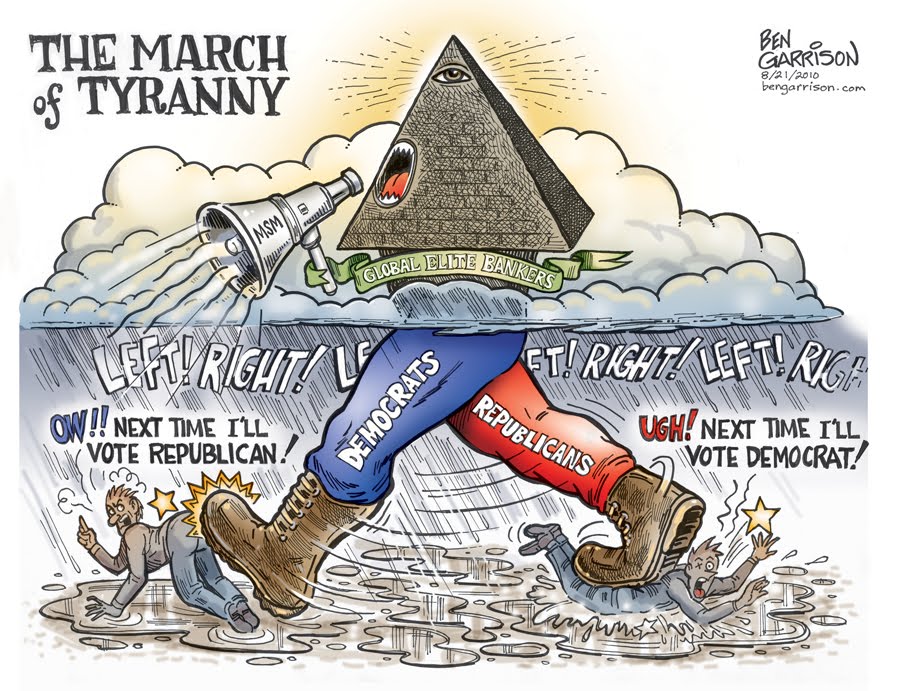
During an election, you give your proxy to anybody who is willing to be a representative. Each representative votes in Congress with a vote weighted by the number of proxies they received. The top 500 or so representatives get to sit in Congress. Those who didn't reach the threshold must pass their proxy on to another.
Nobody is no longer "represented" by somebody they didn't vote for. You can be represented by somebody who much more closely matches your interest. "Districts" will still be represented because many people will choose a local candidate, but everybody is free to choose someone who will represent them better if no local candidate does.
This won't eliminate political parties, but it will significantly weaken them as strong representatives will no longer be as dependent on the party machinery.