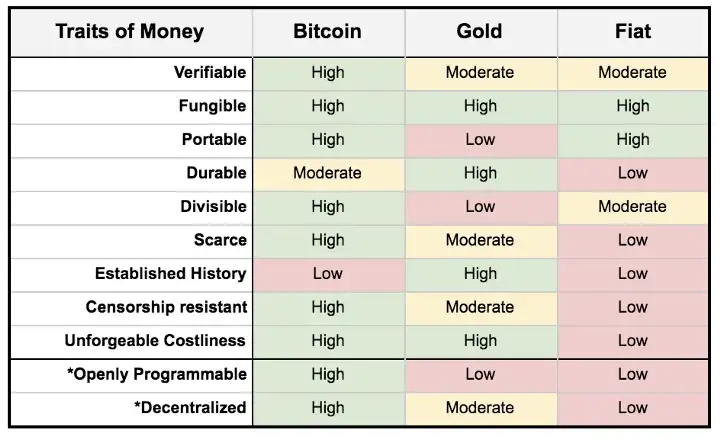
>What would someone use this for, when fiat works everywhere?
For the same reason some people line to use linux when windows works everywhere. Actual technical use cases, ideology, and 'tinker-friendliness'
1) there are some use cases where it is better (typically when you want to do something that the state doesn't want you to do)
2) there are ideological reasons to prefer decentralized ownership of the financial system rather than assuming the state can be responsible with the dials and levers of that system
3) There are neat properties of crypto that are fun for tinkerers - money is programmable and you can do neat tinker-toy things with it like micropayments, fintech like collateralize loans and decentralized derivatives trading, dumb things and experiments like the old peepeth, etc.
I think eventually if adoption is wide enough there will be society-altering implications inherent to crypto but for now I think it's those 3 things.
Core developers of the Bitcoin ecosystem are also Linux hackers. Rusty Russel, C-lightning main developer was also the creator of iptables and a good part of the Linux TCP stack.
Technical minded people showing hostility toward Bitcoin because of some obvious scammers is as unfathomable to me as showing hostility toward TCP/IP because of malwares.
TCP/IP works quite beautifully for something designed decades ago, and actually solves real problems, though (like delivering your message to my t̶e̶l̶e̶t̶y̶p̶e halfway across the globe). "Crypto" seems to be quite good at worsening air pollution in my country (which is already very bad) and not much else.
Of course, whether it's gold, fiat or cryptos, we'll have scammers and gullible people who fall for ponzis, but because money can be used to scam doesn't mean it's a scam itself.
Although I bet there are a lot more either useless or scammy projects in crypto than in gold (fiat must have the most scams since it's the most popular), people writing off the entire industry as a scam is disingenuous, myopic, and so often delivered with obvious jealousy that they had the chance to buy up some space cash when it started but said it was stupid so now they will stick to that argument.
I had to donate to Wikileaks years ago via a very expensive wire transfer since the credit card companies bowed down to the USA and cut them off. If I had BTC, I would have used that for almost free.
I feel like it's somewhat poetic and a powerful indicator of something I can't quite put my finger on that this thing we call the internet is now old enough that some of us are doing old-man-shakes-angry-fist-at-cloud at newer parts of it. The more things change the more we stay the same.
I hear this a lot. And I know it’s true. But it seems like a bad use of crypto.
I prefer to do crime in cash. Cash doesn’t have a permanent public ledger associated with it. Even if that ledger is “zero-knowledge” - I’m betting my freedom on bullet proof math staying bullet proof for the statute of limitations.
I understand that “at scale” cash may be a higher risk than crypto. But I’m not “at scale.” Local, last-mile, cash transactions are preferable in nearly every way.
Except that you are now committing your crime in a single jurisdiction and performing all elements of the crime at the same time. It makes it much more convenient for law enforcement to catch and prosecute you.
And what's worse they have incentive to get you to roll on your dealer. So they're more likely to hammer you with charges to force you to take a deal to testify.
Compare that with my situation. You need to prove that I received the package, associate that shipment to an order, that order to a payment, and that payment to me. It's a multi-jurisdictional effort that would require subpoenas and some sloppiness by my dealer.
And to what end? All I know is that I sent bitcoin to an address and drugs showed up some time later. I have no idea who I paid, where they got the drugs, who mailed the package or anything useful at all.
If I were to put my game theory hat on, I’d take it one step further and say “crypto is good for crime” is a meme likely promoted by gov institutions.
They get a criminal financial system committed to a permanent public ledger. Between deanonymization techniques and zero-days, its likely they view chains as an asset. They can use them to see how money is moving through criminal organizations. Best of all, it’s likely they never have to reveal their hand (they are using chains for investigations) since they can use parallel construction once they know where to look.
All the other comments here seem to be speaking strictly of illegal drugs that otherwise can't be obtained. There is also a market for things like semaglutide, HGH, any sort of anabolic steroid, ED drugs, certain types of stimulants and asthma meds, that are fairly trivial for any American to get a prescription for from an online clinic in the next half hour if they want, but they'll be charged extortionary prices. You can also buy these same things for 1/100th the price from well-established, well-known black market labs that will reimburse you for third-party blind purity testing, and nobody is ever going to arrest you for it, public ledger or not.
Or take your chances handing over cash to some dude in an alley.
The instructions above can get you pretty far. But before trying this, make sure that the crypto you are using supports zero-knowledge proof or zk-proof. This way, you make it harder for law enforcements to link all these things to your identity.
I think it would be neat if I could pay 1 penny to read a single HN-linked NYT or WSJ article. But the entrenched payment processors refuse to give up their 5%+25cent cut or whatever.
The fees are closer to 3% or a bit under these days. And that's for a very robust and mature infrastructure, not just on the merchant side, but the buyer side. Credit cards do a lot more than just send payments, you get all the benefits of things like dispute resolution, rewards points and the bug/feature of spending money you don't have in hand. If you go to a fully-baked crypto payment provider like Coinbase, they still charge 1% for a far less sophisticated product. The cost of all the things that crypto doesn't do get shifted to consumers and merchants indirectly.
Sending any amount of ETH it costs between $0.01 (on the Loopring network) and $0.46 on the Ethereum mainnet (with the most popular layer 2 network, Arbitrum, costing $0.02).
So not quite there to send 1c micropayments, especially since sending USDC would instead cost something like 2x-3x more, but not inconceivable that it might get there on newer layer 2 networks which do more aggressive batching (using proof techniques called STARKs and SNARKs).
There are some other networks, such as Solana where transactions are effectively free (though even very small fractions of a cent add up for an algorithm): https://solanabeach.io/transactions
So the defense to crypto being expensive to transact in is to...use another network on top of the crypto instead of the crypto I actually want to use.
THIS IS WHY CRYPTO DID NOT TAKE OFF. It's too complicated and expensive to use for all of the supposed use case; it's objectively worse than comparable fiat options.
I send USDC on eth pretty frequently and for larger amounts find it more convenient than Venmo or Zelle. For smaller amounts it would only make sense if other people are already using L2s, which might happen through website integrations (or not).
Don't forget to include the conversion fees. In the example shown in the blog post, it looks like using ETH to pay that $10 bill costs $1.63 vs. the $0.59 it would cost to use a credit card for the same transaction.
I guess that people in US and other big countries with strong currencies don't really understand that there are smaller fiat currencies and these are actually used. I wonder how often you have to convert your USD even when traveling, last time I was visiting Africa I remember most just accepted USD or euros directly even though the countries had their own local currencies.
I'm tired of pointing this and getting downvoted into oblivion. Most negative comments come from privileged people living in Western Europe or the western US. You can even guess which is which from the timestamp.
In the end it is a soft family-friendly version of "stop being poor".
GP's comment is about Stripe's service, not cryptocurrency in general. Unless if Stripe really wants to set their money on fire, I doubt that they're going onramping any hyperinflating currency.
If you're in a country with a weak currency, what you really want isn't crypto but rather a stable fiat, mainly the USD. Cryptocurrency only really helps the relatively privileged people in these countries to bypass currency controls.