I still cannot get over this product. They whole selling point of a dyson fan is the 'air multiplier' tech, which creates a low pressure zone that propels air through the ring. According to dyson, this tech can move 15x more air than the fan in the base of the unit. Why in the world would you build an air filter around a system that does not directly interact with 93% of the air it moves?
The fan also sucks compared to something like a Vornado.
"Buffeting" of air is not a practical issue when using a fan - you want a fan that can create a lot of air flow.
The Dyson fan comes across form first then making up reasons to explain the form retroactively. It feels like an interesting look is the goal rather than something that's actually better.
Am I wrong about this? Do people that have the fan like it? Is it better? I've only played with one in a store, but haven't owned one myself. I have owned Vornado fans which I liked.
Another one that comes to mind is the Molekule air filter which is basically fraud.
There were probably too many things lost from "our" (n-1th generation) childhood too. Things like marveling at the first TVs, playing with unspent WW2 ammunition, etc. I'm sure each generation has its own things that they miss and think are detrimental to have lost, however I'm not sure that overall it's worse for the current generation. Hard to say. Growing up, I certainly would have loved having near infinite amounts of programming help available for free, instead of trying to decipher something from a 50-times photocopied manual. I guess some things get better, some worse, change is the only constant.
>Growing up, I certainly would have loved having near infinite amounts of programming help available for free, instead of trying to decipher something from a 50-times photocopied manual.
Would you be as good of a programmer today if that was true? I remember spending an entire week trying to figure out how strings worked in QBASIC, when I was in 5th grade. There was no internet and I only had the Apple IIGS Basic manual to work with. I tried and tried and tried and eventually figured out that it had something to do with those $ symbols. Eventually I got the hang of it. I guess the point is, that challenge and struggle with simple things helped me develop the attitude to overcome truly difficult things later. Maybe this is more just memories of childhood than anything..
Fair point. Though who knows, it's hard/impossible to say. For some individuals, it might have been positive, for others, perhaps negative. Overall however, I would not say that today's programmers are of worse quality, on average. (It's hard to compare however, as clearly we have a 10/20/30 year experience gap over them.)
It ebbs and flows. There was a low point in the late nineties and early 2000's:
* Windows 95 removed all thought of the user as a programmer, killing things like QBasic.
* Apple was doing likewise, even killing Hypercard.
* The web wasn't in its prime yet, limited to HTML 2.0 and 3.2, and really lousy JavaScript.
* Even electronics was tough, since DIP parts were being replaced with SMT, and the service manual was starting to become a relic, but things like Arduino and RPi didn't exist yet, and making PCBs was $$$$$.
* Shop classes were on the decline in schools, but makerspaces weren't in yet.
I feel bad for kids growing up then. Short of installing a Linux distribution, kids were left out in the cold for being anything other than consumers of technology.
There was really a golden age in the eighties and early nineties, and we seem to be in another golden age right now.
Familiar with all in your list, plus I'd like to add a few:
Lawn darts, BB guns, wrist rockets, bottle rockets (I know you said M-80s, I had those too, but bottle rockets could be shot at friends), can of WD-40 (with requisite red straw) plus a lighter, backyard archery set.
I guess you haven't had chance to join a conference call (Zoom, BlueJeans, Hangouts ...) where someone has a fan running in their relative vicinity?
At first I also didn't know why is one of colleagues sounding "weird" - never would've thought they had their fan running, until one product manager asked "Hey X, do you have a fan running nearby?"
Instead, they get apps that can change their voice and face in thousands of ways.
I mean I get the "born in the wrong generation" vibe, but at the same time it's easy to get blinkered and not realize what came instead. In a LOT of ways, they (and we) were born in the RIGHT generation.
Part of the fun in the fan is discovering the accidental feature. You play with it and transform what it can do, unconstrained (except by natural laws).
With an app, you’re using a tool for its intended purpose. There’s little joy in discoverability because you’re following the rules the developer set.
That’s why the fan can be more fun; it’s not generational. The fun is in exploring a novel feature in something you though you thoroughly understood.
When the novelty is over with the app, you delete it (was the hour of fun worth getting your data mined?) and return to the boredom (find the next app). With the fan, you simply stop and it continues to be useful. Without you taking deliberate action, everything returns to the way it was. Except for your mind, which metaphorically expanded and wants to see what else can be used in creative ways.
I can't tell if they missed the joke about losing 10 fingers and having to stop there, or if you missed their joke that you can insert the same finger multiple times as long as you only lose a bit of a finger each time.
This chain has got me wondering how we count in base 10, but we don't have 10 fingers instead 8 fingers and 2 thumbs. Maybe we have 10 digits, but digits can be fingers or toes so we really have 20 digits.
Is there a word in English which exclusively means hand-digits or fingers+thumbs or digits-toes?
Plenty of people raise their kids this way. When I see parents laugh when their kids fall down instead of panic, I smile. And the best part? The kids smile too, because they're actually looking to their parents for how to react.
I'd rather raise daredevils than anxious wrecks. My best friend has a kid who's always climbing on stuff, falling down, getting hurt. That kid is going to grow up to be awesome.
Plenty of people need to rethink their parenting then. I laugh when my kid falls down.
I scream when I saw my kid trying to stick a key into an electrical outlet, and I screamed when I saw my kid trying to put a finger into a vornado fan.
Modern fans aren't the same as the box fans we grew up with. And adult would likely walk away with an emergency room bill and a bunch of stiches. A small child would likely lose a finger.
If it makes you sleep better, most household fans are designed to not severe fingers. They use plastic blades (please don't buy household fans with steel blades) which are both light and dull. You might break it but a major cut is highly unlikely.
Yeah... if anything I would have said the opposite: I remember when fans were made of metal or at least had sharp plastic blades. Now, everything's designed for some combination of cheap construction and liability reduction. (And, also, feels a bit more "disposable"... the fans my parents had when I was a kid were designed to be taken apart to fully clean, and I do remember taking them apart and running them without the covers as I was "one of those" kids ;P but I think I'm just expected to throw these plastic fans I have away if they get dusty?...) I just purposefully stuck my pinky finger into my fan on fully speed and it didn't even hurt. (I guess I'll admit that the Vornado on the other side of the room looks a bit more intimidating, but I'm not sure I could actually get my finger into it anyway... the one where I succeeded was actually really hard as, despite my fingers being pretty slender and long, I could barely find an angle where I could touch the blade.)
Ever stuck your finger in a fan with a metal blade?
I have, know what happened? Nothing.
I have a couple 80-100 year old GE fans. Putting your finger in the front doesn't do anything but push it out. Which makes sense if you look at the shape of the blades. The side and back are a little scarier, but i'm guessing unless you really jab it in fast, or get unlucky in some way the worse that will happen is some scraped up skin. They are definitely not _designed_ to sever fingers, for that you need a tablesaw. And none of them have enough rotating mass or HP that you can't stick your finger in the back and actually stop them by keeping your finger against the blades as they try and push your finger.
So, I'm not saying it cant happen, but your kid probably has a greater chance of losing a finger in your car door, or various other places like that before you have to worry about the fans. If you want to experiment with this find something approximating a finger and give it a try, maybe the woody bits of a leftover piece of asparagus.
I have a scar from a poorly-stitched cut on my finger from a "vintage" fan. I wasn't trying to stick my finger in it; i was absentmindedly directing it away from me and my finger apparently missed the cage and interacted instead with the blade!
Glad I still have that finger. It didn't feel particularly close to being severed, it just cut to the bone and then pushed my finger out of the way. Kinda NBD, but ER visits to teaching hospitals are always annoyingly slow...
At least at learning the lesson "did my teacher have anything at all to do with this? If they did, I'm not getting anywhere near it because that person is a fucking psycho."
I watched my dad putting on a rubber glove to pull out a single prong from a broken plug stuck in an electrical outlet. I was perhaps 2-2.5 years old. I asked why he needed the glove. My Dad with his wry Irish humor said it was to get a strong grip.
I told him that I thought I could do it without the glove. He told me to give it a try and I did. What I did was promptly fall on my ass and that's how I learned the power of electricity.
Dad was an American but strongly identified as Irish. He said my great grandfather who I never knew spoke with an Irish brogue.
When I was 16 I was working on my ham radio's linear amplifier. I was certain that I had shorted all the capacitors but one still held a charge and once again with much more force knocked me on my ass.
For days I could see the line up my arm where the electricity travelled. After that I always grounded the capacitors three times just to be sure!
I didn't put a key in an electrical outlet, but in Paris when I was a kid I was having trouble sticking the plug in the 220V outlet so I held it tight by the prongs & plugged it in & boy did that feel weird. I never did that again.
I never told my parents about it because I would have gotten yelled at.
At camp we put crickets on the electric fence, but nothing happened to them, so I grabbed the electric fence, and that was a powerful jolt. I never did that again, either.
One xmas when I was less than 5yo I jammed a knife into our 240v socket and blew the fuse on the Electricity Board side of the fusebox.
They had to send an engineer out to turn the power on so we could continue cooking the turkey.
The other is from a sibling comment.
With primary school, 10 years old, we went to the Lake District and were introduced to electeic fences by everyone holding hands with the person next to them, and the teacher explaining that he would touch the wire with the back of his hand to avoid muscle contraction.
Because I was "that kid" I was placed at the far end of the chain, where I assume it tingled more.
That was fun.
We used to put PP9 batteries on our tongues for tingles.
Just for fun.
I do recall dangerously letting .22 blanks off with a brick and a piece of brick making an entry and exit wound through the outside fleshy part of my hand.
Couldn't let mum know that I was even bleeding in case she asked why!
Touching the wires hanging out of the wall where the clock hung was fab, until I flew across the room and sat on the sofa unexpectedly.
You really do learn respect for insulation at this point.
We had a broken arcade game at after-school, every so often someone would bump it and someone would have to reach around and push the switch that wasn't properly covered by the backboard in order to turn it back on. I reached around without looking one day and shocked myself. Today, it surprises me that it was using enough current to be noticable, and that it only needed to be pressed to turn on, not stay on.
Sure I assume so, certainly ones I've been to. I mean the camp obviously wasn't using electric fences to keep the kids in, but the surrounding farmers where using electric fences to keep their cattle/horses/sheep out of the summer camp.
As a kid - I've put two really long (sweater sewing) needles into power outlet.
I guess luckily I hit earth/ground with one of them - since we had differential (RCD) circuit breaker(s) installed it just shut off electricity in the apartment.
If I managed to hit both into real live and neutral - the differential breaker wouldn't have done a thing, and I wouldn't be typing this.
Well, for both cases the risk depends entirely on the (here unspecified) circumstances. Sticking your fingers in a fan where the blades have a low moment of inertia and the motor has low stall torque? You'll be fine. Falling down and hitting your head on the edge of a rock? Could put you in hospital for weeks.
No it’s a cognitive framing thing. The concept is to make a toddlers tumbles into not a big deal for them. I think it is also in part an overreaction to the common “oh you poor baby” response which is thought to encourage children to be upset when they fall. I favor the Montessori guide approach of observing|ignoring and giving a kid a chance to make up their own mind to ask for help or deal with it themselves. The optimal approach probably depends on the kid.
When I pick up my children from a small fall, and I laugh belittling the hit, they do not feel mocked at, instead laughing with me. I think the kind of insecurity that makes you suspect that people are laughing at you comes later - and if you don't have crappy parents you don't even come close to suspecting that your parents might be laughing at you...
Obviously you don't laugh with big falls and broken arms.
But from my own childhood I can remember that kids are not subtle - if they are mocking you, you will know (names, finger-pointing, jokes, etc.). Whereas if a friend laughs with you about a silly fall, you get a completely different kind of scenario played out.
Coming back to your initial point, and being blunt: showing your children that clumsy falls can be funny, and not to panic about them, does not increase their cruelty towards other kids.
Very young children mirror the emotions of their caregivers. Generally if you laugh they will think that it's time to laugh, if you are concerned they will think it's time for them to be concerned. Very young children don't really understand what to do when they are concerned, and so they cry hoping that their caregivers will focus on them and make things better.
Yeah, I think there's a middle ground between teaching a child to laugh at injuries and immediately having a protective, sensitive reaction. Personally, I tell my son, "You okay, bud?" in a positive tone and wait to see whether he needs comfort or is ready to get back to playing.
Everyone parents differently. I would be interested to see which culture the "laughing" reaction parents come from.
It really does depend upon the consequences of failure. Naturally, I want my children to learn to laugh at themselves when they fall off a bike.
In my case, I taught them this by laughing at myself when I fall off my bike, so I am modelling the outcome I want--them learning to try things, fail, and laugh--rather than some kind of "do as i say" style of parenting.
But even falling off bikes can have an unacceptable worst case. So we insist on helmets. It is bad parenting to allow undeveloped brains to suffer avoidable and entirely foreseeable concussions when reasonable precautions like proper protective gear exists.
I think that sums up our parenting approach: Model the risk tolerance we want to encourage, including both taking risks and managing the consequences intelligently.
You seem to assume that everything was 100% safe in previous generations. Actually it was not the case, and you don't see many 60 years old crippled by domestic accidents when they were small kids, do you?
I haven’t had as much trouble with those as they mostly do what it says on the tin. strcpy(), sprintf(), etc. all have slightly different semantics and even their “n” versions will do funky things if you don’t very carefully account for null termination. I find it way harder to use those because I have to keep remembering which of them does what regarding \0 at the end. And I guess now we have strlcpy() which is supposed to fix those issues but isn’t available on all platforms I use.
Yeah, I'm skeptical that any reasonably new fan under modern safety standards could a) allow children's fingers to reach in to the blade, or b) do any real damage if they can reach it. The idea that it's a Dyson or fingers get chopped off is funny. But I guess people have to justify spending $500 on a fan.
newer fans have much tighter spacing on the guards. Of course, plastic is still plastic, so 10 year old fans that had tighter spacing are going to have lots of broken off sections so you can make cool noises with the fan and [other objects]
I have one that we keep in our daughters nursery. The thing I like most is that it can run in auto mode and night mode meaning that it’s on all the time and the fan only runs from level 1-4 out of 10, which also means silent operation. It has a sensor for air particle and VOC that causes it to turn up. It seems to work (like if I fluff pillows or make the bed beside it it will detect a spike in particulates on the graph around that time. So, set and forget, silent operation, and safety for small fingers made it the best choice for us despite tests showing lower efficacy over a defined time frame.
We recently bought the giant one with the ridiculously high CADR. They removed the air quality sensor (covid parts shortage?), so there's no auto mode for that model, at least. :-(
It's noisier than expected, but on low it's quiet enough and fine for our entire house during "normal" bad pollution days (PM 2.5 between 100 and 300). During severe smoke from wildfires (PM 2.5 > 300), I'm OK with it being noisy.
These are some fair critiques. I like the form of the Dyson + Heat I have (not an air filter), but more importantly, I like that it's constantly drawing in air and sampling the temperature much more accurately than a typical space heater which is basically just hoping the bi-metallic strip eventually flips the thermo off. The Dyson seems to do a really good job of holding a fairly consistent temperature, plus it looks cool.
But I got my refurbed on Woot for like, $100, not the $450 brand new they wanted, which is lunacy.
Their app and particulant metrics/ graphing are kind of neat and user friendly. And I don't know, it's furniture kind of. Some people buy expensive furniture because it looks nice, some because it's comfortable and some don't bother and just use a milk crate.
I had the dyson fan with the heater and filter for a short time, as well as a medify. I was disappointed with both, and returned them.
The dyson looked cool, but the heat function was kinda useless unless you sat right next to it. i might get another one without the heat.
The medify seemed to work well, but it felt like it was poorly made. I kept thinking I could probably diy something just as good. Though the main reason I returned it was because the advertising claimed it came with two sets of filters, when it only came with one.
I bought both of these last year after almost a decade of wanting to get an air filter, and not doing it. The whole industry feels like a scam. This is why I stopped shaving 20 years ago.
It my experience it actually warmed the room better than it warmed me. If I turned the fan up enough to make the air reach me it was cool air by the time it got to me. If I ran it on low it would slowly warm the room.
I was referencing a razor scheme. when you sell something cheap but the part you need to use it is locked down and expensive. Like the blades for a razor, or ink for a printer. Or filters for an air purifier.
I use it as a white noise machine, I find the particular noise it gives out to be calming. The heat is also nice, not biting. It could be after the fact rationalization for blowing 250$ on a 25$ equipment.
I have a bunch of air filters (I live in the bay area during fire season).
Coway Air Mega
Coway Mighty
Blue Air
Medify Air
They're basically all equivalent and they all work.
The reason I like the Medifyair is because it can move the largest volume of air relative to those so it can clear a space quickly (and quietly). I also think it looks nice (though it is huge).
Of the rest, the Blue Air uses weird custom filters which I think cost a little more (though I haven't had to replace them yet). The Coway Mighty is also pretty small and mostly for a tiny room.
Relatedly, if you're interested in sensors I think the TemTop sensors are the best (I've tried a bunch of different ones, and a lot of them suck).
Wirecutter has a review of one of the Medifyair models. They don't recommend it because it's too big, and overkill for their test apartment in New York City. It had the highest CADR in their testing.
For a modest house in the Bay Area during fire season, we needed a high MERV furnace filter and also two filters similar to their recommended models, so I moved up to the Medifyair. It arrived after the last fires, but it seems to work extremely well.
That's one example of a Wirecutter recommendation that goes against the prevailing wisdom. There are probably others, too -- but that doesn't necessarily mean all their reviews are somehow bad or tainted. You can find recommendations from Consumer Reports that run against the prevailing wisdom, too; I know I'm not alone in having thought in the past that there were some categories of products they were great with and other categories of products they were... not so great with.
I know the "you can never trust anyone who has affiliation links" argument, but if we follow that to its logical conclusion, Wirecutter should be strongly biased toward picks that give them the most money for referrals, and that's not really backed up by their choices. They pick cheaper choices pretty frequently, and it's possible to find picks where there's no apparent affiliate link at all, e.g., their pick for best "high-performance" subwoofer. One can posit, as was done in the thread you linked, that there might be deals directly with manufacturers that we don't know about, but "we can't be sure they're being underhanded without us knowing" doesn't actually get us anywhere useful -- the same could obviously be said about anyone, including CR.
In the review business it's better to be playing the long-term game if you're building a real audience. In Wirecutter's case their long term advantage is to make good reviews without regard to the affiliate payment.
There are already thousands of other websites that are just disguised ads. Wirecutter's differentiating features is that they don't do that.
They still have some reviews I think are pretty mediocre or products they chose that I think are bad, but generally I think they're worth looking at.
They make nonsense claims about their technology - none of which empirically hold up. They lie about it and are just generally full of shit, quoted below:
"In the summer of 2019, we purchased a Molekule Air (the flagship model) and tested it. We bought an Air Mini that fall and tested it in February 2020. At the time we tested the Molekule Air, the company claimed that its “scientifically-proven nanotechnology outperforms HEPA filters in every category of pollutant.”
Our tests proved otherwise. And by mid-2020, that language had been withdrawn, after many of the company’s claims were ruled against in a case before the National Advertising Division and upheld in a later appeal before the National Advertising Review Board. The Molekule Air turned in the worst performance on particulates of any purifier, of any size, of any price, that we have tested in the seven years that we have been producing this guide. The Air Mini outperformed it, but that’s not saying much: It still gave the second-worst performance we’ve ever seen.
Guide author Tim Heffernan asked Molekule CEO Dilip Goswami why the language was removed. He answered, “The point about ‘in all categories’ is that we see a device that outperforms across all of the categories. Right? So we’re not trying to say that individually, on any particular metric, we would be number one. Right? What we’re saying is, when you look across all the categories, we outperform HEPA. Right? And that’s what we’re attempting to convey with that. And so—it’s fair to say that we needed to re-examine some of the language to make sure that it’s saying what we’re intending to say.”
The NAD and NARB cases made clear that this was an understatement: All of Molekule’s quantified claims about the Air’s performance; all of its claims about superiority to HEPA; all of its customer and doctor testimonials about the ability of the Air’s filter to reduce asthma and allergy symptoms; and many of its claims to have been independently tested, were ruled unsupported. Other claims were ruled too broad."
Fan intakes on non-purifying Dyson do get plugged with dust over time, so it makes sense to add filters. Aside from whether it makes sense to advertise them as air purifiers.
That makes me wonder if that was how the product originated. Dyson realizes its fans have a problem. Engineers suggest an air filter. Marketing see an opportunity.
The Dyson marketing person's angle is a sleight of hand:
"Dyson has developed its own testing methodology, the POLAR test method, which, unlike the CADR, Hill said, "measures the intelligence of the purifier, the ability for it to know when that room is clean or dirty and automatically react, and its ability to mix that pure air around the room."
The detection function seems of spurious value if the device is operating at max capacity regardless of whether a pollutant is detected or not.
Is that the case, or does the Dyson adjust volumetric flow to match the detected level of pollutants? That would make sense in the case of smoke, although humans could detect smoke and turn the device on or off accordingly.
COVID19 particles are a different case. If the Dyson can detect those and switch itself on, eliminating the virus from the room, $800 is a bargain. But it can't.
I live in a large loft-style apartment on two floors which is actually a large room. There are only a few windows and they are placed in a way that no air draft gets created.
When I bought a purifier, one of the things I was looking for was air movement. I position my Dyson so that there's a draft throughout the apartment.
I thought this would improve the air filtration because the air would move through my home and eventually reach my purifier.
My previous experience with a purifier was a Honeywell tower that didn't move air. I noticed an improvement when I switched to a unit that moves air better.
Am I wrong? Should I give up Dyson anyway and choose another product?
My local costco has these units in store for $800 USD. Further down the isle they have oscillating tower fans for $30, and smart air filters for $100. I bought two pairs of each before winter. The fans are quiet, have plenty of control options, and non-volatle memory so you can use them with smart plugs. The air purifiers are 4 stage, with active charcoal and a long life (6 mo, 20$) hepa filter. They are wifi enabled, monitor and log air quality, and controllable from a phone. The purifiers should filter my bedroom's air once every 10 minutes, and ~15 min for my living room. This was all under 300$.
Edit: to answer your question, the regular dyson fans are great. They quietly and efficiently move air. Pointing one at a real air filter should really help the filter do its job. My issue is that dyson built a small filter into their fans and doubled the price.
Dyson, like Apple, doesn’t make products for nerds like us who are willing to go through that level of effort. Their prices are high because their products are simple and “just work” without much fiddling.
I've never claimed that it does not filter, just that it is a fraction as effective as the alternative at 5x the price. We heat with wood in the winter and some smoke escapes when you open the door to tend the fire. My $100 unit filters the living room back down to the baseline in ~15 min.
I recently got into building DIY air quality sensors. Any kind of smoke hangs around in a room for many hours well past when you can smell it. My house periodically spikes in air pollutants (still looking for the cause but we are moving soon anyways). The one night when PM2.5 spike from safe levels of below 12 ug/m^3 to over 1000 for one night was the worst sleep everyone in our house got. It seems that it was the equivalent of smoking something like 44 cigarettes in a day. Don’t smoke, especially indoors. It’s a bad time.
If that's sarcasm, you aren't providing enough context for me to pick up what you are putting down. If not, then the honest answer is "I don't know for sure, I'm still researching it."
From what I can tell, PM2.5 isn't the end-all be-all metric and sensors can give false readings. That's why I'm building multiple devices with different types of sensors and monitoring multiple metrics. PM10 and PM1.0 are also concerns, as is CO and CO2. I am researching which VOC sensors to get because unfortunately not much info is readily available. But from the research I've read PM2.5 is the most prevalent and damaging in typical households (CO being a big exception, but that's also monitored by regular household CO alarms). I can tell when someone has been frying something in the kitchen from my bedroom sensor for example, and it lingers for a while. I can also tell when outdoor air quality is poor, and then my indoor air filter and closed windows do help. I am still learning about all this, but in general this data has been helpful to figure out when to open windows to avoid headaches.
I plan on publishing my findings at some point, but currently I am still waiting on parts and PCBs and working out the software to make it more usable without having to run to grab a USB cable to flash new firmware on the sensors. I was inspired by https://www.airgradient.com/diy/ but those plans are outdated and the dashboard is proprietary so less than ideal. I am working with simply integrating my sensor network with Home Assistant so I have to do very little with frontend stuff. It was very quick to set up notifications to my phone so I don't have to look at sensor screens all the time.
I might play around with the BME680 but it’s VOC detection is very rudimentary and it does eCO2 which is basically a guess. There is also the MICS-6814 breakout for relatively cheap on AliExpress but reviews on it are mixed, saying it uses the wrong values for its resistors and capacitors and it’s not as accurate as the Grove one. The Grove board is the only one that measures separate gasses separately instead of measuring total gasses and then using a formula to try to divide the number down to expected parts.
In practice, who knows. I need to lay my hands on all of them. If I could get all this into a controlled environment to test it all that would really be ideal.
Thanks for that link, it was a great read and the comments were helpful as well.
> but those plans are outdated and the dashboard is proprietary so less than ideal
Have you looked at open source smart vivarium projects? Several seem to have good front-end.
This may seem weird, but the reason I first started to explore air quality and sensors was to build a smart vivarium for a reptile.
I didn't go through with that project but it was a waking call for me. Animals need so much environment control to thrive and humans are animals.
So instead I focused on adding sensors and filters to my own home. Nothing fancy so far, just a mix of product that work with google home and smart sockets.
Thanks for mentioning our DIY sensor building instructions. Can you please let me know what exactly is outdated so that I can update it.
Also I am more than happy to give people trial access to our dashboard. Just PM me via the support form on our website.
Hey! I actually emailed you when I started but haven’t heard back so I assumed the project was not being worked on.
The biggest thing I found was that the PMS sensor has seen two generations of revisions. I built an original AirGradient and it’s sitting on my night stand currently but for new builds I am using a PMSA003 instead of PMS5003. Also I am substituting a DS-CO2-20 from Plantower for the CO2 sensor. That CO2 sensor seems to be well regarded and is slightly cheaper. And lastly I rewrote the drivers to be a bit different and a little more organized/readable/efficient. It doesn’t add much in terms of functionality, was just an excuse to write some C but I think it came out nice.
I redesigned the PCB to tie the PMS sensor’s SET and RESET pins to 3.3V per the data sheet. It seems to work fine without that with the PMS5003 but I haven’t yet received the new PCBs so I don’t know how it’ll work out. The PMSA003 has a different, slightly more convenient 1.27mm 2x5 connector so it’s easy to mount and get all the connections onto a PCB but isn’t breadboard friendly.
One other difference is that I’m not using a the Wemos OLED shield in favor of a stand-alone 0.96” OLED screen for double the resolution horizontally (your instructions show that one but not in the PCB build). And I wrote a different UI for it, plus added a button the PCB to do things like reset the sensor settings.
There are probably other things I’m forgetting but my email is in my profile if you want to move this conversation to that medium and once I polish up the code a bit more I am happy to share it. I will likely continue using these sensors with HA but I see no reason that you can’t use some of this in your work if you find it useful. I was planning on publishing the code and plans under a BSD license.
Overall, I wanted to thank you for the amazing work you did on AirGradient. I wouldn’t have been able to start on this project nearly as easily without your plans and code. It’s really impressive work very polished.
are you able to share anything / willing to work with anyone? I'm just getting through the research phase and am looking to coat my house with sensors - its been a struggle finding quality writing in the research and it looks like a graveyard in the world of pcb design.
They charge high prices because of marketing. Suckers are willing to pay more than their products are worth because marketing has them convinced it's better.
Why wouldn't you just use a cheap fan in place of the Dyson? Sounds like you have a separate purifier that does the cleaning, and all you need is something that will move air.
The only fans I can find that are big enough to move air over two floors make more noise on their low setting than the Dyson's on its high setting. Then there's the issue that the fans would need to be connected to an app in order to power automatically as air quality drops.
(I don't have the Honeywell anymore as it was my ex's)
This conversation makes me want to buy a second purifier and simply stop purchasing filters for my Dyson. That way, it would continue to work as a space heater and fan but the air purifying would be done by a dedicated device.
Makes sense as by rule of thumb, no "jack of all trades" devices will ever be better than a dedicated device. Hindsight is 20/20.
Sadly the second floor is a low and angled ceiling. We had installed a ceiling fan with an adapted mount but it wasn't long before one of us hit the fan while removing a shirt.
This sent the fan spinning at a weird angle and it hit the ceiling. This broke the wooden blades and sent them flying in all directions.
It sounds like you're using the Dyson as a fan and something else as the actual purifier. Sounds like that setup works great for you, but it does prove the point that the Dyson is a fan, not a purifier.
My previous experience was with a Honeywell tower but I do not have the device in my apartment anymore.
What I am describing is that the Dyson ends up doing a better job alone than the Honeywell did. Especially when it comes to the second floor. However, as you said one could quite likely achieve the same result with any air purifier and a strong fan.
Diffusion is precisely why open-air filters (filters that draw in a portion of the air and filter it) work!
The Dyson filter is an open-air filter, that draws a small sample of the air through a filter, and passes the rest through unfiltered.
Each pass reduces the average (diffused) load of contaminants.
Two identically effective filters with different flow rates will eventually achieve a specified target diffused contaminant load in the air in the space; the only difference will be the time taken to achieve this (given a fixed initial contaminant load).
"Despite no concrete evidence to support the concept, belief in fan death persists to this day in Korea,[further explanation needed] and also to a lesser extent in Japan.[1][2][3]"
The wiki page links to the EPA which does advise against fans in a closed room when it is over 90F:
Don't Use a portable electric fan in a closed room without windows or doors open to the outside. ... Don't Use a portable electric fan to blow extremely hot air on yourself. This can accelerate the risk of heat exhaustion. ... Don't direct the flow of portable electric fans toward yourself when room temperature is hotter than 90 °F."
That one's interesting in part because South Korea mostly doesn't get that hot. (Summer highs seem to be mid-80s Fahrenheit.)
Looking at climate data for the country, I was struck by how similar it is to upper Missouri. Saint Louis is about as humid, but a bit hotter on average. Which would make me suspect that if "fan death" was a thing, we'd be seeing it in a band of US States that're similarly hot and humid.
Speculative difference would be if air conditioning is really uncommon in South Korea, but presumably we could even that out by comparing to poorer people in the US.
It's a shame, I realised you were joking and I liked it. I think the idiomatic HN way to indicate this unambiguously but subtly is ending with "/s" for "sarcasm"
I grew up believing in it (because my parents), and it took me a while to shake. At some point it became more of a superstition, but was still nervous to leave it on overnight...
The Japanese version of that Wikipedia article has the Japanese phrase for "Urban legend" in the title, unlike the English version. The literal translation of that title would be "Urban legend of electric fan".
Some effects of extremely low frequency electromagnetic fields (ELF-EMFs) on human spermatozoaare reported. Significant increases in the values of the motility and of the other kinematic parameters have been observed when spermatozoa were exposed to an ELF-EMF with a square waveform of 5 mTamplitude and frequency of 50 Hz.
To the downvoters on wincy's comment: please let's not downvote people for asking questions, or just because you believe they are misinformed -- that's what replies are for.
You shouldn't downvote people for asking questions, but asking a question and supporting it with a link that tells you the answer is fair game, especially when your "question" is an argument hidden behind a question mark, and the link disproves that argument.
There is, of course, the possibility that wincy's comment was meant to be tongue-in-cheek, though. I personally can't quite tell which way it was meant.
I'm saying that this statement especially when your "question" is an argument hidden behind a question mark, is not consistent with the suggestion to "assume good faith" espoused in the guidelines.
I will note that people make arguments via questions pretty often in normal conversation, so that's not necessarily an accusation of significant bad faith. It could be more of a complaint about rhetorical technique.
But let's treat it as an accusation of bad faith. In that case, we have a deeper issue. Assuming that it's a real question asked in good faith is actually the weakest plausible interpretation, because the link makes it a self-disproving theory. Honestly the tongue-in-cheek interpretation is probably the strongest one.
There's no way to treat it as a strong argument and as a real question asked in good faith.
Also it can be okay to downvote misinformation even when the commenter didn't do anything wrong.
I guess I was being charitable, and imagining that the poster might be a Korean of a certain age where this myth held weight. The article suggests that young Koreans have changed attitudes, but that doesn't mean that everyone has. I think the comment replies to his question did a fine job challenging the myth. Obviously it's just my opinion, but I'd rather save downvotes for people who were clearly trolling or maliciously off-topic (and I don't see that here).
To be clear, I didn't downvote their comment — I don't think it warranted it — I'm just saying I can sympathise with the argument that a comment that doesn't add anything useful to the discussion is a fair target for a downvote.
Saying "But what about x?" when you yourself provide a link that says that X is a non-issue doesn't make for an engaging discussion. "But what about x? This link suggests it's not a problem but I think it is because of y" does make for an engaging discussion, even if y is seemingly nonsense.
To be fair, I was bored at work and wanted to see what would happen if I brought up fan death on Hacker News.
I’m not Korean, but used to work at a company with quite a few second generation Korean Americans and we’d have Korean students studying in the US we hired as interns. They were very bright and very polite, but if we brought up fan death they’d say “oh haha yeah it’s funny... but it might be true”.
For recurring revenue… selling only the fan, you get one sale and you’re done. Selling the fan but with a filter unit, some subset of customers will replace the filter every 6 months as “recommended” and you have recurring revenue on that fan forever.
Dyson suggests replacing the filter every year but you could vacuum off the dust on the outside. Their vacuum cleaner filters are washable which is probably where OP got the idea.
Having just gone back to a bagged vacuum, I genuinely wonder why people ever accepted bag-less vacuums in the first place.
Aside from the “empty the canister out and watch all fine dust float back into my house” issue, vacuum bags function as one massive filter. It’s not physically possible to build a filter into a bag less vacuum that approaches the size or capability of the vacuum bag itself.
Bags are a razors + blades model. The vacuum is $100 but the bags are $30 for 3 if you buy the branded bags. Plus the suction on a bagged vacuum measurably decreases before the bag is full.
These days I have a roomba and a Dyson cordless stick vacuum for occasional use.
Then I imagine part of it is the fact that people are willing to spend $x on a fan (of any sort) and $x+y on an air purifier.
If an air purifier is generally accepted to be a higher-price item, then making a fan into one with some sort of filter helps justify the higher price.
(Just speculation, though. I have no info about their design or marketing decisions.)
Don't underestimate the placebo-effect of having a Dyson, regardless of it's physical effects. This is what you can do with a premium brand.. only a Dyson is like a Dyson
Don't underestimate the bad mouthing effect of having a Dyson. Relatives, neighbours and friends will be making judgements. Because everyone has an opinion on Dyson they will gossip. Might as well join a religious cult.
I think its a good quality fan and a fan heater that also purifies. Purification isn't its only goal, so if you care only about that just get a purifier. Presumably the cheap DIY box did a bad job at heating the air.
Check out dyson's website. They don't even list fans on their product page. It's just variations of air purifiers. They are all advertised first and foremost as purifiers.
I don't think they sell the non-purifier ones anymore. Google searching led me to a page with a mix of purifier and non-purifier fans [0], but the links either bring me to the "air-treatment" section or break completely.
Everything Dyson is overpriced dreck, except for the handheld. 5% more function for 200% more $.
Cheap vacuums are way better than they were. I bought a $60 upright at target for my office 5 years ago, it sucks (in the good sense) and is reliable. It does not have a ton of attachments, but it was $60.
Expensive vacuums are usually more quiet and, what is more important, are way better at filtering the output air, whereas cheaper ones - sure, they work, but they let a ton of dust out.
For people with allergies this is a big selling point.
There is next to no reason to buy a Dyson v11 if you can also get a Roborock H6. I made my experiences here and prefer the vastly cheaper Roborock which has precisly the same build quality.
To be fair, the Dyson outperforms it very minimally in suction (I'd say like 5% better) but that doesn't justify the near double price. Also the Roborock has a 'lock' button and a much better wall mount in my opinion. It's battery is Lithium-Polymer and cleaning the vacuum is easier.
Marketing is the only reason why anyone would buy a Dyson v11 over a Roborock H6.
Their app and particulant metrics/ graphing are kind of neat and user friendly. You can do stuff like have it run on a schedule or run when air quality gets below a certain threshold. I knew that there were better cost for air purifying options out there, but the metrics and graphing kind of sold me.
Fallacy! The air stays in the room and will be cycled into the filter 7% at a time. Given the output volume and the typical volume of a room, this could be multiple times every hour.
> Why in the world would you build an air filter around a system that does not directly interact with 93% of the air it moves?
Dyson fans produce a continuous stream of air. Regular fans produce choppy air. I don't think anyone actually notices this effect until you point it out though.
This dispute could be a matter of frequency range. Older ears can't hear high pitch. If the Dyson noise is mostly high pitch, older ears will perceive it as quieter.
I agree on the noise of the Dyson. The quietest Dyson fans are not that quiet. I work in studios that require quiet fans. A Dyson fan that rotates is especially noisy due to the squeaking motor. If you need a quiet portable fan/filter find one that is static and has more than 7-8 speeds, preferably in double figures - and put it close to where you want the air, on low.
What part of the world would you be buying from? (I don't do Amazon).
Yes, I found exactly that.
There is a company called QuietMark, I've bought fans from there and sent them back for being above average noisy, they're not interested in outside contact.
I recommend to buy and try for your own situation. Measurements of loudness are not the full story as the tone of the noise will interact in ways that can be unpredictably pleasant or harsh.
The Dyson fan issue is the audible motor whine at lower fan speeds (and with oscillation on, it creaks as it turns).
"If you need a quiet portable fan/filter find one that and has more than 7-8 speeds, preferably in double figures - and put it close to where you want the air, on low."
Ignore the price, cheaper may be better, but having many speeds suggests some sophistication and the option for lower speed means lower noise.
1. I concluded that's what you did, but found it a bit annoying. 100x15/16=93.75 . I find it unnecessarily confusing (as the parent commenter probably did) to round it to 93, when the correct rounding is 94.
2. The article says "15x more", so the right math would be 100x16/17=94.12 .
This is exactly the kind of pedantry I was trying to avoid by rounding.
Fan X moves "15x more" air than fan Y. For every 1 unit of air fan X moves, Y will move 1x15 = 15 units. In the time it takes fan Y to move 100 units of air, fan X will move 100*(1/15) units, or 6 2/3rds units. 6.666... rounds to 7.
I've spent many hours navigating the air purifier market and it is one of the most opaque and customer-unfriendly ones I have ever seen. Beyond the advice given in the article, it's also important to check what the filter exactly is. Some filters are washable, but it often means that they are not as thorough as HEPA filters, which is a big deal if your goal is to avoid the dreaded PM2.5 that are as far as I can tell the main threat to health and the pursuit of happiness.
A more general problem is that there is a conceptual contradiction between low noise and high filtering. It will be difficult for a silent filter to be quick at filtering your room.
The good news is that even a relatively crappy, low CADR setup can still filter a bedroom over time so long as it remains closed. You will however be paying for replacements more often and it might not be worth it if you have to ventilate daily and the filter takes many hours to give you a clean environment.
I like the work that Smart Air China is doing. I am not affiliated with them, but they have essentially done and made available the same sort of research as the one highlighted in the article and have long promoted the no bullshit use of a simple box fan with filter combo for lower income and highly polluted regions.
Yes I agree. There are a lot of non or low performing units out there that are hyped up by marketing and dubious claims.
My startup [1] does air quality measurements primarily for schools and we very often come across schools that wasted a lot of money purchasing non performing units. The best is really to get a PM2.5 meter and compare the performance of different units.
Are there consumer tier air monitors for home use worth using?
Also great startup idea. This will have long term demand. IDK if targeting (public) schools and their gov acquisition processes is wise but definitely a need there and probably plenty of new budgets for this stuff.
Btw your mobile marketing site could use some work. The spacing is off in a WebKit browser.
I completely agree. Recently purchased an air filter and it was a ridiculous amount of work to find a quality product. Even the supposedly data driven blogs didn't post the lower cost options, probably because of affiliate revenues on the high end models.
Besides the PM2.5 aspect (which, as far as I can tell, can be solved by pushing a large volume of air through a HEPA filter), there's also the quality and type of the carbon filter, which is what traps a number of other things such as VOCs and most scents. You also need to know the type of thing you're filtering - smoke, for example, you really need a carbon filter for, and if you really want to filter a decent quantity of smoke, you'll need to drastically oversize the filter (e.x. Get a large industrial filter for a small area.) In case anyone's curious what I got, I didn't need to filter smoke, so I got one of the larger Levoit filters and used it in a small room, and I'm happy so far.
not to mention that it's almost impossible to buy actual bonafide HEPA filters from consumer facing vendors. True HEPA? Nope that's marketing speak for something else
I bought an expensive Dyson air purifier for a couple of reasons. It has a remote so I can turn it on from bed. It looks attractive. The sound profile is much different than a box fan for sleeping at night. It can analyze the temperature, humidity, and air quality in real time and turn on if it notices air quality is getting bad. It also oscillates.
That said yes it was expensive, but it replaced needing a fan for cooling and an air purifier, and if I needed a heater it could have done triple duty.
It's obviously popular to hate on silly-expensive tech, but these quotes were telling for me:
> "I think what we're trying to do is pull back a little bit from the CADR metric," he said. "Not everyone needs an enormous CADR, has huge rooms or incredibly dirty air."
> Several experts told Marketplace the CADR is the most important metric and an internationally recognized benchmark.
> "CADR is what you want to know, period," said Francis (Bud) Offermann, an indoor air quality researcher who has helped develop test methods for the performance of portable air cleaners with the American Association of Home Appliance Manufacturers (AHAM).
CADR may well be "what you want to know, period" when it come to air filtration. However it might NOT be all you want to know when buying a consumer product. If the filter is quiet and effective and good looking and only ramps up when needed, is this not in some ways a better PRODUCT than a box fan running at full speed all the time with a filter taped to it?
I'm also a little suspicious of relying entirely on the CADR metric. If you're running a filter in an environment that's constantly producing particulates and you need to filter large volumes of air, it seems useful. If you're about to walk into a smoke filled room and have 25 minutes to clean the air first, there's no question that CADR is king.
I think it would be interesting to run a purifier in a normal house for 48 hours and see what the steady state particulate levels settle at around the house. I would guess that over a certain threshold CADR, there might not be that much difference. Room air circulation combined with a good enough CADR might even be more important, which is what Dyson claims.
For all the people in the bay area worried about the next fire season, CADR is probably the most important since there's an extreme source of particulates. I'm just not sure that's the final say on air purifier effectiveness in less extreme conditions.
I am also living in an area with high periodic air pollution from wildfires.
I have now removed all my stand-alone air purifiers and replaced them with a positive pressure system that works so much better. I wrote about the benefits of that system on our blog: https://www.airgradient.com/blog/2020/01/08/positive-pressur...
You have to make sure the filter is HEPA, and calculate whether the device has had the time to do a full air change given the room size and its CADR rating.
Viruses are generally too small for even the best filters, but the droplets that carry them are well within what a HEPA filter can manage.
> Viruses are generally too small for even the best filters...
The average diameter of coronavirus particles is around 0.12 μm. The diameter of the envelope is 0.08 μm and the spikes are 0.02 μm long.
A P100 HEPA filter will remove as much as 99.97% (for P95 it is 95%) of all airborne particulates with an aerodynamic diameter of 0.3 μm, and particles both larger and smaller are removed with an efficiency greater than 99.97%.
Even if viruses are smaller than 0.3 μm, they are an easy target for HEPA filters.
The masks we all wear are primarily droplet guards, not air filters, they catch splatter that might float. All of the air that blasts out the back and escapes is barely going to be diverted by another mask after it’s already escaped the other mask and has had time to exist, right?
I guess for my threat analysis, if you’ve already invited them inside your house and they’ve stayed long enough that you think their breath particulates are floating in the air, you’ve already lost the war, so to speak.
Probably just a few minutes will be all that matters, I suspect. If you like, go take a walk and wait for the droplets to land?
> I guess for my threat analysis, if you’ve already invited them inside your house and they’ve stayed long enough that you think their breath particulates are floating in the air, you’ve already lost the war, so to speak.
That's why ventilation is important if you are sharing a room with other "external" people.
Yeah, it felt a bit like me (a software developer) recommending to someone to use Google Cloud for their blog infrastructure rather than some basic one-size-fits-most solution that may or may not meet their needs forever.
These people come from civil engineering backgrounds where air filtration requirements might often be thought of from an industrial or at least much larger than a domestic/micro loft scale.
Having any air filtration at all at a smaller scale is generally just great if you replace filters often enough, don't aren't near industry or aren't in a city, don't cook at home often... Even then, a smaller air purifier's going to do an awesome job if you let it run regularly.
I own this Dyson, and like it. It has a remote. Works from an app on my phone. It has a heater and a fan. It monitors the air quality which is usually fine. The "filter" is the least interesting part to me.
Disclaimer: Own the dyson cool-tower thingy, not the heat/cool one (as it didn't seem worth the money IMO). It was $200-$300 cheaper iirc.
It does seem that they're comparing apples to oranges. Of course if you optimise for one metric ignoring the trade-offs and extra features: fixed air flow for a single given particulate removal measure, the cheapest solution that arrives at and maximises that metric is going to come out on top.
But if you consider:
- Hepa vs Merv
- Additional carbon filter
- Remote control
- Multiple pivot options
- Multiple power options
- In built sensors and real-time reporting for small particles, large particles, no2, volatile organics, temperature and humidity
- smaller horizontal footprint
- Smartphone integration + remote operation
- noise footprint
then "shock", you have to pay more to have those features! (and they do provide value).
Dyson certainly offers "I like to burn my money" options like many other companies, and they're not priced cheaply, but it's dishonest to review a sports car and a utility van on the metric of boot space and proclaim a "one little trick they don't want you to know about" type headline.
Also, I haven't seen anyone else tackle it: what the hell is up with this "corona-virus protection" hints and claims in this article? Is that not enough to set off most people's internal alarms that the article is quackery?
We're also in the same boat. It's something that stays out all the time. It's just unsightly to keep a box fan filter out all the time (we used one when we first moved out, and man, the back of the filter gets disgusting).
Looks do matter, and at least for our decor, there isn't really much choice. We pick our furniture based on how it mathes our interior decor, why would an air purifier be any different if it's out and on all the time?
I suspect the answer here isn't "replace your dyson with a box fan and bungie cords" but - if you care about air filtration, buy a cheaper more effective one that looks ok.
It's not surprising a 3-in-1 product isn't very good at (at least) 1 of those functions.
White I agree with everything else, a furnace/ac does _not_ oscillate. It's fixed. You can adjust the vents to aim them, but you cannot make them push air to every part of the room on a rotating basis.
Having said that, oscillating fans annoy me because the degree of rotation is almost never controllable. I have very rarely seen fans with a clip underneath that causes the rotation to reverse direction.
The recommended pick from the Wirecutter is the Coway AP-1512HH Mighty (as of this post, the recommendation was last updated January 15, 2021) [0]. The CADR is available on Coway's product page in what I assume to be imperial units given the units of the other specifications: "233 (Smoke), 246 (Dust), 240 (Pollen)" (under "Specification") [1]. This CADR score puts it just between the BlueAir Blue Pure 211 and GermGuardian AC530B in the graph from the post [2].
We have four in our house and they are workhorses. Still running strong and quiet 3-4 years later of running 24/7. Probably one of the best things I've ever bought.
They are also popular enough, and have been around long enough, that there is an "ecosystem" of third party replacement filters that are affordable and capable.
The sound of the Coway is also quite nice for sleeping in our opinion. It's a quiet "whoooosh", not grating at all.
Given the observed longevity of the Coways, I suspect they are actually cheaper than "DIY box fan" solution after a couple of years if you're running them 24/7. Sure, you can get a cheap box fan, but you'll be lucky if it lasts 6-12 months running 24/7 while trying to suck air through a filter.
What benefits do you feel from having four filters? Not hating, genuinely curious. It's just never occurred to me to filter the air in my home aside from burning something on the stove or similar
It depends greatly on your climate. I didn't need one in the midwest, where air quality is pretty good and there's a lot of humidity in the air, but when I moved westward I definitely noticed the difference in air quality (my asthmatic symptoms came back which I haven't had since I was a child).
Especially in autumn when the wildfires start up - even if it's many miles away there is a very noticeable degradation in air quality.
I have asthma and mild allergies triggered by pet dander and sometimes seasonal pollen and such. It's a 3 bedroom house. 7 rooms total. And we have pets, because we're dumb.
Ideally we'd have one filter for each room, but they're not the cheapest things, so we just keep them in the rooms where we spend the most time.
Do they work? They've had a positive impact on my asthma/allergies. Not a magic cure, but nothing is. Obviously, it is a part of a comprehensive strategy that includes vacuuming and so forth.
Side benefits of the filters are that they also cut down on dust accumulation on surfaces, and are somewhat effective at reducing odors in general thanks to the swappable charcoal filters.
(FWIW they used to go on sale for like $119 once in a while, in pre-COVID times. That's when we got ours...)
    It's just never occurred to me to filter
    the air in my home aside from burning
    something on the stove or similar
Yeah, I don't think this is some sort of thing that everybody needs to do.
If you're currently doing fine, then this doesn't seem like something you need....
I have one in the bedroom and one in the main living/office area. They were essential in California during the past few years of fires. The indoor air quality was maintained consistently while outdoors was horrendous.
It's not a necessity if you have the window open to move around the air, but that's typically not as much of an option in the winter. You'd be surprised how much dust and particles a purifier picks up.
If you take a look at the photos for the Blue Air 211 on Amazon, you can see how much it picks up. Mine was exactly like the photos. The pre-filter was completely covered in dust, and the inner filter was completely dark after 6 months of use.
Mine run 24/7 on low for a few years so far, one is going on 3 years and the other is about 8 months. No issues other than periodic cleaning and filter replacement. Main hint: keep a spare filter before California fire season.
I check my indoor air quality and I only have to raise them to medium/high when air quality is bad outside (winter temperature inversions, summer fire season) or when cooking (often don't bother but I'm not as sensitive)
Was wondering if I’d see this model mentioned. I’ve bought four of these, given one away.
One in living room, bedroom, one is boxed for an office I’m setting up.
Couple notes on this: It is the iPod of air conditioners in its UX and look.
The lights on the top are too bright and can’t be dimmed, we cover them in the bedroom with a taped piece of heavyweight paper.
The filters do need to be either clean or replaced on a reasonable basis but catch all manner of stuff that you’d either inhale or clean off other things.
Better air is like less noise pollution. I believe you can improve the quality of ambient environment you should.
It isn’t always obvious it is helping. I can’t measure how much faster the fried food I cooked no longer smells because of it.
That said there’s a reason we use AirPods Pro’s to isolate from distractions. I think air filters can be a simple way to improve quality of life.
I would use a box fan if we had fires in Oregon again. (Our coways had the angry red light on and ran full speed for days, they were not enough.) But it’s not practical to have a box filter going every day of the year.
One more item, this Coway _occasionally_ goes on sale for $120 on Amazon. If you see it for that price grab it because it lasts only a couple of hours.
Some additional info about this device is available from Energy Star to confirm the CADR ratings are in cfm. [0] This is odd, as the standard for CADR is often in m3/h. That works out to about 420 ish m3/h in this case.
I rememeber seeing a video on YouTube indicating this device takes 2.2W on low, 4.4 on medium, and about 40 on high. [1] The disparity is reasonable, as the fan laws state that power increases with the cube of shaft speed, and airflow is proportional. Given that the product runs with such low power, it uses a brushless dc motor.
The only issue with this device is that it appears to lack serious amounts of carbon filtration - no hundreds of grams of carbon pellets for odor and chemical adsorption. Not sure if this could be added as a DIY addon.
Our Coway (bought from the Wirecutter recommendation) has been running for 2.5 years straight. The members of my household with asthma appreciate it year-round and especially during fire/smoke season.
The article completely ignores noise. I personally have a box fan filter, but I don't pretend that it's appropriate or better for most people-- it's loud and annoying to work in the same room, and almost impossible to sleep with. And it is important that they're constantly on [0] (air quality generally reverts to normal levels in less than 2 hours), because all homes breathe to mitigate moisture and mold growth.
The cobbled together box fan may work better than a Dyson, but my wife isn't going to let me put a cobbled together box fan in the library.
People care about aesthetics. There are entire industries built around this, even in technical areas (industrial design, UX, etc...)
So the Dyson wins simply because it will exist in the house and clean a portion of the air, while the Sanford and Son rig won't be in the house and will clean zero air.
The best part from an engineer at Dyson (his last name is Hill):
"Dyson has developed its own testing methodology, the POLAR test method, which, unlike the CADR, Hill said, "measures the intelligence of the purifier, the ability for it to know when that room is clean or dirty and automatically react, and its ability to mix that pure air around the room."
While Hill agrees that CADR is an important part of purification, he notes that it is important that products also sense and capture pollutants, and project air.
"I think what we're trying to do is pull back a little bit from the CADR metric," he said. "Not everyone needs an enormous CADR, has huge rooms or incredibly dirty air."
Several experts told Marketplace the CADR is the most important metric and an internationally recognized benchmark.
"CADR is what you want to know, period," said Francis (Bud) Offermann, an indoor air quality researcher who has helped develop test methods for the performance of portable air cleaners with the American Association of Home Appliance Manufacturers (AHAM).
"An air cleaner with a very high-efficient filter and very little air-flow rate will have a low CADR and little air-cleaning ability; same for an air cleaner with a very high air-flow rate and a very low filter efficiency."
"
"The POLAR test chamber is much bigger than a CADR chambler, and more representative of real-world environments than existing standards dictate with a 81m3 footprint and no external fan to support air circulation – the purifier itself must do this."[1]
ie: dyson has written POLAR to exclude external fans into their new "standard". Honestly they also don't clarify what they mean by external fans. Since they compare to a box fan/filter in the CADR example above... one is left to either guess or assume that they are either talking about traditional fanned purifiers or are assuming that no hvac exists in "real-world" environments.
Wouldn't it just help to compare purifiers by setting them up in the same room in CA summer wildfire season and measuring the PM2.5 particles over time? How does that POLAR crap compare to that?
"Marketplace took its results and questions to Dyson engineer David Hill at the company's headquarters in Malmesbury, England.
"We are, we think, delivering quite a good value proposition for the consumer," he said, stressing that Dyson purifiers can sense pollutants in the air as well as capture them, and also provide strong air projection."
I just want to point out the above:
Along with the picture, it gives the appearance that a reporter waited outside of a Dyson office and started interviewing an engineer.
I've literally never seen a piece like this where the company's PR department ALLOWED an engineer to be interviewed.
I certainly hope Mr. Hill didn't get in big trouble for this. At my company, if I speak to a reporter without explicit permission from legal, I'm a goner immediately.
I've been to Dyson's HQ and I very much doubt they just grabbed an engineer. There is a security post and employees generally drive straight in and out. I can't see how you could interview anyone, assuming you work out who the engineers are.
My wife rigged up a similar box fan + HEPA filter + duct tape solution during last summer's CA wildfires. They are remarkably effective. We also have the BlueAir purifier that was top-rated in this report, and arguably the box fan did better. (The BlueAir is better for kitchen smells, the box fan is better for particulates like wildfire smoke.) I think the filters are like $40 each from Costco and the box fan was $30-40, so it totaled about $70-80, about the same as the jury-rigged solution in the article.
Highly recommend this solution if coolness is not a factor.
Why did you believe the box fan did better? Did you do any kind of testing to verify that? The Blue Air's CADR is 2.7x that of a box fan.
I do agree that the box fan solution is a great low cost option for small to medium rooms, but if you need 1 device to purify a large area, it's not gonna cut it.
No objective data, because what I care about is usually "Am I choking on smoke? Will I stop choking if I run the air filter?" Subjectively we were still having problems with just the BlueAir (~1000 sq ft apartment), add the box fan and things got better, take away the BlueAir and things are still better.
The filter on the box fan also got black faster, which is our indication that it pulled more particles out of the air. Makes a lot of sense, because the actual filter material is the same (they both use HEPA filters inside) but the box fan blows a greater volume of air through a larger filter area.
> which is our indication that it pulled more particles out of the air
This is not a good indication.
The larger black particles are not nearly as harmful to you, and generally just fall to the ground. BlueAir and other vertical filters attempt to make sure they don't waste your filter on these large objects, and pull the smaller particles out of the air. Box fans pull a lot off the floor, which isn't super helpful.
The CADR takes into account the differences you speak of, because it measures the amount of clean air. You may enjoy the fans more, but the filter material being the same doesn't mean a box fan cleans air any better.
I realize there are other concerns here (noise, power usage, aesthetics), but at the price points this article is talking about, you can buy 3 box filters for the price of one BlueAir device. Or spend a bit of extra money (but still comparatively less than $400) on a more powerful box fan.
I am doubtful that a BlueAir would outperform a setup with multiple independent fans.
The study doesn't mention the air flow rate of the box fan, nor the size of the box fan. I'm not familiar with it, but on Wikipedia it looks like CADR is calculated as (fraction of particles) x (airflow rate). So one good explanation would be that even though the box fan could be less efficient at filtering particles, if it's moving 2 or 3 times the air over the BlueAir, it will clean a room faster.
I think it's a feasible estimate of CFM, as the diameter of the box fan's impeller would be larger than the one used in the BlueAir box.
Box fan filters are great. The fans aren't really designed to operate with much load, so I had issues with the motors burning up eventually (3-12mo) when trying to force air through too fine of a filter (somewhere around merv 15 iirc, taped at the edges to prevent air from going around).
In college I had a _really_ cheap flat, and all my neighbors were chain smokers. I didn't realize quite how bad it was in my apartment (large gaps under the door, etc) till a classmate pulled me aside and asked how long I'd been smoking -- apparently the residue on my clothes was easy for anyone with a functioning nose to recognize when I walked nearby. Long story short, box fan filters completely fixed that problem, and as an added benefit you could set one up next to any cooking disasters and watch the smoke get pulled from the air.
You can reduce load on the fan by increasing the number of filters. Arrange 2 into a wedge or 4 into a cube around the box fan and direct the airflow with cardboard and tape. Worked great at our drafty place during the forest fires last summer.
I've used a box fan with a 20x20 filter for years when I'm doing woodworking, but it's a little too clunky of a solution to use in my primary living space.
I love the fact that Lasko has decided to own this concept with box fan designed specifically for this setup. It looks much better than a filter taped to the outside of the fan. Maybe this would help with your decor vs cleaner air conundrum?
They are great for reacting to bad air quality (like wildfires), but are way too loud for normal use.
I have an Awair and did that dance of turning on the box fan filter when levels were higher than normal, then turning it back off once in normal range.
Now I much prefer keeping a quieter (less performant unit) on continuously to keep the levels low.
I've had one of these for years with MERV10-12 (depending on availability) filters. This is in addition to the 20x25 filter in the central unit. Judging by how dirty the filter on the box fan gets, it is amazing how the central unit is just unable to do an adequate job.
I am an EU resident (Netherlands) and have wanted to make a DIY air filter for myself for several years. Unfortunately, I simply can’t find any flat box fans on the market. Would someone else in the EU be willing to point me in the right direction?
I'm not Dutch so I used Google translate and searched for "vierkante ventilator" (no ideas if it is correct but it worked). Look at image results for a quick overview. I also got interested and found this one:
Some of the best air filtering systems (and also among the most expensive) are systems like the IQAir [1], which are essentially boxes with a fan at one end and a series of filters arranged in an alternating diagonal pattern:
  Note: / and \ are each separate filters

            Filter
             box
             ___
            | \ |
  Inflow -->  /  --> Outflow
            | \ |
            | / |
             ‾‾‾
This maximizes the filtration while reducing the static pressure, since the filtration is distributed over a large surface area.
Of course a lot of the high cost of installing such a system is the whole-house ducting. They also make single room purifiers, but there are also not cheap [2].
How do you think their standalone purifiers, like the IQAir Health Pro Plus, compare to the smaller Blueair Blue Pure 211+?
The article measured a CADR on the Blue Pure of 325cfm, while some hits on Google show a CADR rating of 300 cfm for the IQAir one. I'm mainly interested in filtering pet hair, allergens, viruses and SLA 3D printing smells.
It's important to not just consider the "max" number but what it's like while doing that.
I have one of the BlueAirs (forget the exact model number, it's fairly large but not the largest). On any setting other than low (but espeically on high), it's quite noisy.
Like, not just "I can hear this", but "I wouldn't want to carry on a conversation within 10ft of it".
Be aware that some of the whole house systems might not have a fresh air intake. This can lead to relatively high CO2 levels inside the building and affect wellbeing and cognitive performance.
Ideally yes, they should have a fresh air intake connected to something like an HRV, but there is still value in dust/smoke/pathogen filtration even if the fresh air source for removing CO2 is a different one (i.e an open window).
They are definitely better than no air filtration at all.
You're right about the orientation. I've fixed the diagram. But they don't just use 1 filter, they use a series of them, like you can see at this timestamp of this video:
I could be wrong, but I think using separate filters distributes the air streams across independent filtration channels, reducing the static pressure of the system. Similar to a pleated filter, the angular orientation is probably about packing more surface area into a smaller space vs. parallel filter channels oriented linearly.
I always treated my Dyson purifier as a fan that happens to clean the air a little. I leave the real heavy lifting to my Blueair purifiers which my taped up box fan purifiers cannot beat (I measured the 2.5um output during the wildfires).
I've got two Blueair 121s (the larger sibling to the 211+) that were recently on sale at Costco.com for the price of the 211+. My family could sense the difference in air quality within a couple hours.
I can't say that about any of the prior purifiers we've tried.
To be fair, the wildfire situations are pretty much the extreme edege of "acceptable" living conditions.However, these consumer products aren't meant for those extreme conditions. The fact that any filter can handle that is a good testament.
to add on, it helps in some cases to have another fan or two to move air (and dust) to your air purifier. i have 2 blueairs (211+ & 411 auto) and they do a decent job cleaning by themselves, but the fans aren't powerful enough even on high to draw all the crap being constantly kicked up farther than a few feet away without extra help.
Last year I bought an air purifier for ~800, but PLN ($1 = 3,7129 PLN at the time of writing) to deal with the Polish winter - already swapped out the HEPA and carbon filter(<$40 total cost) because the air coming out started to smell bad(four days of 120ug/m3+ smog with peak at 200ug/m3 tend to do that to filters).
At a CADR of 300m3/h I think the price/value ratio is decent, as opposed to whatever Dyson is trying to con people into buying.
If I was running a business and wanted maximum filtration for cheap, the box fan is rad. I want something which sits in my office and quietly sucks little bits of crud from the air. The Dyson absolutely does that job. Probably not as much as a loud ass box fan, but that’s not the point.
There are other solutions which might do what the Dyson does in terms of noise/ air circulation, but the box fan rig isn’t it.
I thought the Xiaomi Air Purifier line [1] was at least popular enough to be considered in such comparisons. Maybe it's my skewed European perspective where the Xiaomi phones and home products seem to really popular among people.
From what I can tell getting a good air purify is all about how much air the thing is actually able to move through the filter, which is primary a combination of filter size and the design of the fan itself. At its core, an air purifier is a remarkably simple product. The biggest mistake people make when buying these things is getting something that cannot exchange enough air to keep the room it is in clean. Manufactures contribute to this problem by overstating the square footage their units can cover.
With respect to Dyson, I think that their cordless stick vacuums are pretty good, and you can sometimes find good deals on them that can make them not too expensive. They have decent suction that probably compares okay to many low-end corded vacuums, and the battery life is reasonable. If you have only a small area to vacuum, and it is mostly hard floors, the Dyson cordless vacs are a reasonable purchase. Just don't expect them to compare to a decent corded vac in the same price range in terms of power.
Pretty much every Dyson product I've used, from the public bathroom air "blades" to the vacuums, seem like a gimmicky, inferior products with a premium price tag. None of them do their intended job better than older, cheaper products in their category. I know James Dyson is regarded as a genius engineer, but the consumer product company bearing his name seems to be 99% marketing.
Check out AvE’s tear down of a $500 Dyson hair dryer.[1] He was expecting to ridicule it but was instead blown away by the engineering - tiny high torque zinc cast brushless DC motor, CNC-milled impeller, etc.
It’s a good watch, including FLIR performance analysis, Fourier analysis of bearing noise, and more.
In summary it’s definitely more engineering porn / extreme overkill than marketing bs.
It reminds me of a less-extreme version of Juicero. They made a $700 WiFi-connected "juicer" that squeezed bags of juice using QR codes to scan the bags and then a custom power supply, custom machined gears, and a custom 15A 330V DC motor to actuate a press to squeeze the bags between two metal plates. Of course, a roller could have done it for a fraction of the price, or you could have just let gravity pour the juice and not even need a $700 machine.
Dyson's very into moving air in creative ways and blowing through holes. They definitely seem to be the best at it and are very good at it, but they're just playing with an artificial constraint. No one says you have to be able to see through your hair dryer or air purifier. You could make much more effective or cheaper products without those constraints. Just people think they look cool, so they're willing to pay a premium for the weird, "futuristic" Dyson product over the boring normal product. That does make it seem like largely marketing though.
> Of course, a roller could have done it for a fraction of the price, or you could have just let gravity pour the juice and not even need a $700 machine.
Or, as some journalists found, just squeeze the bag in your hands and get more juice out of it than the Juicero did. You know you've over-engineered your product when it's that hard to get something that simple right.
Talking about Juicero I remember its pressing strength was "enough to lift two Teslas" as per its founder. Really difficult to find something as over engineered as this now-defunct product.
Yeah, I'm pretty sure the people saying "they have no good products" or "their only good product was a bagless vacuum" do not have adequate hair dryer experience to be making that judgment. It's interesting how quickly commenters are assuming that the target audience is incapable of evaluating performance when it doesn't take an air particulate sensor to do so.
I think they see themselves as reinventing solutions to problems that had solutions created 50-100 years ago but that the manufacturers are still using basically the same 100 year old solution today.
So you have products that are marginally better (because those people 100 years ago were smart too and they have not been completely sitting on their laurels) because it uses modern technology and design informed by modern aerodynamics and the like, but is expensive because it doesn't have 100 years of cost optimization behind it.
Worse, you have products that have 6 months of heavy cost optimization resulting in high precision high power motors mounted in flimsy plastic cases that break the first time you drop them.
That video you linked is absolutely solid. Learned a tonne watching it. Never woulda thought 45 minutes about hair dryers would be so great. That dude is awesome.
I’m glad you enjoyed it! When you have time, check out one of his BOLTR (bored of lame tool reviews) videos for more of the same. He’s a piece of work.
Loved it a lot and I'll check out BOLTR too. I'm an emigrant of Canada and this guy's mannerisms and verbal style make me miss home so much. There's something really endearing about rough-around-the-edges Canadians. They make vulgarity downright homey.
Oh yeah, it's a classique. $500 for a hair dryer. Let me say that again: $500 for a freak'n hair dryer. Does it run Android and give your hair 8K video? I think I paid $29.99 for one for the guest bathroom that winds-up the cord in the handle. I can buy 16 and 2/3 of those for one over-engineered, over-marketed, unrepairable cash grab.
That's kind of like saying an expensive designer shirt has the same insulation utility value as a cheaper generic one without the high class logo. Yes, this is obviously true.
In the actual consumer marketplace, luxury is more about exclusive high priced varieties that look different than it is about superior functionality.
People seem to be eternally shocked by this like we're living in some real life version of groundhog day. Almost as if believing consumers actually aren't infinitely rational utility maximizing automatons is some kind of impossible leap of faith.
Sorry, everything is absurd and there's nothing you can do about it.
Thats fine but the parent comment is saying that the video has high praise of the product when the closing quote of the video says something to the effect of "You would be a complete moron to buy this".
He has some interesting discoveries like how they make plastic feel like metal but overall the vibe I got from it is the product does not match the price.
Interesting since the cordless vacuum (dyson v11) I use at home seem to work really well. The previous big corded model we had (Dyson DC33) was also built like a tank and served for almost 10 years before being passed on and still works so maybe I bought into marketing or maybe just different people have different experiences with Dyson products?
Yea, it's weird reading this thread to me. I have a cordless Dyson vacuum and it is by far the best home vacuum I have ever used, both in terms of suction power (even compared to non-cordless ones) and in terms of other usability/features.
We must have had a dud as we got the Dyson animal hair one and it was terrible. Battery life was rubbish, the suction was crappy and the pick up just wasn't that good.
Ended up getting a gtech which was fine for 2 adults in a small 2 bed house with wooden floors, but now we have kids and a bigger place we got a Shark corded and it is amazing. Literally the best vacuum we've ever owned.
I'm not sure the cordless Dyson I have compares well to a good corded vacuum cleaner for cleaning power. But for me, I got one a couple of years ago (after thinking about getting a Roomba for the umpteenth time and concluding it wasn't for me) and it's been perfect for my use case. I normally have a housekeeper come by once a month. But the high traffic areas including the kitchen really need a quick vacuum now and then in between cleanings and the Dyson's been perfect for that. I hated having to haul my corded vacuum out to do this. (So I mostly didn't.) Now it's literally a couple minutes work to grab the Dyson and give a quick cleanup.
Same experience for us. The cordless Dyson is a lesser vacuum cleaner compared to our old corded hoover. But it's light, it's easy to grab from the charger and you don't have to deal with a cord, so it gets used more. It just removes all the friction from the chore.
Yeah, the gtech was a battery vacuum too, but placed the motor/impeller right next to the entrance of the device, no long pole. I wanted to love the Dyson because of what we paid for it, but I left me a bit meh. My folks have a corded Dyson now and it is a good machine, but I really feel the shark just wins. Man I am dull :p
My cordless Dyson (V10 Animal, I think) is strong enough to get stuck to the carpet on the highest power setting. I won't use it past medium because I'm afraid that it will tear up the carpet.
FWIW, we have six furry animals of our own (with four different hair types) and also foster and board dogs. We never buy the “animal” cleaning machine. I’ve never seen a product that in any way shows it’s somehow more capable of dealing with hair or messes than other products in the same line. I have had them be more expensive and flimsier relative to that same line though.
The "Animal" product line is identical to the regular product but comes with a few additional attachments (powered hand hair brush) and is a different color. We have a Husky dog that blows her coat twice a year, 2 longhaired cats and a shorthair. The machine is amazing.
We have both a Dyson cordless vac and a Shark corded one. We use them for different things - the Dyson is for spot-cleaning, toddler messes, cars, furniture, bedspreads while the Shark is for our floors. Both are very good at what they do.
I had a similar experience with the Dyson and then the battery died. After getting the battery replaced under warranty, the machine has worked great ever since.
I think Dyson benefits from the same effect as Apple/Tesla/Beats/etc. Their products are good but their triumph is upselling. Dyson cordless vacuums are like $800+, was your previous one that expensive?
Their tech probably can't be imitated at the moment because they've got it patented up the wazoo. Luckily patents have a sane lifetime and once they expire I'd expect many competitors to show up with similar designs at lower price points and possibly better engineering.
Perhaps, but just like Apple they have a refurbished category where you can get very good deals - and that's on top of them having sales regularly.
I should add that I called Dyson once for my 7 year old wireless vacuum which was having battery problems. They mailed me a replacement completely free of charge. The upselling might be there, but the up-service also seems to be there.
This thread is filled with anecdotes. But vacuums do get tested periodically by objective reviewers. As I recall, the Dyson usually does okay, but it rarely wins overall, and never on price.
My household vacuum cleaners have almost always been corded (with the exception of a couple battery powered ones I had 5 or 10 years ago). Granted, I didn't shell out several hundred dollars for the cordless ones, but dead batteries and replacements got old after the first round so I've stuck to corded ever since. It's just not something I ever really had a problem with. The cords are typically quite long and I never have to worry about battery capacity or lifespan.
I was referencing GP's Festool comment - Festool does make great stuff, but in the vacuum space they mostly make dust collectors for woodshops and shop-vac style shop vacs -- not the household-style vacs we're talking about.
I actually hate my Dyson vacuum (animal 8 I think, or something like that). To me it's absurd that it has a trigger - very inconvenient when carrying it around, and tiresome to use for extended time. Made me think that Dysons are form over function, so the linked article plays well into my bias.
That's weird because the cordless Dyson vacuum we had was utter garbage and my 20 year old Dirt Devil was better in almost every single way except it didn't look as cool and had a cord.
2. My Kirby G3 is 25 years old and can suck a blonde through the chrome of a trailer hitch. How old is your Dyson? How long will your Dyson last? Can you get parts for it? Is it repairable?
The G3 does have bags but they're HEPA H11 and EN1822 that catch ultrafines, so there's negligible emissions and it's all contained in a bag rather than breathing that crap while dumping a baglass.
If Dyson had to choose one product to keep making, but discontinue all others, it should be the V11 vacuum. Runs forever and cleans very well. All their other shit can kick rocks.
I have one of their circular fans in my bedroom. It's got a remote, it's quiet. Yes it's expensive but it's definitely better than the cheap fan I used to have there.
My mom still uses her Hoover from the early 70s. It's mostly metal and the bags for it are still readily available at the store.
A Dyson would probably clean better, but she's not going to upgrade until her old one breaks, which may be never.
That said, it hasn't been completely care free. My parents have had to replace the belts several times, but those parts that are easily available and very cheap. The light bulb is more of a special order part, but you can find them on the internet.
In comparison I bought a Dyson vacuum back in the early 2000s and it died due to the plastic at the joint between the handle and the body breaking after about 15 years. There was no repair that didn't cost more than a new vacuum cleaner. Also, the hose that connected to the corner brush never connected properly because of a factory error, so it always had tape holding the hose on.
But we replaced it with a Dyson ball vac because my wife was convinced they did a better job getting the dirt up. The ball vac is still going strong, although I think we may have shortened it's life at one point. It had gotten plugged up at one point and after my wife had tried to vacuum two rooms it suddenly shut off. I took it apart and removed the blockage but it still wouldn't turn on. So I used a shop vac on the blow side to force air through the motor to get it spinning again and discovered that it had probably thermally shut down because the air that came out the other side was so hot you couldn't put your hand over it. A few seconds of that and the vacuum turned back on and sent out a blazing hot stream of air for several minutes. I'm pretty sure if I took it apart I'd find cooked and now brittle plastic around the motor housing.
My wife has caused every vacuum we’ve ever owned to literally catch fire. Ranging from cheap Bissell to expensive Dyson. It’s quite impressive, actually. The cheap ones usually last <1 year while the Dysons last ~2 years. So now we just buy the cheapest one and run it into the ground. It probably doesn’t help that we have 5 animals + 1 husband in the house.
Ouch. Maybe you should be more aggressive about cleaning out the filters? Our Dyson says to clean them every 6 months or so I think, but if your house is especially dirty (say because the dogs track in a lot of dirt and shed) you should do it more often.
If you have not done it in awhile it can be surprising just how much better at picking up dirt it will become after a good cleaning. Because the filters are trying to get down to 2.5ppm they clog easily.
I wonder how much that Hoover cost brand new (adjusted for inflation, of course).
I've always had the narrative in my head that appliances have become flimsy and have shorter lives because people tend to buy whatever is the lowest price. A race to the bottom on prices means a drop in quality.
I'd say with couple of times a week usage for a thing made out of plastic I could expect a lot more troubles than it had.
It did require one dyson service which they kindly provide even for old devices and one this pipe thingy swap since it ripped.
But as other commenter pointed out - it still works we just wanted to move on to something smaller and cordless and we expect the first thing that will fail in V11 is going to be batteries because other than that they're really sturdly built.
Any cordless appliance with non-replaceable batteries is going to be designed to last only as long as the batteries. Typically 5 years or so.
At least cordless tools usually use replaceable (but absurdly expensive) battery packs. Home goods however seem far slower to adopt battery pack technology.
One thing I hate is that every single manufacturer has their own special battery tech that is expressly incompatible with every other manufacturer. This is an area that is absolutely crying out for standardization but probably won't get it because they're making too much money selling literally $7 of materials and labor for $80. I meant that too. 8 18650s for $0.50 each, plus a cheap off-the-shelf $1 charge controller and plastic case.
Seriously, the Dyson cordless is one of the best investments I've made. Having the charging station hang on the wall means it takes up no space that I was previously using.
Dyson the person had one very successful idea (the bagless vacuum) and brought it to market himself after being ignored by the then-incumbent manufactures of existing models.
Dyson the company has been riding that one idea since, and I agree the rest of their products are over-priced luxury items. In fact their vacuums are over-priced as well now.
Dyson rubs me the wrong way as well personally by purporting to be a "patriotic Brit" moaning about the current state of the country. Then upping sticks to Malaysia with the company HQ in tow.
He started with the ball barrow but I have a dyson vacuum and it's OK. The main part does have a lot of suction that I am pretty sure is eating the carpet. The wand stick thing attachment though is absolutely the worst designed product ever produced. It's impossible to wield and bend into tight spaces. The vacuum itself is just too heavy as well. I'll go with an upright bagged version though for better Hepa filtering or a canister in the future.
The public bathroom air blades drive me crazy. It keeps splashing the water back and forth, the air speed is too high and my hands inadvertently touch the sides and probably there are a bunch of germs circulating inside, as not everyone washes their hands thoroughly.
The old school super blowers that just do hot air down, or whichever direction you turn, probably consume more power, but certainly dry my hands faster and I don't have to worry about touching anything that isn't clean in the process.
Not only are airblades gimmicky nonsense, they are very loud.
Anything that blows air around will also blow viruses and the like into the air. People do not wash hands in a "standardized manner" and some people do not even use soap. After their hands are wet, they just stick their hands to the airblade, sometimes touching the sides and shaking the rest of the water all over because they are in a hurry and can't wait that 10 seconds or whatever it takes.
Reminds me of newer appliances (such as washing machines/toilets) that brag about water efficiency yet don't do nearly as good a job, requiring a second cycle, thus using more water.
I did recently buy a HE washer to replace the junker that came with the house. It may just be that I live a (mostly) white collar lifestyle, but I do make a mess of clothes I wear for renovation and yard work or for camping.
So far, the new washer hasn't given me any issues with getting things clean. The only adjustment I had to make was learning to use much less detergent than I was used to.
There are also just two people in the house and no kids, so perhaps it's more of an issue with larger loads or more grass stains, etc.
Washers seem to be an exception. My gut feeling is that the real HE improvement was switching everyone from top loaders to front loaders. Front loaders do a great job cleaning and use a whole lot less water in the process.
Yeah I can see where that might end up being an issue. We always leave the door open when it's not in use, and we run the cleaning cycle once a week, so we haven't had any problems at this point (knock on wood).
HE washing machines seems to be one of the few things where less water is still ok. They make up for it by running longer. A water efficient toilet just ends up not working as well because it’s using less water and not reusing it (like washing machines).
I prefer the Excel XLERATOR hand dryers, and usually spec them over most other models. Hands dry in ~10 seconds, not spashing onto a lower surface, etc.
Yeh, those are good. Though they seem to have appeared shortly after the Dyson blade dryers. Dyson seem to have shaken the market a bit into realising you actually need power in these things for them to be useful.
No, the XLERATORS predate the dyson airblade by ~4-5 years. The dyson just made people realize that they were more expensive than the garbage units people used before, but not that expensive.
I checked and I spec'd an XLERATOR in 2004, and I think they became available the year before. The dyson took another 2-3 years to reach market, so 4-5 years is probably overstating it.
Either way Excel were the innovators. Dyson just made it look cool. The apple-style marketers who charged 2x as much so could afford some stupid overengineering.
The noise is a feature. It is a social signal that you are clean for everyone in the establishment, or at least for everyone who can see the entrance to the restroom.
Protip: If you're in a public rest room and there are two hand dryers next to each other, use them both at the same time. One for each hand. Much faster.
I had to read this comment like 3 times to parse it... and I'm still not sure I get it
Wiping your hands on your pants when there's towels or something is kind of silly, but how on earth does the article of clothing define if you can wipe your hands on it?
I interpreted it as: Generally the clothes they wear are either too nice or too nasty for wiping clean wet hands. At the library and Starbucks they wear clothes appropriate for wiping hands. Too nasty makes sense to me, if you work landscaping, construction, maintenance, auto repair, possibly even in food service.
The too nice viewpoint is less relatable, but could be from fastidiousness or OCD applied to the clothes themselves, rather than being concerned about your hands.
It’s a very intriguing post. I, too, have been trying to work out its logical ramifications. I feel, perhaps, that the poster may, at any given time, be in possession of two sets of clothing.
think the point is here that things would stain / be too expensive.. jeans don't really "show" if you wipe your hands on them, and if they do, oh well, just part of that 'worn jeans' look
They released a new version that fits the form factor of traditional dryers where you only put your hands under it without having to dangle them between 2 pieces. They work pretty well although they do make the table/floor wet since they are blowing the water off your hands rather than evaporating it.
I always found the traditional hot air ones to be useless and I would walk away with wet hands after using one.
I thought that until I came to own a dyson ball vacuum for free. My lord. If a hoover/shark/whatever is a 25 year old toyota corolla, this is a brand new rolls royce and feels like it. It's extremely powerful despite being used, and collects a frankly disturbing amount of dust and hair every time I use it (picking up about a full chamber of hair from my longhair cat some times, hair that was invisible to the eye on the rugs before vacuuming). Pretty much every other vaccume I've had turns to hell in a few years with the poor build quality and dealing with my cats hair, but this is a tank in comparison and has tumbled down stairs. The ball system is actually pretty nice and easy to push around, and the low center of gravity helps with balance as well. It's loud, but not nearly as loud as my old vaccuum (my cat doesn't run away). Maintenance is extremely user friendly and easy; I had the whole thing apart to clean the filters without looking at a manual, just moving bits of plastic conveniently colored red so you know they are there for you to move or remove.
But none of this is something you would notice from a sexy ipod-esque ad. All of this you pick up on after you start using the tool. Then it makes perfect sense why this is such a good vacuum and well worth the premium relative to other offerings on the market.
Pretty much every Dyson product I've used, from the public bathroom air "blades" to the vacuums, seem like a gimmicky, inferior products with a premium price tag
That's interesting to me because I've had the opposite experience.
I move a lot. For almost decade I moved twice a year. I don't like taking the dirt from one place to the next, so I buy a new vacuum cleaner every time. So I've been though a lot of vacuum cleaners.
I've tried every brand and almost every level of vacuum cleaner on the market, because sometimes I have more money to spend on a vacuum cleaner, and sometimes things are a little tight, and I have to get a cheaper one. The two Dysons have been the best of them all. My only complaint is that with the wireless models, the battery doesn't last as long as I'd like, but if I stick it back on the charger while I'm moving furniture out of the way in the next room, it keeps up well enough.
> I don't like taking the dirt from one place to the next, so I buy a new vacuum cleaner every time.
That seems extremely wasteful. Why not just emptying the vacuum cleaner before bringing it to the new place? One person buying 20 new vacuum cleaners in a decade is just one of the reasons this planet is running out of resources.
> Dollar for dollar, a bagged vacuum, when compared to a bagless, will almost always: ... Cost less to repair and maintain (Often including consumables).
He says elsewhere in the thread that "you're going to budget more than [$400] if you want a quality vacuum". He calls anything under $200 "pure shit". He recommends cleaning the brush roller monthly, and changing the belt in the vacuum yearly. He recommends a brand that sells a pack of bags and a filter for $100 that's "a 2 year supply".
Sometimes I wonder if people in threads like this Reddit thread live in the same universe as me. So many times it's cult-think to justify spending absurd amounts of money. (E.g. "obviously that $200 fountain pen is going to write so much better than a $30 Lamy.") The trap is when you start thinking "people who really care about X buy Y brand", and then you start thinking that way about everything.
For reference, I own an upright bagless Black and Decker that I bought from my local big box store for ~$70 over five years ago. I have never replaced any parts. I've cleaned out the brush maybe once in that time. It still sucks just as much as it does when I bought it (you can fill up half the damn canister on one vacuuming run). Even granting that I could get a bagged vacuum that would last the rest of my life for free, the $50+ a year for maintenance would cost me more.
(Granted, a more expensive vacuum would probably clean better by some metric, but this vacuum does not leave any noticeable dust or debris or my very low pile carpet.)
I am sort of worried that a lot of internet sentiments go back to just one person. I also have a vaguely negative impression of Dyson, and realized it came from that same Reddit thread. It feels like every internet community just recycles information from previous threads and only rarely gets input from reality.
FWIW, I have a Dyson wireless handheld vacuum. It's pretty good, but I can't way if it's worth the price.
It's not only that thread that is giving Dyson a bad name. They've been selling overhyped, over-marketed products for years. I've heard the same from multiple sources. As multiple commenters have said here, they're like Bose in that aspect. They're not bad as such, but there are much better products out there that are not heavily marketed.
I was in the market for a vacuum last year and followed the advice in that topic. I bought a used Miele C1 Compact for $80. Great vacuum for my small apartment and I've been very happy with the purchase.
I remember seeing the Dyson Ball vacuum the first time in the store and being incredibly underwhelmed after all the marketing on TV. It was heavy, and felt like a bunch of cheap plastic that was going to break apart. Then I tried a few of those handheld Dyson vacuums in different Airbnbs I lived for a while. They were a pain to clean, hair would get caught in the spinning brushes, and the battery life on all of them was terrible (one would only last about 2 minutes, likely because the battery was aging). It always feels like marketing and "cool" gimmicks come first with Dyson products and the actual quality is second.
I was of a similar attitude to you until I tried and failed to get a decent cordless vacuum cleaner that has a proper wall holster (i.e. putting it in/out of the holster also plugs/unplugs the charger)
I went through several other brands (both well known and no-name things from china) and then returning them to amazon because they were either just crap at cleaning, and/or the wall holster was a glorified hook that required you to put it in the holster and then still plug it in too as a separate step.
I finally gave in and paid a little bit more for a dyson cordless stick vacuum and it has been really quite excellent and I cannot fault it. It always gets a lot more "out" of the carpets than our previous vacuum, and the usability of the wall holster means it is super-fast and easy to just grab and go without faffing with cables (vital for me with a small kid - we're vacuuming multiple times a day)
I have found dyson to simply be reliable. Yes it might not be the best value for money but when you buy a dyson product you will almost never be disappointed.
I love the public bathroom Dyson thingies. They kinda became a standard for me now, love how quickly they dry hands. Way better than paper, towels or weak fans.
But yeah, the other stuff is a bit gimmicky.
> the researchers attached high-efficiency particulate air (HEPA) filters to the dryers, which would eliminate most of the bacteria from the air passing through the dryer.
As I recall, one of the selling features of the Dyson Airblade is that it has a HEPA filter built-in.
they might have a hepa filter, but the output drags a tonne of air with it. They are pretty unhygenic, but I'm not sure how bad it is compared to having wet hands.
I hate them. They blow water all over the place and I can't help but touch them by mistake. I don't even use them and just wipe my hands on the back of my t-shirt like an animal after washing if there are no paper towels.
Air dryers are super unhygienic. One person who did not wash their hands properly means droplets with germs all over the place. Plus, in places with high humidity (or even otherwise) it takes a long time to actually dry your hand. Recyclable paper towels are so much better.
I've worked in a place with those. Over time they build up mould in tiny crevices that are nearly impossible to clean without taking the whole thing apart, which is not an easy task. Plus, they blow water drops all over when you use them (put down some strips of water reactive paper... It blows them up to 10 feet away). Not a very healthy technology.
I wondered how powerful an Xcelerator dryer is compared to an ion thruster a few years back. I'd looked at dryer specfications and realized they're in the same magnitude in terms of mN!
They are basically terrible, as they spread whatever is on your hands all over the room.
Paper is actually really effective, but only if you use it properly (don't crumple, always fold in 2, and wipe). 1 small piece is actually enough for both hands unless they are still dripping water.
The nonsensical Dyson canister vacuums are the ones that amaze me. Dyson competes based on premium coolness, so just consider at its primary coolness competitor: Miele. Across the board, Miele canisters are lighter, more powerful, cleaner, and much more effective than their Dyson cost equivalents. They have a far lower failure rate and last much longer. Bagless canisters have so many negatives compared to bagged vacuums, it's a wonder they're still being promoted.
Do you have any more info to back this? I am honestly curious- I bought a Dyson Animal about 12 years ago now, and its still going strong, and is the best vacuum I have ever used. Not having to keep bags around is nice too. Our usecase is relatively light- we have area rugs mostly, but its still head and shoulders above the previous vacuum we had, and any of the ones my parents had growing up.
The common reason I see for vacuum enthusiasts bashing on bagless units is air hygiene; as soon as you take out the canister, you're releasing a bunch of the vacuumed matter back into the air and breathing it into your lungs. This can probably be mitigated by carefully emptying the contents outdoors, but a lot of apartment-dwellers can't really do that.
how do you dump your cannister? i empty mine after every use and it always releases dust into the air. bagged seems much better as it just keeps the dust inside.
I just do it over the garbage can, the cannister is removable and just flips open up top. I guess some dust escapes, but its mostly contained. The cannister being clear, its also very transparent as to when its full and needs to be emptied. Its been awhile, but I remember this being problematic on my previous units- the "indicator" mechanisms didn't work very well, so you eventually ignored them, until suction was noticeably deteriorated, then you finally changed out the bag and it felt like you had a new vacuum.
I have to agree with this. I have a Miele bagged canister and my partner has a Dyson bagless canister. The Miele is superior (often significantly) in every measure, including price. Granted I do have to buy bags but it'll take decades of bags to negate the price difference.
Yes, we have the vacuum on a stick at work. It's a cheap plastic thing that looks like a sex toy for Buck Rogers and it doesn't perform nearly as well as the Numatic Henry we have at home.
We also have a Real vacuum (the numatic, we have a George but same thing), as well as a dyson v7.
The dyson's are bagless but they have to be emptied all the time, and the maintenance is a lot more of a chore.
I think the ideal mix would be to have a cordless dyson but with sort of a base that empties into a bagged vacuum, similar to the robot vacs nowadays that empties themselves and have a bag that can be thrown away once a month.
Having to empty the dyson every 3 days sort of defeats the point of having a HEPA filter for allergy viewers.
I have the same take. I had a cordless Dyson that worked okay, but I would spend a lot of time cleaning the rotating brush and crap getting stuck in the small inlet (which probably had to be small in order to get good suction with the smaller capacity of the battery-powered motor).
And while it's bagless, with my cats I had to empty the canister a couple of times every time I cleaned the house.
Now the power supply to the rotating brush seems to have died, I'll probably try to fix it eventually but I took the opportunity to buy a good old Henry as a replacement. It's got a huge bag, a huge filter, it's much more powerful and does a great job. Yeah, I have to buy bags, but they're cheap and that's basically the only maintenance I have to worry about.
We have the Dyson v10 animal vacuum stick and use it daily to clean up after our 1 year old. It’s fantastic, easy to use, strong suction, easy to empty/clean. I’m thinking of buying a second for our upstairs.
One thing I particularly appreciate about our Dyson corded vacuum is that I can take the whole damned air path apart if needed, without tools. It's quite useful when something gets jammed up in a u-bend.
I have no comment about the rest of it, compared to other ones, because I haven't had to replace it since we got it a couple of decades ago.
> One thing I particularly appreciate about our Dyson corded vacuum is that I can take the whole damned air path apart if needed, without tools.
the first time i went to clean the filter in ours, i kept seeing that i could easily take off/remove one more thing, so i did. next thing i knew i had completely dismantled and washed it.
then it went back together just as easily. hardest part was waiting for things to dry out.
Dyson focuses on over-engineering and clever-engineering. Sometimes those things get in the way of what is practical, best, or even useful.
But I am quite fond of my dyson upright and handheld vacuums. Their fans and other things seem more like novelties to me, but that doesn't make them bad, they just are what they are. Expensive and neat, but not optimal if you want to chase a metric or price optimum.
I don't diagree with you on some of the Dyson products being gimmicky with a premium price tag, and the air purifier does look suspect to me. However, the Dyson v11 cordless vacuum I just bought is phenomenal.
It has far better suction and cleaning effectiveness than anything I've ever used - which is partly why I bought the v11. Our mains powered central vacuum just wasn't cutting it, and was bothersome to use.
All I know is the two vacuums we have. Both have absolutely exceeded expectations. The first was a wedding present in 2005, and it still works GREAT -- we only bought the 2nd (a cordless model) to avoid lugging the big one up and down stair so much.
I absolutely would buy another Dyson if either of these failed or broke, no question. We're super happy with them.
I hated the vacuums (the one I bought was way too heavy, loud, expensive for what it did) and air blades, but love the fanless ventilators. It’s light, cute, easy to move, with no visible moving parts, is still surviving spotlessly. I wish there was better competitors.
I don't think there is an equivalent of the Dyson vacuum on the market atm, it's that good, so I'm not sure what you're talking about, you definitly never tried their product.
He's an avid brexiteer as well, which is enough for me to never ever touch any of his products again and put maximum effort into discouraging people from buying anything from the company.
I currently use dyson v11 cordless vaccum. I am in the market for a new one, what do you recommend instead ? Price is not too much of concern for me ATM.
I really like my Miele canister vacuum. It's light, quiet, and powerful. I find bagless vacuums, including Dyson's, to be a pain in the butt to clean by comparison. However Miele is certainly not a good value brand either. I've never used a cordless vacuum, but I find the concept suspect for basic physics reasons. You're either giving up weight, power, or both compared to something you can plug into a wall.
Even if you are giving something up for cordless--and I'm happy to stipulate you may be to some degree, there are a lot of situations where you want to do a quick touchup, clean up a spill, etc. and a cordless vacuum like a Dyson is so much quicker and easier. It's the same with a lot of battery-powered tools. They may not be quite as powerful as a corded or gasoline version but they're increasingly powerful enough, especially for relatively light duty use, and they're a lot more convenient.
Is there a vacuum that doesn't have a battery but uses the same form factor? I don't mind plugging it in but I don't want to drag around another object I just want to use it like a swiffer.
I've had a good experience with a Shark vacuum. It had high ratings from Consumer Reports. I bought one and found it did a great job with heavy carpet and rugs, and wood floors. It is easy to take apart, clean, etc.
I have a Shark also, sub £200 (£170 i think), pretty sure a similar Dyson was easily twice the price. It is quite, light (its one of the hand held models) and certainly powerful enough for general use around the house.
The air blades work quite well; you can actually dry your hands in a few seconds instead of holding it underneath some lukewarm air for 30+ seconds. I never even use them as they're borderline pointless and so damn loud (I dry my hands on my trousers if there are no towels), but airblades work well enough for me to us them.
I can't speak to the other products as I never used them, but air blades really are a big improvement IMO.
i recently purchased a vacuums on sale and i am very happy with it. what problems have you had with the vacuums?
I also bought a pair of beats running earphones that work better for me than the apple airpods because they do not fall out, they were both about the same price.
I think Dyson is the best example that shows marketing really works. I've yet to find a single Dyson product of quality. Their vacuums are downright terrible.
I'm surprised to hear that sentiment about the vacuums in particular!
I found the v11 I bought to be vastly better than previous vacuums I've owned, with excellent power despite being cordless, really light and much much quieter.
I haven't used any other Dyson products; I opted to buy Rabbit air purifiers over a Dyson Air.
It's actually the cordless ones in particular that I think are so terrible. They get jammed just about every time you use them, the max button gets stuck, the battery doesn't last, etc. I struggle to think of a positive for them if I'm honest. We've owned two of them and have vowed never again.
I have tired this with an air quality sensor (measuring VOC, PM2.5, and PM10) and found doing this method I had a huge increase in PM2.5 compared to baseline levels (1-2 to 100-280), so I imagine this method would only work well if you have distilled water. I would also be worried about bacteria and mold.
After watching his dishwasher episode I lost all respect for him. He clearly forced that episode and his conclusions were predetermined so he could have a clickbait video title/theme.
Can you elaborate? That episode really worked for me, and fit with my own experience of dishwashers and adding pre wash. My latest machine doesn't have a prewash holder, but does have a prewash cycle on the eco setting - which cleans fine for the majority of my needs - but if things are filthy I through some bicarb in to the machine before I turn it on and it is awesome.
I’m getting ready to hop into some meetings, so here is the short version, I can elaborate more later today.
So he only measured cleaning results after the pre wash cycle and not after the full cycle. Obviously you would expect a short wash with soap to be better than a short wash without. And the results there were a lot closer than I would have expected.
He completely ignored final results while opining that dishwasher tabs aren’t effective without actually testing them side by side.
As a counter point: I've got the bottom ranked one in this and it definitely made a real impact on measurements. It's totally a budget bottom end, but article makes it sound useless which is not the case. That said I'd not recommend it.
If I had to do it again I'd skip straight to my latest purchase though: Xiaomi Mi 3H
Everything about it just screams OK this was designed by people that actually live with real air pollution.
I bought it because interwebs said one can home assistant it, but thus far I haven't. Seems usable without wifi frankly
Also I'd estimate effective filter surface area on the Xiaomi to be maybe 8x of the Levoit. Physically they're just different beasts
I've been taping filters to box fans for decades. Got them running in my home and office 24/7. I put a filter on each side. It's pretty impressive how much they catch.
The Blueair 211/221 they’ve tested has essentially the same design and performed best. It’s CADR is also the highest (590 m3/h). It’ll be interesting to compare them in terms of efficiency and noise levels.
I am surprised that so few people discuss the centralized, presumably less-wasteful, less-cluttered alternative that is a furnace-adjacent air bypass + filter (particularly relevant for those of us with access to our own fans/furnaces).
The idea, as I understand it, is that a furnace can be modified by an HVAC specialist to send a portion of the air through a low-flow bypass duct containing a HEPA filter (or some other high-MERV-rating filter). This highly filtered air is, of course, combined with the less-clean air that passes through the low-MERV (standard) furnace filter before being delivered to ducts/rooms. This enables filtering of air for the entire living space without the need for an air purifier (a large plastic box containing future e-waste) in each room where clean air is desired. One obvious shortcoming of such a system is that in-duct/in-room sources of particulates (including concentrated bursts of particles from things like cooking) might be harder to combat. I don't know whether such a system can reduce particulates to levels commonly reached with in-room purifiers.
Just buy a high merv (e.g. merv 16) filter and you'll be good. No need to move the HEPA. Most modern hvac systems can support high MERV filters and doing this will significantly clean your air.
In Australia, Kmart has a house-brand bladeless fan for AUD$89. The Dyson full-sized bladeless fans cost $600-$800. The reviews of the Kmart cheapo one are very positive, both from customers and review publications.
We bought one for the baby's room and it's been great so far. It also doubles as a white noise generator.
That's a name I haven't heard in a long while. K-Mart was always one of those stories of going to live on a farm upstate. Now, I know that it actually went to live in a land down under.
Why bother building your DIY one for $70 when you can get a decent air purifier with touch screen, PM2.5 sensor and wireless control for just $100? You'd be paying why more than what you should if your DIY one also have touch screen control, PM2.5 sensor and wireless control - the PM2.5 sensor itself costs $30.
I have 4 Xiaomi air purifiers at home in Shanghai, during a highly polluted day (pm2.5 > 150), the in door measurement can be maintained <10 just a few minutes after turning on the Xiaomi air purifier. It has a nice LCD touch display and you can control it remotely using your phone. The price is just $100 each with a preinstalled filter, a replaceable filter that can last for 6 months costs you $40 only.
I have tried the box fan + air filter. It's way too noisy and ugly. I ended up just getting a generic tower hepa air filter for a few hundred bucks. I have not tested whether or not it's more effective than the box fan, but it's way quieter and it looks way nicer, and that matters to me.
I've been using BlueAir (have the original one that looks like a tank) for 20 year and it has been fantastic. I live in NYC, so the air can get dirty and the BlueAir def makes a difference.
And I've never even had to change the filter in 20 years! It is that good! Kidding - change it about every 6 months.
I've got one of these Dyson purifiers + humidifiers, and it does seem to make the air noticeably nicer in the room we us it in.
But it's definitely NOT worth the price tag, as with all things Dyson lately. (Loved my vacuum 10 years ago, but the stick vacuums are kind of overpriced idiocy - get an Oreck)
> Siegel and other indoor air experts said you should avoid ion generators and plasma air cleaners, which can emit ozone, a respiratory hazard that can cause serious health problems.
Ozone (O³) are used to deodorize, fungicide, and disinfect air (and water, or products bathed with ozonized water). O³ is secure if the concentration isn't too high. And it's really effective doing this. Far better and secure that chlorine. Plus the O³ becomes natural O² given enough time (like 10 to 30 minutes for a room with a high O³ concentraion to be enought low to be safe.)
I know very well that were it's used to disinfect air coiling tower, the risk of legionella bacterium infections, becomes 0. And I saw personally how effective it's to keeping at bay fungus on a problematic damp basement.
I'm in Australia and have a few air filters around the house. They're good when you live in semi-rural and have neighbours who like open fires, not to mention occasional bushfire.
A couple of different sized Philips which I like for the big colour led circle; two have PM2.5 count displays. But the air filters I have that really work are two Inovaair beasts. Solid all-metal construction and big drum filters that move a huge amount of air.
Had an oven mishap recently which filled the house with burnt oil smoke. One of the older Philips (a 6000 series) was soon showing well over 250ppm but was struggling to bring the numbers down. The big Inovaair had the whole downstairs clear and the Philips happily reporting single digits in about 20min.
If the only metrics you are comparing is price and purification level, then of course you won't want a Dyson. But there are other important objective metrics such as size and loudness which deserve to be a part of any scientific comparison.
If the box fan is bigger and 4x as noisy, it's not a valid comparison for many situations. Instead should compare fans which are similar sizes and operating at similar noise levels.
I have a Dyson fan and a box fan (not air purifiers), and the Dyson fan is significantly quieter, smaller (same height but about half as wide), while having a similar power (not exactly sure which one is stronger).
The quality of the products is really poor. Cheap materials, sloppy tolerances and no longevity. The best team in Dyson is the marketing function to make people spend so much on so little. I won’t even comment on the man himself.
If you are in the SF bay area, LA, Australia, or another place with wildfire smoke problems, the 3M filtrete MPR 1900 filters with a fan is close to ideal.
All the smoke uses up a lot of filter material, and this alternative has 10x cheaper filter replacement. It also moves a lot more air through a lot more filter, cleaning everything up more quickly. And the lack of aesthetics is fine for a few weeks. It's worth doing even if you rock a normal filter most of the year.
For an upgrade use a few silent computer case fans instead and you can have a super quiet setup to run all day.
Yeah... No! I don't have an axe to grind here but indeed there are more than one way to compare a product.
Air debit is only one dimension. You can pick arbitrary dimensions to compare products depending on which one you want to (if you would) show preference to.
Did they check also the noise level? The dimensions? How long you can run the thing before changing the filters? Do they have some form of regulator or are they always on? Do they fall apart when you bump on them?
It's like comparing processors by their clock speed. Which one 'is outperformed' by the other?
> "I think what we're trying to do is pull back a little bit from the CADR metric," he said. "Not everyone needs an enormous CADR, has huge rooms or incredibly dirty air."
It seems plausible that CADR is becoming just a bigger number without improving effectiveness, like megapixels.
It also seems plausible that Dyson is just struggling to avoid commoditization because it's a losing battle for them. And it's possible some of that has merit, because running a noisy fan when the air is already clean seems annoying.
CADR is an important metric for determining if a purifier is correct for your room. You can use it to calculate how many air changes it does per hour. If that number is too low, the air purifier is not going to work well in your room. Basically there's a minimum CADR for each room in your house, but of course, exceeding that gives you little benefit. Most people search for devices that are ~4 air changes per hour.
I'm not a fan of Dyson products, but i really like their air purifier (with heat). I'm not that concerned with performance as I'm just trying to maintain clean air, not actively clean it.
It's quiet, has an actual thermostat (instead of the 0-10 knob). No burning smell and hot air temperature isn't a fire hazard (great for clumsy kids).
Best of all, it looks nice.
That said, I don't think I'd be willing to pay upwards of $600 for one. (I got a refurb HP02 for <$200, and would buy another one at that price in an instant.)
Is there any point to air purifiers at all? I remember researching them a while ago as a way to alleviate my allergy symptoms without medicine. But the overall scientific consensus seems very dubious. To be frank, it seems like yet another one of those very expensive placebo products that rich people like to buy because of media scare mongering.
I can see the obvious exception being a heavily polluted eastern city - but don't you need some heavy duty medical grade HEPA filters and fans to really make a large impact?
My Coway AP-1512HH has a CADR of 400 m3/hr, higher than all but the most expensive purifier they tested, and was $150 when I bought it. Looks like it's $200 now, though.
Not sure I like this article. I would have liked to see the Levoit LV-PUR131 which is rated for 1000sqft/hr, 500sqft in 33 mins at $190, instead of the little one which we know will have a really low CFM/CADR.
Blue Pure 211 rated 540sqft,
GermGuardian rated 167sqft,
Honeywell HPA160 rated 170sqft,
Dyson Hot + Cool Air Purifier rated 290sqft.
Levoit LV-H132 rated 68sqft,
Also the Levoit is called out for being $150, as their cheapest, however they are on Amazon or at the local box store for $90.
If you have a NAS or Fan cooled Server near your living area, put a HEPA filter in front of the Airflow.
Managed to find a fitting size one for my Synology one that can simply be affixed by making an impromptu collar out of half-folded wide duct tape around the front.
PM 2.5 dropped down from 25 to 5. Temperature increase is neglegible and well within safe range.
Plus you get no dust in the device itself, which was my motivation for this in the first place.
Interesting. Do you think it would still be effective to purity the room air when done on a desktop computer with a single 120mm intake fan (and a 140 exhaust though I assume there wouldn't be a filter on that)?
That was my next step, look at the pressure ratings for mm H2O of your fans. Problem with most cases is, they are not a single tunnel like most NAS, but would have multiple openings that might change airflow direction if you add a filter in front of a single intake.
For the NAS I trialed a range of Noctuas, but the stock fans (KM121225LL 2x120mm 2.3mmH2O) proved most reliable with the default Synology control settings. So anything in that 2mm Range should work.
I always thought of Dyson similar to Apple products. Sure you’ll get a more powerful machine for fraction of the price if you get a windows computer, but you’re missing out on the brand and the experience. Most consumer don’t care about cpu speed or memory size, it’s probably similar for the vacuum market. Which company can tell their story more effective that’s where the profit is.
Meanwhile I can vouch for the top performer in this test. I have multiple BlueAir filters in different sizes. They work very well, are reasonably quiet, look nice, and while they’re not cheap they aren’t the most expensive either. Most importantly I also measure particulate and the measurements back up what I can already tell just by smell: the BlueAir really do filter the air well.
Quote: "Dyson has developed its own testing methodology, the POLAR test method, which, unlike the CADR, Hill said, "measures the intelligence of the purifier, the ability for it to know when that room is clean or dirty and automatically react, and its ability to mix that pure air around the room."
Yup, corporate mambo-jumbo when they get caught with their pants down.
Why would you want a remote on an air filter? You want it on 24x7 because you never know when something will happen that means the air needs cleaning. If you need a heater, buy a heater, don't try to mix the heater with the air purifier as they have different needs. Pivot might be useful, but only for mixing the air - if you want to feel the air, then you want a fan not an air filter.
We bought a larger Honeywell model for around 250 USD to help cut down on smokiness from woodstove, cat hair, and general dust. It works quite nicely, though it does have a high pitched whirr on higher settings. I don't have a PM monitor but anecdotally, it cuts through smokiness quite nicely.
If you're trying to move air, a vornado works far better than a dyson.
On the flip side, if you have young kids, the heaters are great because there's no hot element to burn themselves on like a normal space heater, and no fan to stick their fingers in.
One of the best air filters is your furnace + good air filter. No need for additional products.
But if you go with a Merv 14 filter (which is amazing by the way), you will spend some serious money. Merv 12 is affordable. Merv 11 is an insult to air filters.
I don't understand how air purification systems work. I live in a relatively warm climate so windows are at least partly open most of the year. How would an air purifier help me if air keeps flowing in and out the windows?
They’re mostly useful when the outside air is heavily polluted.
They’re also useful when you can’t open windows for some reason. Indoor air pollution is generally much higher than outdoor air pollution. Houses concentrate dust, etc.
Was personally hoping for a noise-normalized version of the test, as well since I'd imagine most people aren't going to keep an air purifier running on high, and the low setting may not deliver the requisite airflow.
Dyson is about design (art) not practicality. You want a boxy filter that works well, go right ahead. But some people don't want that in their living space.
Ideally they could be beautiful, and clean properly. You can't win them all.
I am living in Northern Thailand that goes through the annual smoke season with often US AQI beyond 300 and in the Hazardous area. That experience lead to the foundation of my startup AirGradient [1].
More and more people here are moving beyond air purifiers and install positive pressure systems in their house, offices or schools. Positive pressure systems take the outside air, run it through a set of high performance filters and pushes it inside the rooms. This has mainly two significant benefits:
a) The positive pressure prevents dirty air from entering the room in the first place. As a results you become totally independent from the outside pollution and you can achieve zero PM2.5 inside even on the worst polluted days. I made a performance comparison between a standard air purifier and a positive pressure system and the positive pressure system won by a huge margin [2].
b) Low CO2. If you use normal air purifiers you are in a catch-22 situation. In order to get good results you need to keep your doors and windows closed. This leads to a very fast build up of CO2 in a room. High CO2 levels significantly impair cognitive performance and can lead to drowsiness and headaches. We measured the CO2 in classrooms [3] and very quickly you will see CO2 levels beyond 3000ppm (most Standards recommend levels below 1200-1500ppm).
Against Covid transmission prevention, the best setup would probably be a combination of positive pressure system (to ensure a constant ventilation rate) together with a recirculation unit (standard purifier) inside the room to trap aerosols with viruses.
We have open-source open-hardware build instructions for a DIY air quality sensor measuring PM2.5 and CO2 [4]. I am more than happy to send you some free PCBs (you just paypal me the cost of the postage) and you can build your own sensor and log the data. Contact me if you are interested.
I have a related question: How do AC boxes and air purifiers interact? Do they work together or against each other? Would an AC unit keep reintroducing impure particles (like mold) nullifying the purifier’s work?
Does anybody know if there is a filter or something that increases oxygen concentration in the air? Maybe something that pumps air from the outside and only lets oxygen in?
You can get air exchangers with filters. They use the hot/cold air from inside to heat/cool the air from outside as they filter it. It reduces co2 by venting it outside.
I’ve seen ads for medical “oxygen concentrators” which involves a face mask. No idea how they work, or what they do.
I guess I'll bring up the "let your kids play in dirt argument" and see if I get any comments. I've personally taken this path in life and I seem to have much fewer allergies and immune issues than lots of my friends who grew up with hospital-like childhood circumstances. It could just be observor bias but it seems like there is some underpinning to the theory of if you don't use it you lose it when it comes to immunity. I do wash my hands and keep my house tidy, but I don't dust every day or put in MERV32 level air filters. (just cheapest-that-i-can-find MERV 8 recommended by my HVAC manual)
I'm a function over form kinda guy, and a filter (cleanly) duct-taped to a $20 box fan has functional, eco- and prudential beauty. The money saved on the Dyson will buy MANY houseplants. And replacement filters.
But then I'll never live in a $3M home or entertain guests wearing tuxes. No need for a whisper-quiet fan because in-house string quartets. Like Apple, Dyson's selling 'purdy'.
People are surprised that people are overpaying for a brand premium for a dismal product like Beats headphones.
How else will Mr. Dyson be able to afford an 8~9 digit Singaporean penthouse?
Certainly didn't become a billionaire by building an affordable, efficient working product and not using misleading marketing to obfuscate the short comings.


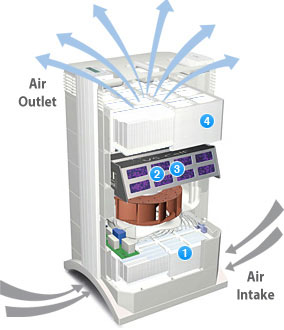
https://www.jameco.com/Jameco/workshop/Howitworks/dysonairmu...