"The question then becomes a matter of how we fix this without diminishing access to a college education."
This is the crux of it that everyone needs to get over. Universality, High Quality, Low Cost. Pick two. By letting the government meddle you have guaranteed no one can afford college and will be long in debt to a loan they cannot discharge in bankruptcy. I'd rather have cheap college then universal access for every single person who wants a English Literature or Anthropology degree with low ROI. Colleges are now awash in money and they pump it into newer and fancier campuses to attract more of that government backed debt from all the masses, driving up cost significantly.
Or how about breaking the degree monopoly with something like equivalent certification programs and let private companies fill the gap. Similar to what Google is doing with its certificate program they are rolling out. 4 years for a piece of paper that includes 2 years of general education classes for "well roundness" is starting to look more and more ridiculous considering the cost of that "well roundness" is years of non-dis chargeable debt weighing you down during your best decades.
A lot of the cost of American college doesn't go towards education but things like sports stadiums and teams, various non-academic events, administrators, various other non-academic staff, uniquely-expensive American legal costs and insurance, on-campus police (a big wtf for Europeans), and then there are also those people who decide which Halloween costumes are appropriate for students, investigate various misconduct on campus etc.
Americans expect college campuses to be like resorts, parents expect a lot of pampering and personalized whatever for their kid etc. In Europe, university students are independent adults who take a bunch of courses, take exams etc, but have lives on their own, outside uni. They may rent a room in housing with connections to the university, but the university doesn't babysit them. They don't expect anyone else to keep tabs on what they need to do, no pampering. There is no customer mentality. You spare a lot of money this way.
So it's at least in part cultural and also reflects in different attitudes regarding healthcare, restaurants, retail, and general business conduct.
> Americans expect college campuses to be like resorts
You say that but the typical dorm room offers no privacy or air conditioning, and the showers and bathrooms are shared. They're similar in nature to SROs which the US pretty much abolished anywhere else, but way more expensive.
And then universities have the audacity to demand that students live in them freshman year, even though living off campus would be cheaper.
My freshmen year I paid $8,400 to have access to a bed, desk, 4 drawers, and a third of a closet (two other roommates) for a total of 8 months (no access during winter).
Living off campus costs just about $450/mo for a private room with utilities and AC. If you could find a landlord that lets you cram 3 people in 1 room I can't imagine how cheap the rent would be
(except you won't find it because city regulations forbid more than 4 persons per lease, and you can only have 1 lease per obvious division of a house/building. To go above the limit you need a boarding house license, which is how the school gets away with charging $67k/yr for 8 people to share a 3 bedroom apartment).
And they force the students living in them to purchase meal plans which cost 3x what a restaurant meal would cost for defrosted food from Aramark/Sodexo. Obviously someone is getting paid.
Last time I ran the numbers at my alma mater, the mandatory meal plans were (in most circumstances) more expensive than paying cash for the same meals at the same dining halls.
There were a few low-end restaurants on campus too (sandwiches, wraps, pizza, burgers, etc) that were both better and far cheaper than the dining halls. Their defining characteristic was that you couldn't spend your dining dollars there.
Same at my alma mater. One point is worth $1 at the dining hall. You can top up points for $1/1, but you're required to buy a plan of at least 1,200 points that costs $1,800.
...demand that students live in them freshman year
What? I've been watching movies and series made in USA for decades and didn't know that. I assumed that students living there was a way to save money or the parents wanted it. I had no idea it was required.
If it's in the same city, can students just keep living with their parents?
A prestigious residential university is the student's whole life. Leaving its boundaries is a special event. You eat, sleep, study, exercise, work, etc. with your classmates around the clock. Like a monastery. Administrators are not just engineering the content of lecture. They are engineering the group of classmates in the library at 12:45am puzzling out together what the lecture meant. Students who only show up on campus for scheduled classes throw a wrench in those plans. Hence the mandate to live on campus.
This has always been the image of college in the United States. The alleged change is that conditions are getting less monastic.
This mandate can relax after freshmen year because at that point you've integrated. You'll take an apartment with some friends in the neighborhood, but you won't really be leaving. The university may no longer be your landlord and your grocer, but your landlord and your grocer will be doing 99% of their business with university-affiliated customers. The neighborhood is still campus, de facto if not de jure. You're still immersed. Technically some students may use this freedom to move across town or back in with their parents, but the mandatory year on campus has brought this risk acceptably low.
When it works, it works well. I have memories from late nights in the library and from Saturday evenings in the theater control booth that I wouldn't trade for anything in the world. But many schools in their search for prestige are trying to force this on kids who don't want it, and on top of that are failing to deliver.
> If it's in the same city, can students just keep living with their parents?
It's a pretty easy requirement to get out of if you know to expect it and are able to plan a bit. Parents in the same city are one option. If you already have a lease, that often suffices. I tested out of a few generals so that I wasn't technically a freshman when I started. Etc. There are loopholes for a lot of situations.
> I assumed that students living there was a way to save money or the parents wanted it. I had no idea it was required.
It shocked me at first too. I've talked to a lot of people trying to get a sense of the other side's perspective, and a large number of parents feel that the "college experience" is so beneficial that they don't feel anyone should be able to make the in-all-cases worse decision to live off campus..... It's a tiny bit similar to the mindset behind worker protections -- some deals are so bad that workers ought not to be able to make them in any circumstances. I don't agree in the slightest that students should be _forced_ to stay in a dorm and whatnot, but people who aren't me feel the opposite pretty strongly.
IMO a lot of oddities in the US university system can be explained (please bear with me) by assuming students are viewed by the larger system not as adults consciously making an investment but as children who need to be cautiously guided into the real world. You don't get to choose to live off campus because you aren't an adult and need to be protected from making the wrong choice. You need to make friends in the dorms because otherwise you won't be socialized for the real world. Teachers assign points for homework because it will give you an incentive to do it (because you're not an adult yet and can't make the right decisions without additional incentives). It's even solidified a bit in our laws and tax code -- financial aid must be available because college is an important part of transitioning into the workforce, and any available aid explicitly assumes you have an amicable relationship with your parents and that they will pay as much as they're able to help you through the last stage of your childhood.
97% of Stanford student undergrads live on campus. At many other colleges students are not allowed to live off campus unless they submit a formal request and receive approval to do so, and 90%+ is common. Then there are other types of schools with few or no students living on campus.
Most schools don't require you to live in a dorm freshman year, at least mine certainly didn't and plenty of my peers at other schools didn't have problems getting off campus accommodations freshman year.
Students live on campus for convenience and/or for socialization/environment - its not to save money, depending on a bunch of factors it's usually possible to live cheaper off campus.
> If it's in the same city, can students just keep living with their parents?
The uni I worked for eventually rolled out that policy after the initial "all freshmen live in dorms now" backlash, but it's a tiny fraction of the student population whose parents live in town. State unis are deliberately located away from the population centers, for obscure reasons involving a mistrust of European politics.
The logic seemed to play out in land grant unis as well, but looking at some history articles about my alma mater, it seems more complicated than "big city bad" -- the big city was on the opposite side of the state boundary river, and on the opposite side of the Slavery issue. Instead as best I can tell, the decision was driven by local legislature party politics of the time, with accusations of voter fraud, vote buying, and bad faith negotiations.
Perhaps the reason most of the state unis I can think of are in small towns is simply that without a crossroads or river confluence driving trade, landowners in those areas were most eager to get a state institution to prop up property values?
I made the mistake of commuting from home my first year in university (UW, i graduated high school in the area), it is really not that great to “commute” and pure commuter schools (where most students commute to from home) offer a different experience from other universities.
One point of university is to make it on your own. If your daddy is rich, this is in the dorms, if not, you rent a basement room nearby and bike in.
I went to SUNY Buffalo and while it isn't purely commuter, there was a significant commuter population. I lived with my parents nearby and had an 8-9 minute commute. If I had an 8am lecture (before the majority of commuters were there for the day), I could typically leave the house at 7:49am and still usually get to my seat as the professor began the lecture around 8:01am.
I had heard that there was a huge trend among colleges to build new single occupancy dorms that have the ammnities of a nice bed and breakfast. Partly due to increasing expectations and partly due to decreasing social skills around sharing living space (more only children or grew up in large house with no shared rooms among siblings). My alma mater built one of these dorms 15 years ago and it was incredibly popular.
While I understand that many students in the US are away from home, this degree of coupling between education and housing seems odd to me, an outsider. It adds a lot of requirements that certainly make the operation significantly more expensive. Even in the less luxurious ones.
I guess this is the equivalent in NYC.[0] Which, admittedly, looks nicer than my dorm in college, even accounting for the normal difference between advertising and reality.
But most of my Manhattan-based friends started off with summer jobs and living in spaces smaller than closets out in suburbia. But that came with a certain vie boheme that you probably don't get at "The Block" in Texas.
To be fair, the last time I was apartment shopping (8 or so years ago) I quickly realized that basically every apartment complex gets terrible reviews.
I went to a large school in one of the big NCAA athletic conferences. Their stadium cost around $100M in 2020 dollars, and they bring in roughly $100M in revenue from all sports annually. They call football and basketball "revenue sports" because they fund all the others. I'm not sure how much tuition goes to sports, but the big ones are very self-sufficient. That, and they serve as marketing for the school, and that can add value to the degree.
Sport, at least in principle, if you squint, has more to do with education. After all, grade schools have a physical education subject but no gambling subject. (Elite, pro, spectator sport is different though, that's why the squinting is required).
Generally, Americans have an obsession with what they call "well-roundedness" and a "holistic" approach which I don't see elsewhere that much. For example in European university admissions nobody cares about subjective stuff like volunteering experience, musical talent etc, when doing university admissions. It's all focused on the narrow academic subject. You also don't take generic subjects unrelated to your study program as in American undergrad.
The whole culture and concept of what a university is supposed to be, is pretty different in the US overall
I thought college sports helped university get huge amount of money. But yeah, American's obsession of sports is bewildering. Caltech was mocked in national media for their poor performance in NCCA. I mean, really? Why would I give rat's ass about NCCA or Caltech in NCCA? For all I care about, I just wanna see Caltech produce top-notch education, research, and students.
The schools don't have shareholders to whom dividends might be paid. The extra programs and the employees to support them will expand to use up all extra income.
I attended a small but well-known liberal arts school that increased tuition about 20k in well under a decade.
In a single year the tuition increased 5k, and yet the department of my major was downsized and classes that I needed to complete my degree were full. At the same time though they built a new $42 million "cultural exchange" building and began adding an enormous sports facility. It turned out that actually there was no intended purpose for the new building either, and it was mostly sat empty as far as I know.
It seems to me the appeal of the expensive colleges is at least partly that you get to hang out with other rich kids, making connections that can benefit you later financially.
It's like Donald Trump's golf-club you pay lot mostly for the chance of being part of the club
Universities in Europe are generally high quality and low cost. It does have it's problems but it is not one or the other.
You do not need a degree 30 years ago to do lots of jobs that now require one. Higher education for a lot of organizations is just an easy way to cut the application stack down
Are Universities in Europe really that high quality? Certainly some are, but as a parent researching schools I have been really surprised by how many European colleges are a bit mediocre by the criteria I was evaluating. For example, Spain and Italy have some of the oldest colleges in the world. But in many ways there are four or five colleges in California that are better, four or five colleges in Texas, and across the US many many colleges than any college in those countries.
I know a lot of people will disagree because there are so many ways to compare colleges. But what I look for is the strength of the top faculty (not necessarily the teachers but who you might work with as you get more advanced), the facilities, the quality of the research that comes out of that University. The US really has an impressive number of schools that attract top faculty from around the world and produce world class research in many fields.
A lot of European colleges seem to give you a good education. But if you really wanted to be an expert in something, or just get the experience of working with top people, it is amazing how relatively strong US colleges are.
I know I am making a lot of generalizations, perhaps unfairly. So if you disagree or see it a different way please correct me. This is something I am really trying to learn about.
My issue with the rankings is how they emphasise research. Why would it matter to an undergraduate how highly decorated his prof is? We used to joke that the more titles a guy had, the worse he was at teaching. I think this is true because the guys with the titles have moved on to managing research and finding funding, rather than having daily tasks to do with the research.
I went to a very well known university that's known for giving tutorials with just a couple of students, and this always seemed to be the case. Top prof = doesn't have time or motivation to teach.
If you look at it, everything you do in undergrad is fairly well known anyway. There's no reason why a course at one uni would be much different from another, the fields have decided long ago what is and isn't important.
What might affect your kid is what peers they end up with. If you go to a top uni, people are used to doing well and tend to come from backgrounds that allow them to succeed.
1. Research is part of the pedagogy. Getting involved in a research lab as an undergraduate is a great way to land in the top 5-10 percentile.
2. I think what you're saying is roughly correct, but would warn that you can very easily go way too far in the other direction. For example, check out some of the smaller colleges and state branch campuses launching data science departments staffed entirely by non-stats/non-CS faculty who have 0 days of work experience. Mostly because their math courses are under-subscribed and they've gotta do something with those bodies. The quality of these programs is about what you'd expect. So, you don't need top-tier faculty. However, you do need faculty who have at least a relevant terminal degree and/or significant work experience. Otherwise, it's the blind leading the blind.
3. Curriculum does vary radically between universities! C.f., Stanford and a random branch campus of a state school.
4. As you noted, cohorts can also vary even more radically.
> Research is part of the pedagogy. Getting involved in a research lab as an undergraduate is a great way to land in the top 5-10 percentile.
I just want to point out for any newer undergrads that might be reading that research is really one of the best things you can do during your time at school. Even if you don't plan on going into academia, it looks great on a resume and professors are often have industry connections that can get you an internship easily.
A few caveats to be aware of: more scrutinizing employers will recognize that undergraduate research at the same university you attend is usually a gimme. And at my large state school was often used for cheap labor that grad students didn't want to do.
A good rec from a strong researcher carries weight. Likely lots of execs, managers, and senior engineers in the ranks of their academic siblings, old grad school friends, collaborators, former students, etc.
It’ll add a band or at least max out comp in the existing one if the right person gives the right rec.
And that’s assuming the undergrad research project was totally irrelevant to the position. New grads who can contribute to cutting edge stuff are super hard to find and super cheap relatively speaking. Usually your options are super expensive engineers or the few phds who decide to go into engineering instead of research.
I’ve seen undergrads sign in the 3s and 4s when their research aligns perfectly with the advertised position, cause the alternative is often buying the kid out of his startup a year later.
1. Research is part of the pedagogy. Getting involved in a research lab as an undergraduate is a great way to land in the top 5-10 percentile.
5-10 percentile in what? Grades? Amount of papers?
Grades generally don't speak to someone's practical ability on whatever job they choose after college. For example, one's ability to learn stoichiometry in a time-constrained environment hardly implies they'll be a great chemist.
Papers also come cheap and there are already enough out there of insignificant value or dubious quality (a good indicator might be the journal/conferences most undergraduate papers are submitted and accepted to).
As others have said, just because a teacher is skilled doesn't mean they are skilled at teaching. To your second point, I've once had professors who had significant achievements on their resume not be able to explain the basics of their field in a coherent way. In a case like that, those professors are equivalent to lecturers who have 0 days of "work experience" (which seems like a weird term to use for what I read from your comment as "research")
First Outcomes. So, either total comp or other relevant metric. Feel free to disagree, but I have tons of data so I’m not even going to debate.
You seem to simply not understand the rest of the comment. The “or” is a branch with qualified professors of the practice on one side. It’s ok to not have any research experience as a professor, but then you better have a strong track record in industry. Having no relevant research AND no relevant industry expertise is the problem. One or the other usually suffices. Yes, usually. Spare me your anecdata about that one professor you still hate.
High quality researchers almost by definition do have several years of experience — “research scientist” is a job. One that pays better than most, even. 200K total comp starting in CS - CMU and Mit publish data. Just because you’re not building crud apps or cleaning up PDFs all day doesn’t mean you don’t have experience in a marketable skill.
I know a lot of cs phds. 100% who are current faculty either spent time in industry or had mid 6 figure offers they turned down for professorships.
"Feel free to disagree, but I have tons of data so I’m not even going to debate."
Why say you have tons of data and not just post it? If there's tons of it, it should be easy to find and post one link showing direct correlations between undergrads in research earning in the 5-10 percentile.
It's funny how you can say "One or the other usually suffices. Yes, usually. Spare me your anecdata about that one professor you still hate." when whatever evidence you have to support your "Yes, usually" is probably exactly that. When I was referring to "work experience" I was emphasizing the point that there's the "work experience" being referred to still doesn't factor in teaching which is a large part of what the job should entail.
And a 200k starting salary isn't too impressive when the time taken to get a PhD can be used to get that salary in the industry. 5+ year senior engineers can be seen getting 200+ total compensation on levels.fyi and I personally know people who make beyond that with even less experience than that.
What I'm saying is that the school system is broken and isn't structured to incentivize good teaching. Some hiring processes for university staffs don't even take it into account even when some of their salaries and facilities are paid by students. If you want your kid to actually learn something then I'd suggest vetting colleges by other metrics that actually indicate something about the quality of education he'll be receiving and not the quality of education his lecturers received.
> Why say you have tons of data and not just post it?
For the same reason you don't you dump your employer's IP whenever some internet rando asks for proof: it's not mine to give.
There are many paths to a happy early career. Getting involved in undergraduate research is one of them. There are other paths too.
tbh I'm not even sure what your point is anymore. You clearly have some sort of weird chip on your shoulder re: undergrad research. Sorry for your bad experience or whatever.
Your chances of landing a job in a research lab in undergrad probably doesn’t correlate with top research output. People who have armies of phds and post docs don’t have time for undergrads.
I spent my last 2 years of uni in a research lab and got some stuff published. Im pretty sure i got this opportunity because i went to a school with a dearth of grad students and i showed some initiative in an intro class for what became my minor.
I went to a public university with a good engineering program. After freshman year I took most of the Edx circuits course from MIT to see what the ivy league education advantage would be. It was pretty much the exact same topics and lectures. I thought the MIT lecturer did a slightly better job and I'm sure all the students were smarter than me, but I feel like I learned the same things for a fraction of the cost.
One of the problems that universities need to contend with is that they’re simultaneously meant to be research institutions and educational institutions. I think universities tend to do better if they focus on research first and let that lead their (comparatively smaller) teaching responsibilities.
Speaking as a dual US/Italian citizen there are some things I would add to your picture (which surprised me when I first learned them). I should also add, my picture is a bit dated since I last looked at this in the early 2000's but a lot of this is still true:
US vs Italian "high school"
- Finishing Italian secondary education is most equivalent to US high school + at least the first year of most US universities
- I believe this is true for most major European countries and boils down to the expectations for students being higher in Europe than in the US
US vs Italian universities
- It's true that Italian university is free
- It's also true that "anyone" can attend
- However, there is a mandatory "advancement" exam at the end of the first year that MOST (~70% in the early 2000's) students fail which bars them from continuing
- The above is what sometimes skews comparisons between US and Italian colleges
- To complete university, you are required to do a "thesis" and then defend it. Historically, this was done orally in front of a panel
- There is also the effect that because university is free and housing is usually paid for by parents, taking 5+ years to finish is both normal and somewhat socially acceptable (this is more of an interesting side bar)
Long story short, this means the Italian university is really Sophomore year of an American university plus some graduate level work. A good example of this is how there is(was?) no separate law school in Italy since you are essentially doing advanced level courses in "undergrad".
Another comparison: at the time (early 2000s) multiple people in senior level positions in European companies mentioned to me that in their opinion, having an MBA from a top US school was equivalent to a degree from a top Italian economics school like Bocconi University. Since most US companies thought of the MBA as the "advanced" degree, they weighed it more heavily so it did "matter" in that sense but not from an education only perspective.
“ Another comparison: at the time (early 2000s) multiple people in senior level positions in European companies mentioned to me that in their opinion, having an MBA from a top US school was equivalent to a degree from a top Italian economics school like Bocconi University”
HBS and GSB have much more brand value than Bocconi university. Whether the economics education you get is on par is debatable but it’s clear one of the selling points of an elite US MBA is the signaling.
I’m skeptical of the claim that Bocconi university has anywhere near the signaling effect of HBS/GSB.
Bocconi might have more signaling value to European or Italian companies perhaps, but American companies have European companies thoroughly beat in terms of number, size, power, global influence, etc. One of the "benefits" of valuing capitalism as much as we have is that the opinion of American company management carries quite a bit more weight around the world, and they would pick harvard over bocconi any day.
US high school education is not uniform throughout the country.
Are you going by some states' requirements here or are you assuming some amount of AP credits?
Top European universities provide pretty good education pre-PhD level, in many cases the first 3-5 years in European schools is superior and more focused than the equivalent US curriculum. The first 1 or 2 years in US universities seem spent filling the gaps left by a mediocre High School education.
US universities are then miles ahead of most European schools in their PhD programs bare a few exceptions (Oxford, Cambridge, ETH...).
This is true. There are a lot of pointless liberal arts classes for a STEM degree in the US. For example, my engineering degree required 3 English classes, psychology, fine arts, and sociology. These were all incredibly easy and I found the course material was what I was used to as a freshman in highschool (no I'm not exaggerating). So those classes weren't even remedial, but felt like a joke. Please note that I'm not saying all liberal arts classes are a waste, but I think all the 101 classes are pretty bad. The fact that people were complaining and struggling to make a C was mind boggling. The university says they're there to make you well rounded, but we all know it's an excuse to charge more money. The human brain can only take so many technical courses at the same time as well, so it's not like I could cram in another mathematics or engineering course and stay sane. Instead of giving you a break and getting to use that time to study, you have to take the useless other classes which costs more money.
> There are a lot of pointless liberal arts classes for a STEM degree in the US.
I understand, this was my outlook when I left school too, but I changed my mind about that.
It took me maybe 5 years of work experience before I realized that no matter how "technically" smart I was, my technical skills were worth shit if I couldn't communicate better with my teammates. My writing was poor, I couldn't explain myself concisely, I could get flustered when someone didn't understand a point that looked straightforward to me... I had no notion of how I might go about convincing someone to do something I needed, especially someone who wasn't working in the same field as me or didn't have the same educational background. Not saying I'm a rockstar at this either now, but at least I understand the benefits of well-roundedness in a way that I didn't see earlier in my career.
I also see this with some of my younger colleagues now, who seem to care about technical output and cranking out smart stuff, but they're having problems communicating or taking feedback, and it's really clamping their future professional opportunities until they work on that...
Anyway - I don't mean this to disclaim your experience of feeling like you were wasting your time, and maybe the classes weren't the right level for you, just pointing out that at least for some people in the tech field, lack of skills in the humanities dept eventually prevents their professional advancement, hence it's not necessarily a waste of time for everyone to take classes outside of their major even if they're studying in a STEM field...
I think he means there are classes that really are pointless. They're basically adult babysitting.
I found quite a few interesting history/culture/etc classes and enrolled in them. They had no prerequisites, but offered engaging material. A week in I notice... these classes don't fulfill my general education requirements--only the most fundamental, non-challenging classes do.
So I switch from classes with 15-20 students that would've involved long discussions, some research, and actual thinking, into lectures of 150 students and only 3 multiple choice tests in the entire semester.
I went to every class. Never was I challenged. They were very much "here are facts. Memorize these for the tests" classes and nothing more. Very surface level stuff. Not even any questions from the professor, and oftentimes if students asked questions, the professors would tell them to ask later because they're short on time. Just a waste of time and money.
I've been out of school for a decade now and would agree that communication is vital. However, that isn't learned via English Literature, psychology, sociology, art history...etc. Public speaking, writing descriptive emails and so on require practice, literacy, and putting yourself in someone else's shoes. Something like Toastmasters in class form would've been nice.
None of what you identified are covered in these useless classes. In my undergrad we had a sociology course that when over how people have different roles in life (family head, care giver, money maker, etc). It was all stupid obvious stuff without any non-technical merit.
If only those mandatory liberal arts classes taught things as useful as communicating and writing...
The one that got under my craw was when I went to see an academic advisor with one or two semesters left.
I had been fastidious about covering all the specified requirements, and my proposed course-load covered the remainder. Except apparently you needed 128 total hours, and actually covering the requirements of the programme left you six short. They designed the timetable assuming that people would bounce between majors or otherwise load up on go-nowhere electives, and the advisor basically said I could take underwater basket weaving and it would count for the gap.
I ended up taking a CLEP exam a few weeks later to claim the equivalent credits of several semesters worth of Spanish classes.
> There are a lot of pointless liberal arts classes for a STEM degree in the US
Only in a liberal arts program. In an engineering program, there is almost none. Other programs may fall in between. When I was at UC Davis (which was before Biological Sciences was its own college), the non-major liberal arts course load went (both in general, and where multiple colleges had the same degree program, between those specific programs) College of Letters and Science > College of Agricultural and Environmental Sciences > College of Engineering.
> For example, my engineering degree required 3 English classes, psychology, fine arts, and sociology.
That's, what, semester and a half all told? That's an odd basis for claiming “a lot”.
> The university says they're there to make you well rounded, but we all know it's an excuse to charge more money.
No, if they wanted an excuse to charge you more money they'd drop the liberal arts requirement, keep the length of the program constant, and add more engineering courses, whose faculty are much higher paid, and keep the same tuition to cost ratio.
I've looked at many programs and most schools claim that they want students to be "well rounded". I think that is pretty common and a scam, but that's just my opinion.
We may have a difference of opinions here, but six classes that I have no actual need for IS a lot to me. I still had to show up for those classes, listen to the instructors, do homework, buy stupid textbooks, and briefly study for the tests even though they were easy. That cost money that was the equivalent of me flushing it down the toilet, but more importantly, robbed me of additional time I could have spent studying for my thermodynamics, electronics, and differential equations classes (things that I was struggling in and I was intentionally paying good money to learn) or sleeping or actually getting to spend time with my fiance.
Curious what university you attended. From my experience the engineering liberal arts courses were still engineering focused. E.g. English was about writing ieee formatted papers.
I had an engineering ethics course where we discussed sensitive issues such as a medical radiology device which accidentally delivered 10x the dose due to sticky keyboard keys.
PhD programs in the US and elsewhere are often not directly comparable. Doing a PhD in the US typically involves 1-3 years still taking classes. Doing one in the UK means starting thesis-forming research immediately. Not really the same thing at all.
Uk CS PhD: spend one year figuring out what you are doing, 1/1.5 years doing research. 1 year writing up. Thats the summary I've gotten from several faculty.
On top of that, you have to go do a few postdocs if you want to do academia.(maybe a good thing, but not necessary in hot areas in the US for PhDs from highly ranked schools)
There's a reason the UK is trying to go over to centers for doctoral training and 5 year PhDs. Yes, in those and the US system, you spend 2 years taking classes. But in that time you are also getting spun up and then doing research.
Every friend I have (or ex-wife :) with a US PhD (this spans physics, history, computer science, physiology, geology) did classes for the first 2 years (roughly).
non-US PhD programs typically require you have a masters. In the US that is not a requirement, hence the course work. If you are a more mature student coming in (e.g. have a masters) the course work is often a straightforward refresher and you can start doing research when you aren't doing classwork.
Not compared to northwestern europe. France, Belgium, Luxembourg, Netherlands, Germany are similar (not the same - similar). Scandinavia probably as well, but i don't have experience there.
US is great for Masters levels and above, where there is indeed such a thing as a world-class specialists helping shape the next generation of experts.
If you're thinking about college though, that doesn't churn out experts. The material is well-known, and IMO it's more important to have great teachers available to answer your questions than to have world-class research experts on the brochure. Great teachers are also not everywhere, but they are in far higher abundance than the so-called "top faculty", and maybe good teaching doesn't even correlate very strongly with research brilliance.
Some of the classes in which I learned the most had teachers who were (I now see in retrospect) relatively middling postdoc folks, or long-tenured professors who didn't really have much more research "juice" in them... but they had a well constructed syllabus, were able to cleanly articulate concepts, give examples, give exercises, give encouragement, etc.
I've also taken classes with world-class researchers, and some of them were outstanding, while others had sloppy syllabus prep, didn't adequately coordinate with TA's, gave lectures that weren't engaging as they jumped into long solo calculations at the blackboard that they had trouble making their way out of... In short, they couldn't be bothered.
So I wouldn't generalize from my experience either, but I think that especially for college, teaching quality, and student body quality (peers are an important source of motivation) are more important than world-class research renown.
Working in tech in the US, I see enough high-performing European and Asian immigrants that I think it could be good for an American kids today to consider getting a degree from a school abroad for a fraction of what it would've cost them in the US.
The best math professor I had was atrocious at teaching. If not down right abusive.
Taught me how to ask the right questions. How to capture requirements and learn on my own.
Top Universities aren’t their to teach. They are their to empower you to teach yourself and explore deep in areas. While also learning the fundamentals that are necessary for this enablement.
That is drastically different than the average ranked schools.
Nonsense, there are a lot of universities in Europe to choose from that have been around for centuries with excellent reputations that also publish world class research, rake in nobel prices, attract foreign students & researchers, etc.
US universities tend to be better at marketing because their core business is separating their students from their cash and making them feel good about that. That does not automatically translate into a better academic performance. There are a lot of second and third rate institutions that are perhaps better at their marketing than actual academic performance. Arguably the smart move for a US school kid would be to opt for the life experience, language skills and education at a university abroad instead of opting into a mortage to get an education from some local college.
> Are Universities in Europe really that high quality?
Anecdote from a friend studying biochemistry in Milan, but mind-blowing. Apparently, he was the only one in his graduate class to know how to use a pipette and other basic lab equipment. Until that point, their training had been purely theoretical.
There are a lot of other problems in a similar vein. But the quality of American high-access, high-quality higher education from a practical perspective is a solid counterpoint to the European model of high-access, low-cost.
That's weird, basic glassware use including pipette is part of the national final grading in The Netherlands, I guess there's differences across the EU.
I think the US collages you say are stronger than European ones just boils down to money.
It's amazing how having more money just buys you more and better facilities and teaching talent, not to mention the US Gov. investing far more into STEM R&D (for defense) than Europe plus all that sweet private R&D money from all the fortune 500 companies.
Also admissions criteria. Italian colleges are known for having little control over who they admit (and graduate).
Almost all students attend a local university, often without leaving the house. The universities are essentially required to admit (and graduate) large numbers of locals.
I graduated Engineering from an Italian university and I must say much of my curriculum consisted of mind-bending exercises meant to keep us busy and out of the way. The currency we lacked most was context, insight, and an understanding of why some particular detail mattered.
I do think that of all that was thrown at me, something stuck after all; but admittedly the most insightful and profound opportunities that I missed are to be blamed on me, and on the precious little attention to students that the scarce funding allowed for.
At least in Germany research is often done by e.g. Max Planck or Fraunhofer Society. These are public research organizations which are practically part of the universities but their research output is not counted in rankings.
It may very well be the that the 10 best universities are in the USA so if you want your kid in the best university rather than sending them to Europe that might be the way to go.
That doesn't mean that in general the quality of education, for the general public in Europe would not be higher.
It's a bit like the US healthcare system, the best in the world, but only for those who can afford it.
> what I look for is the strength of the top faculty
I think most people getting doing normal undergraduate program rarely notice where the top factulty is strong and where it isn't. I sure didn't in the first years of an education. Every university has better and worse departments (those with some reputation for its research, and "others"). I have seen nothing that suggests that the undergraduate education given by staff at the less-known departmenmts is worse than the education given at the "good" ones.
Of course, if you want to get a PhD or even take an advanced undergrad or PhD-class in a 4th or 5th year at a university, you'll notice where the skilled academics are. But the vast majority of the education done at an university is in the basic undergraduate classes given to hundreds of students every semester. It's the quality of that I think is most important, and I'm going to argue that it's probably not dependent on the number of Nobel Prize medals in the department.
My degree was 5 years with professional Software Engineering accreditation (legal title in Portugal), and it had a level of data structures, systems programming, distributed computing, graphics and programming languages that I still find people missing out in online discussions.
So naturally there are bad ones as well, it is a matter of doing the research, and in Portugal's case, having the required grades to get in.
I haven't done a STEM education, but it seems to me like the quality of research output is dependent on the field, to start with. Second, doesn't it really only become relevant at the PhD level, not bachelor's or master's degrees? Seems to me like nothing precludes you from going for a good education in Europe and then getting good research opportunities in the US.
Europe educates people. The US let you believe your child can bring in his little league bat and get to play with the Yankees.
I'd be most surprised if the progress you make as a student was correlated to having the rock stars of the field in your school. In the age of the internet, if you're good and motivated you can work with pretty much anyone in the world.
If you get 50 application is easy just to automatically remove the X that don't have a college degree.
Similarly to the way you might have a GPA cut off of some amount but they don't actually care what your degree was in.
In Ireland there are a lot of people who go on to do a Masters because when a large number of people have degrees it makes you more competitive. Anecdotal most my friends will tell you they use neither their undergrad nor masters in work life
>Stop demanding a formal degree for jobs, allow anyone who can do the job to do it, and much/some of these problems will go away.
It's a symptom of people needing more jobs than are available - if there's a massive labour shortage these unnecessary requirements will evaporate overnight, and if people stop needing to work to survive these unnecessary requirements will evaporate overnight.
The majority of people don't go to expensive private college for the degree , as that is available cheaper elsewhere. They go for the feeling of elitism.
Some of the worst money wasting colleges are the scam trade schools like University of "Phoenix".
University of Phoenix was founded and is based in Phoenix, Arizona, so if you want to put scare quotes on a part of it, maybe "University" of Phoenix is the better way. ;-)
it's not a feeling - it's real. Connections with other highly connected (and rich) people will give you more opportunities that merit alone won't give you.
It's hard to know what exactly the job will be in a few years. But if a person has successfully completed years of study you know they have a lot of background knowledge which MIGHT become useful in the job as circumstances change.
Sure - as soon as we allow IQ and other such metrics to be valid for job-applications (I would love to just sort-by-IQ when filtering job and team applications). There most certainly is an over-abundance of individuals willing to work for the available spots, and we're artificially handicapping the methods by which the pool can be pruned. That's why we have leet-code type quizzes in tech, they're essentially proxies for memorization, IQ and determination. Consequently, degrees are a secondary proxy for the above 3 criteria, so no wonder employers have been relying on it.
>Universities in Europe are generally high quality and low cost.
The cost is low for the student but it's pretty high for the taxpayers. Not US high but still, it's not free, there's lots of bloat in the system that thrives on volume of students not on quality so they try to push forward legislation and programs to increase the number of students, especially from abroad and build more faculties/universities with more staff to hire regardless if the jobs market has need for more students or not.
It's not super expensive for the taxpayers but because it's mostly free for the students, lots of them treat it like Highschool 2.0, bouncing in and out, not bothering to finish it or prolonging it till their thirties, etc. which turns into of a waste of public resources at some point.
> The cost is low for the student but it's pretty high for the taxpayers.
That is a supposition that proves to be false. The same happens for health care. To have a centralized state sponsored education or health care system allows it to be more efficient that smaller for profit institutions that have incentives to increase cost to the students as their profit depends on that.
Also, I would like to notice, that for European tax-payers it is an investment. That money spend in education brings back way more money that what the original cost was. So, to just talk about "cost" misses the point.
> bouncing in and out, not bothering to finish it or prolonging it till their thirties, etc.
Not true. I have never been in a classroom where anyone was above thirty, probably no one was over their 25 anniversary.
But, that is my personal experience. Can you provide some data about that? I have not been able to find any statistics to confirm your statement.
Americans are over 300 million people, and like Europe we are not homogenous.
And many Americans believe European healthcare, education, and infrastructure are far superior to the U.S.
The problem is that despite Europe being far more efficient at health, education, and infrastructure spending it also has a wide range of policies. So it's difficult to determine which policies are driving the increase in efficiency and which aren't.
There’s no such thing as “European healthcare”. European countries (and I’m going to ignore Brexit and include the UK) approach provision of healthcare in a unique way. For example, the UK has the NHS, Switzerland has insurance mandates, and France has strict regulation of private insurance companies.
Europeans are utterly unable to create new global enterprises at the rate of America and China, apart from a few odd balls like Spotify. Different places optimize for different things, for better and worse.
> Europeans are utterly unable to create new global enterprises at the rate of America and China,
Having a homogeneous, single-language, single market of 350 million, and 1.4 billion people, respectively, is an enormous competitive advantage that Europe cannot replicate, without doing away with sovereignty and brainwashing ~80% of its population.
And despite all that, the quality of life of the average European is pretty good.
And how much success does it have making things sold to consumers? (Which is where the common market is most important.)
I don't think I have a single thing in my home made by an Israeli brand (And I don't use Waze, and either way, it's Google's now). I have quite a few European-branded items, though.
Europe is a collection of small countries. It's not coincidence that the economic powerhouse of Europe, Germany, is the most populated country. And since this is going quite off topic here is some wild idea: let's keep just a fraction of the current universities, like say 5 or 10%, force talent in Europe to concentrate in a few places, force mixing across nations. Actually this is already encouraged somehow but let's be more brutal. Just thinking out loud maybe an stupid idea.
Europeans are absolutely, utterly, unable to imagine that things they pay a percentage of all income earned, over their entire life, are not free. It's incredible to watch from outside.
> CAs tax rate when you factor in federal tax is comparable to the EU
Nominal rates might be, but tax burden is not. California tax burden is well under 15% GDP, and federal collections in the state are a tiny bit higher than state tax revenues, together still under 30% tax burden. EU overall tax burden is over 40% of GDP.
> How do these numbers look when you count health care/insurance cost for CA instead of only for EU?
Then you are counting the cost of the thing you are complaining about not getting for your supposedly-equivalent taxes in order to try to justify the claim that the taxes are equal.
You don't need to go private in the US, either, that's largely a status display and a mechanism for non-educational social benefits more than an actual educational benefit; like the difference between outcomes in different public schools outcomes, the vast majority of difference between education outcomes in private and public schools is explained by factors outside of the school attended that determine educational outcomes (socioeconomic status, parental educational attainment, engaged parenting, etc.)
I agree, that state is a mess.
I happen to live in state with low taxes and affordable school.
Perhaps the european model is better overall, or perhaps there are other complications.
Regardless, the debate is not "free" vs "pay private companies".
Both models have costs and benefits.
I think they are well able to image that, but it's paid as part of income taxes so the hit when they're not earning isn't as catastrophic.
Also, consider that EU tax collection is comparable (and often lower) than US tax collection, despite not EU not having to separately pay for education and health...
When you consider the totality of costs, inside and outside taxes, European healthcare and education is significantly cheaper for comparable or better outcomes.
I'm not framing it as free vs paid. I'm framing it as public vs private. The public sector just does some things better.
No one in Europe is under the illusion that public services are free. This is a complete strawman. But they are much more cost-effective than the alternative, a lot of the time, and provide universal services to everyone and help maintain the social fabric of a society.
To date, that may be true. But give it a few decades. With the GI bill and the immediate post-war boom the US is arguably ahead of Europe in terms of the "college access for all" mindset, and cost of college only really became near the turn of the millenium (note that college debt is a "millenial" issue) and unbearable around 2005-2010 or so; so US colleges have had a bit more time to hone the fine art of rent-seeking.
> Also, I would like to notice, that for European tax-payers it is an investment. That money spend in education brings back way more money that what the original cost was. So, to just talk about "cost" misses the point.
How do they know this is the case at the margin? The analyses I've seen of this is usually [benefits of education] = [# of college grads] * ([avg. college grad salary] -[avg highschool grad salary])
Which has two large fundamental issues. One that college grads are differently from highschool grads in ways besides education, and probably the people most likely to go to college are the ones that would benefit from it the most.
Not to mention several posts have talked about how much better educated Europeans are despite the U.S. spending significantly more money on education than any large European country.
The Swedish report "Education and Economic Development - What does empirical research show about casual inter-relationships?" https://www.regeringen.se/rapporter/2005/12/ess-20054/ asks a similar question and starts its conclusions as follows:
"Our results are potentially contradictory. On the one hand, we have shown that the best studies which used variations in education between countries and regions – here we consider recent studies to be more reliable – indicate that there are no strong external effects from education. On the other hand, we have pointed out that there is strong evidence that education leads to improved health and life expectancy, politically more active citizens, lower crime and possibly that the children of educated persons become more productive. One explanation for these seemingly contradictory results may be that the favourable effects of education are not sufficiently strong to have an impact on economic development. It is also possible that the traditional measure of GDP is too narrow (and perhaps insufficiently stable) to capture the favourable effects."
> To have a centralized state sponsored education or health care system allows it to be more efficient that smaller for profit institutions that have incentives to increase cost to the students as their profit depends on that.
There is a major flaw in this argument: mixing incentive with potential. Yes, governments have the potential to be more efficient due to scale, but there is no incentive to do it. Smaller for profit institutions don't have the economy of scale, but have the incentive to be very efficient. In the end, private institutions need to be extremely efficient to compete with the free state colleges in Europe, while free state colleges have zero motivation to improve and compete, their money is a given.
>To have a centralized state sponsored education or health care system allows it to be more efficient that smaller for profit institutions that have incentives to increase cost to the students as their profit depends on that.
An institution whose survival depends on profits is incentivized to...reduce costs, not increase them. All profits are, are the difference between what is consumed and what is produced. Either your argument is: institutions who produce more than they consume are bad or a service provider ("centralized state education") can be granted a monopoly to the service and will, more efficiently, produce the service. Typically monopolies charge monopoly prices (bad for everyone except the monopolist), if the granted monopoly has its prices legislated to address these concerns (the case in Europe), it must sacrifice either on {cost, quality, quantity, quickness of delivery} of the product.
If you really do think that monopolized industries outperform markets with "wasteful profits" you might study the history of the CCCP and democratic welfare states.
The market manipulation that started in US education is a result of price fixing -- the price of education is a molested price: service purchasers don't select on electing a provider based on cost because that market price has been pushed up by government-secured debt to which a party cannot default on (otherwise know as selling yourself into slavery). Since producers have less competition on price, they compete on quality, quantity, and quickness. It's the same issue that resulted in the FAA price-setting airline tickets - airlines couldn't compete on cost so they had an ever increase set of luxury options to attract customers.
No, the cost to tax payers in Europe is less than what people in USA have to pay the college.
This is because my University (in Europe) had no sport facilities whatsoever, not even a soccer field. It also had no dormitories, canteens, no fancy library, sport teams etc.
For reference, cost in France is about 11kE per year for undergraduate and 22kE per year for master in computer science engineering. That's what it costs the university per student, not what the student pays (up to 1k a year). This doesn't cover accommodation or canteen since that's not part of the university.
I don't know what's the cost in the US but I don't imagine it's orders more. The worst number I heard from coworkers was 60k$ a year in NYC (that's easily triple income and taxes compared to France so not a straight comparison).
Wait. You're comparing total cost in France, to cost at the point of use excluding taxes in the US. Education in public in-state universities is also highly subsidized.
Those state subsidies have steadily been eroded over the time period under discussion--part of why tuition has increased. At most large state flagships, public funding is now a significant minority of revenue.
Right. But you still can't compare US price without subsidies to French price with subsidies. They are still a significant minority, about 30-40% of what Tuition brings in.
Besides, public funding given a year ago still factors into costs today.
Sure. But what I'm wondering is what subsidies you're referring to. Are you talking about grants and loans that students get, or maybe federal grant money for research?
These organizations literally directly receive money from the government. Students grants are a factor too, but they are owned and financed in large part by the State. That's called a subsidy. They are losing money, that the taxpayer shoulders.
Ok. So I looked at the FY19 budget for one of the universities I attended and for the overall budget of $7.3 billion it's broken out like this (numbers are rounded). [1]
Tuition and fees -> $1.8 bb
Government appropriations (it looks like this is what you're referring to as direct subsidies?) -> $ 470 mm
Grants and contracts -> $862 mm
Sales & Services University -> $543 mm
Sales & Services Health System -> $3.3 bb
Sales & Services OSU Physicians -> $480 mm
Gifts and Endowment -> $380 mm
Negligible other items -> $100 mm or something.
So what subsidies are you referring to? Happy to look at a different university if you want to provide an example.
Unfortunately I can't reply, but I'm not sure why you're only considering government appropriations with respect to tuition instead of the entire budget. Seems a bit selective to me.
Yup, government appropriations is about 38% of tuition. Part of tuition is also paid for by the government via various programs.
So if you want to look at total cost starting from the average amount a student pays as tuition you have to increase it by 38%. There are of course other intangibles paid for by the government such as the initial investment, often the land and a part of the endowment too.
So it is consequence fair to say that that tuition in state university is subsidized by the government.
Right -- in the context of Europe, high quality means high education quality; it may not be high quality in the sense of all the frills Americans usually expect out of the college experience.
>had no sport facilities whatsoever, not even a soccer field. It also had no dormitories, canteens, no fancy library, sport teams etc.
Sports teams and dorms are no where near the top of the ticket of University expenses. Many of the Ivies hardly invest in sports and still come with a 60k ticket.
American private universities are more expensive because American universities hire more administrative faculty and pay them more. That’s largely where the money is going.
Idk. People say this but are sports the real cost driver here? Many sports programs in the US pay for themselves and more or might be close to break even.
We also have Title IX (1) which in some cases will lead to increased costs. Not to mention we have, you guessed it, a Title IX coordinator at every university that has to comply with Title IX who probably makes $50,000 - $100,000. If you think about other programs at universities, you’ll see quite the glut of administrators.
The US education system is really just screwed up by free, guaranteed government loans. If we just made loans dischargeable then most of our issues would go away overnight. The issue you have here though is that we are concerned about access to affording college for those who have to take out loans, but this route we have just makes college increasingly unaffordable. It’s a viscous cycle. I think stopping it is the way forward.
Most likely sports are going away at US universities. Big football programs will stick around though because the make a killing and people generally love them. Men’s basketball too because it’s relatively affordable. For reference, as I’m watching Bloomberg there was a report that came out suggesting star quarterbacks at major Us football programs at the collegiate level should be compensated at around $2.4 million dollars. We won’t have a men’s rowing team, or women’s volleyball anymore though. Kind of sad since these are also used as Olympic training programs. But maybe we will change how we do things. I think the US will start losing a lot of sports talent though because the infrastructure isn’t there outside of the university system.
> We won’t have a men’s rowing team, or women’s volleyball anymore though
Universities in Australia generally have sports clubs where students play sport at an amateur/non-professional level. And that can even involve a representative team that plays the sport with students from other universities, even a handful of sports scholarships for promising athletes. That doesn’t cost the university that much at all, because unlike many American universities they are not trying to field a professional level team, just provide students with a recreational break from their studies, some exercise and socialising
Title IX (https://en.wikipedia.org/wiki/Title_IX#Equity_in_athletics) has pretty broadly been interpreted as meaning equal funding. So scholarships you allocate to men's football needs to be equally funded in women's scholarships. IDK what the OP is talking about, beacuse there's no way the status quo changes until Title IX is repealed.
Equal funding, yes, but not necessarily to the same sports. They're allowed to take into account interest and participation. Otherwise, wouldn't we see million-dollar coaches for women's college football teams too? (I actually don't know of any women's college football teams, for that matter)
Probably 20-30 I’d say safely make money. For the others, it depends on how much it costs. Like if they are in the whole $100,000/year they could instead fire an administrator, or ask alumni for donations.
I have to think most universities aren’t losing too much money or they’d cancel the sport already, but I think with COVID-19 this is going to happen across sports in college anyway,
One theory goes that the whole "College ranking" apparatus has created a "race to the most affluent" situation, since high tuition costs have no negative effect on a College's ranking, and if you don't spend on facilities and things to up your ranking, then you'll lose customers to the competitor who does.
> The cost is low for the student but it's pretty high for the taxpayers.
Well, not really. In France for example, the cost per student per year looks like the following:
* Classe preparatoire (math & physic 2 years course to prepare ranked for Engineering schools): ~15K euros per student per year
* Engineering Schools: 10 to 25K depending on the specialty, with a few prestigious schools (Centrale Paris, Polytechnique, Mines de Paris, etc) in the 30 to 60K bracket.
* Literacy student in university: 5 to 7K
* Math or Physic student in university: 10 to 15K
* Business School: 15 to 20K
However, keep in mind this figures don't include housing.
Apart from Business schools and less prestigious engineering schools, most of these are public schools with low tuition fees for students (even if these are slowly increasing, Centrale Paris raised them to 3.5K recently for example).
Also, cost apart, having public schools with low/no tuition fees helps keeping open opportunities for everybody, and mitigate social and economic aspects.
It reduces the "my parents don't have the money to allow me to go through university" or "do I really want I 200K lawn from the start of my professional life?" aspects.
It's just better at giving more equal opportunities to every students, minimizing somewhat factors that are outside of their control like the socioeconomic background of their parents.
Don't get me wrong, it's far from perfect and these factors still play an important role, but at least it's an effort in the right direction.
The parents who do that till yoir 30ties who simtaneously insist on you being formally student at university are rare. Either they cut you off or are fine paying you even if you dont study.
And frankly, my impression is not that American students take school more seriously in average. They dont seem to, the paying money effect seems to be primary demanding more support and stufd from school. Not working more.
If nothing else, the college experience where massive focus is on fun, parties, extracurricular acrivities, fraternities, sorrorities, networking, fun again and sport tend to be American focus.
> Universities in Europe are generally high quality and low cost.
And not universal. You do not go to a German university from a Realschule or a Hauptschule -- you go to Gymnasium, and if you succeed there, you can go to University.
Otherwise, there are professional and vocational tracks available.
University slots are limited as well -- you may have to hunt around for a university that has open space for you in your program of choice, or choose a different course of study.
Changing study programs is much more difficult than in the US.
I would be abundantly happy if we did this in the US, but the "everybody must go to college" crowd would have none of it.
As Portuguese living in Germany, with experience in other European countries as well, that tiered school system always pisses me off.
In those countries I have goten to meet clever individuals with university degree, that in Germany with their high school background would never had gotten the opportunity to attend university.
Sure, but at the same time there are lots of clever people that missed the opportunity to actually go, due to artificial barriers that consider them too dumb for university.
> Universities in Europe are generally high quality and low cost.
But they’re not universal and there’s nowhere near the level of handholding and support that’s common in US universities with high tuition, i.e. private ones. If you have a problem in a German university it’s on you to run around and solve it and if you can’t the administrators are quite likely to say “tough” if you tell them. Missed a deadline? Your problem, should have read the syllabus. Come back next year.
> If you have a problem in a German university it’s on you to run around and solve it and if you can’t the administrators are quite likely to say “tough” if you tell them. Missed a deadline? Your problem, should have read the syllabus. Come back next year.
They'll say that in all the private fancy US schools I've attended, too.
From my experience at a German university, the administration is in reality very helpful and can be proactive once you reach out.
They won't come chase you if you evade them for anything short of criminal, fraudulent or unsafe behavior, though, and it'd surprise me to hear if that's the case in the US.
Is that really the argument? That high quality and low cost are only possible if students are responsible for solving problems? Sounds fine to me. Students solving problems is at least half the point of undergrad anyway.
> Or how about breaking the degree monopoly with something like equivalent certification programs and let private companies fill the gap. Similar to what Google is doing with its certificate program they are rolling out.
This stuff has existed for years and there are probably thousands of "certification programs". Most of the time, they're deemed worthless.
The real question is why schools like Khan Academy aren't accredited?
Why can't we have free online courses for everyone, where the only costs are the actual free market costs that go towards staff required for administration, courseware development, instructors, and test proctoring?
Why should a college degree from an online university cost a fortune, if the course material remains mostly unchanged from year to year? At the end of the day, all you need is the educational materials, someone who help guide you through them, and then a test to prove that you learned the material. Why isn't that good enough??
Because this is all driven by initial post-university employment (and to some extent post-graduate degrees). Employers use university as a screen for jobs, and perceive candidate value based on university prestige. University prestige is based primarily on selectivity.
Accrediting Khan Academy (or Udacity, or whatever) won't change any of this process. Employers don't have an incentive to change their process right now, so in general students would not pick something like an online degree over traditional university.
But wouldn't the perception of the employers change over time if they discovered that the people with degrees from that online university were actually well educated?
Obviously, if the material and teaching sucked, or if cheating was rampant, that would tarnish the reputation, but the same could be said of virtually any educational institution.
Of course, if they ever had a reason to change. But they don't, because they don't really have a problem with supply of candidates. They have issues with selecting for quality, but adding tons of candidates with online degrees doesn't help them.
There are potential ways of addressing this, but they mainly involve the online university developing selection criteria just like elite colleges (e.g. everyone can access basic materials, but only certain X performers can access the premium version with company interviews; or they only admit X students per class). Otherwise the value of the degree is diluted and it has no more signaling power to employers. In addition, the online universities will likely attract less capable students, because for very strong students, top tier universities are still very much worth it.
Why do the employers get little marginal benefit selecting from a larger pool, but somehow the universities have no problem screening hundred of thousands of applications?
> staff required for administration, courseware development, instructors, and test proctoring
These costs are not exactly negligible, though they are much less than the prices charged by private 4-year colleges. The average community college tuition and fees is only $3400 [0]. That's fairly close to the "free market" cost of providing tutoring, creating new tests, test grading, and other administrative fees. So, I think the real reason is that there is not much of a market to be had since---if you don't need the signaling, research, or social aspects of a 4-year college---community colleges already offer an arguably superior product for what would be a similar price.
> By letting the government meddle you have guaranteed no one can afford college and will be long in debt to a loan they cannot discharge in bankruptcy.
A lot of countries have been able to maintain high-quality, low-cost university systems. They all do it with a significant degree of government intervention. I can't think of a single one that has succeeded by letting the market solve this problem.
If you are talking about Europe, the catch is that they weed out those who shouldn't be there early. For example in Italy, everyone can go for the first year, but then you have to pass a continuation exam, that upwards of 50 to 70 % fail. Germany has a similar system with exams early in high school that separate what tier school you can go to (trade schools or universities). So sure, its "free/low cost" but and technically "universal", except for those who fail at the gate. Otherwise try your luck in the US where you can rack up massive debt to attend any for profit college with 90% acceptance rates and the peice of paper is accredited the same as any other college.
IMHO, because what colleges are selling is effectively a positional good[1], one valued specifically for how it ranks against other similar goods. They're selling the certification that "this person is in the n% percentile of employability".
And you generally can't just make more of a positional good. That's like, "why can't Louis Vuitton ramp up production so that everyone can have a LV handbag?"
Right, for example almost everyone in California can go to the state's cheap, accessible community colleges. But not everyone can go to UC Berkeley or UCLA.
People say that, but it's not really true. Tuitions are lower-tier schools are also extremely high; the tuition break doesn't happen until you get out of accredited 4-year universities and into community colleges.
If college were priced purely as a positional good, tuitions at lower-tier schools would be be sharply lower than those of upper-tier schools. In Illinois, SIU and NIU cost approximately as much as UIUC, the state flagship.
>If college were priced purely as a positional good, tuitions at lower-tier schools would be be sharply lower than those of upper-tier schools.
Price (to the buyer) is more than just tuition -- the more prestigious ones are more selective, which is effectively a higher price. It has to charge that higher "price" (selectivity) in order to maintain its prestige. And generally the correlation holds, between prestige and price, even if it's not perfect.
If there really is no difference between those colleges you listed, except that one degree is worth more but costs the same, then I agree I can't explain that.
The answer is we have UBI, and embrace the positional value going to 0. Just about everyone is already overqualified for the jobs that they do. It's a bullshit job economy.
Let's drive up the cost of labor, educate for non-job-related reasons, and see if the the two paths meet again in some vastly different economy.
Please tell anyone that is overqualified at their current job to contact me, about everyone in my company in IT is underqualified, many times incompetent because we don't compete on salaries with the FAANG companies paying 3-5x more.
I'm talking overqualified on paper---in terms of education and other credentials. Absolutely this doesn't translate into the brilliant coworkers everyone here moans about not having, but that that's due to a bunch of systemic things:
If:
- Jobs were less pointless
- School reward system wasn't all screwed up
- Jobs required more skills
People would be "smarter". Without that, of course y'all gonna feel like you're surrounded by smug idiots.
> about everyone in my company in IT is underqualified
Downward spiral, the people who get stuff done get babied to death and decide to change jobs, the ones who are just along for the ride stay. Wash and repeat 3-4 times and you end up with a dysfunctional company.
College's rising price could be as simple as transferring the economic surplus of the education, in terms of your future expected salary, to the institution. That literally happens through loans. For some people, as a great WSJ article noted, loans do work out.
That's all blowhards (not you) really mean by "high quality" anyway.
Nonetheless it is quite the puzzle, why there aren't more colleges.
Like Leon Black could afford, just by himself, to found not one, but five world class universities, instead of donating to Harvard, one for each of his children to be admitted to. And yet.
This was the way medical school quotas / exclusions for Jews were dealt with: new medical schools that didn't discriminate!
Maybe it's a little about money. Getting your kids a guaranteed Yale admit probably costs around $20m - then the legacy system can deal with the rest of your family. It's a lot more affordable than founding a school.
Still I don't think it's about money. There isn't some monopoly on schools or lack of spending. Historically, and in my personal belief, someone has to feel they stopped getting a fair deal from the system. Then there will be more schools.
Essentially, the primary driver is states reducing funding to public institutions. (A reply to the linked comment shows how this transfers into private colleges costing more, but essentially consider that if UMass Boston ended up being more expensive than Harvard due to Massachusetts reducing tuition support, then Harvard would obviously be remiss if it didn't double its prices. This is not a knock on UMass Boston, an excellent institution that nonetheless does not carry the prestige factor of Harvard.).
So the problem is: 1) states are the only entities that can quickly (< a generation) create universities whose degrees broadly confer the benefits expected when purchasing a college degree, 2) states are cutting funding for higher ed. QED we are more likely to end up with fewer colleges in 10 years than even as many as we have now.
We do, although they seem to obey a power law distribution in "prestige". California has 116 community colleges (serving 2 million students), 23 campuses of the California State University, and 9+ campuses of the University of California.
Community colleges and 4-year colleges aren't the same product. I'm asking why we don't simply have lots and lots more 4-year colleges, if the demand is so high that the prices can skyrocket the way they have.
Interesting. I'd guess it had partly to do with regulatory hurdles, accreditation and such. The other parts, acquiring the land, buildings, equipment, faculty are rather capital intensive. I suppose they could be rented at first.
If you are talking about Europe, the catch is that they weed out those who shouldn't be there early. For example in Italy, everyone can go for the first year, but then you have to pass a continuation exam, that upwards of 50 to 70 % fail. Germany has a similar system with exams early in high school that separate what tier school you can go to (trade schools or universities). As far as I know, once you take the test, your fate is sealed. So sure, its "free/low cost" but and technically "universal", except for those who fail at the gate. Otherwise try your luck in the US where you can rack up massive debt to attend any for profit college with 90% acceptance rates and the piece of paper is accredited the same as any other college.
Too many people are enrolling in College, and this is a problem. The end result in many cases has been lower the standards to get students to graduate. More people need to be geared towards trades and manufacturing jobs. The Covid Pandemic has shown us what happens when you put all your manufacturing in one country.
People will naturally go towards trades and manufacturing once the present value of expected future cash flow reaches equilibrium with alternatives and damage to their body.
There’s a reason plumbers and electricians would rather their kid be a white collar worker.
I just had a former carpenter come over to do some work and saw me in running shorts and said he wished he could still do physical activities, but the years of carpentry work have ruined his joints. He was only upper 40s.
The area where I grew up was a mountain region where wood work was the main occupation of most men; even for men that worked in the forest cutting down trees such health problems were very rare, carpenters working in the shops in the village had no such problems. The guy that did the plumbing in my house when I built it was over 70 years old at that time and he was still working because he wanted to be active, even if he could retire at 60 years old by the local law. I find office workers having more health problems than people with some physical activity, sedentarism is a killer.
> More people need to be geared towards trades and manufacturing jobs.
The key is manufacturing jobs - that is what disappeared over the last half century, and most of those jobs are semi-skilled.
But there are no jobs. There never will be - unless the US completely stopped importing from China. They can't - because then people will go to wal-mart and see the price increase, and get mad. And that doesn't take into account automation and technology further squeezing the need for workers.
> More people need to be geared towards trades and manufacturing jobs.
To this, and as we're on hacker news; and bootcamps are proving it for web developers; a bachelor's degree often doesn't prepare students for jobs (and the larger concepts, ethics, systems thinking, etc often come from corporate training just as well)
These are what American universities are actually well equipped for.
It's common knowledge that if you graduate with a BS in some engineering topic, you won't have most of the practical skills necessary for your job --- or at least not from your curriculum. However, a good school will teach you how to analyze complicated problems from a number of different perspectives with both theoretical and practical tools. Moreover, all those liberal arts classes they make you take that people complain about will give you the social and cultural context necessary to understand ethical implications that might arise.
Sure, getting a BS from a top engineering school won't tell you the best way to design web pages in 2020, but it should make you a well rounded, capable engineer.
The "pick two" argument tends to hold weight if there's no way to execute anything better.
Innovation is finding ways to do things faster, better, and quite often (in the long run generally) cheaper. It's the nature of disruption.
For education.. it seems mighty suspicious that we can't create better ways of delivering curriculum that doesn't change often... but in social media we can pump out so much digital information of the latest happenings (or opinions/interpretations) that it can overwhelm the senses and brain and become fact.
But, what do non-academics know. And what do academics know about the capabilities and possibilities of tech.
The next year will be extremely interesting for experts and leaders to show, instead of tell or talk.
I 100% agree that the "pick two" only applies if you cannot setup and alternate system. Hence my recommendation to for certs to break the monopoly. I really think tech has yet to TRULY disrupt education.
It is not possible for me to overstate how very much this is not true at the college where I work, and at all colleges with which I have a personal connection.
Of course not. They ARE AWASH in income. They just figure out how to spend it fast. Fancy buildings, fancy retirement plans, outrageous administrative salaries.... For example the Chairman of UMASS Medical Center makes 2.3 million. The CEO of Harvard makes 9.25 million. How are these jobs an order of magnitude harder than the governor of Massachusetts. (salary 150K) Or harder than the US President (salary 400K). I cannot help but laugh when someone says that 'captains of industry take huge risks and therefore deserve handsome reimbursement". How is it risky when all you have to do is decide how much to raise tuition? Riskier than our soldiers who face AK47 rounds in the sandbox? (What does a marine make, again?) How can we afford to pay our teachers so little? People who literally hold the future of America in their hands?
And now with distance learning, tuitions have not decreased by an order of magnitude though the overhead should have.
FWIW, both of those examples are not only the executives of a university, but also of a hospital system. The vast majority of college presidents make well under that, with a median in 2015 of 300k (https://www.clevelandfed.org/newsroom-and-events/publication...).
To be clear, the presidents of those institutions’ have a major goal of bringing in charitable contributions to those institutions. They are paid well in part because they bring a TON of money in.
But also, there are clearly power law effects here. Your claim is a little bit like looking at Jeff Bezos’s and Zuckerberg’s billions and concluding that all startup CEOs — including those without VC funding — are overpaid.
I have never heard this argument ("captains of industry take huge risks and therefore deserve handsome reimbursement"). What I have heard is that these people are paid market rate for their management skills because they could easily get a similar salary in other endeavors.
Then let those administration be hired elsewhere by the market. A university should not pay such a huge salary to administrators, somebody who is paid a lot less can do the same job. If it takes millions of dollars to hire an administrator at a university, you probably don't need that person. You could just as well hire a person who is willing to accept a smaller salary for the same job. We are talking about administrators who get paid millions for hardly doing anything... let them be hired by industry where they get more salary and hire someone cheaper.
I worked as tech support at a major university in the US in the mid-90s in the College of Business Administration as an internship. The way it works is you get a budget. If you don't spend all of your budget, you get less budget next year. No department wants a lesser budget. This resulted in all professors, most who only use Word and Excel, to get $4000 brand new, top of the line Dells every year. I know, I had to set them up and deliver them.
This probably isn't how it works everywhere, but it's certainly the case in some places. This was a large public/state school.
It's not that extreme around here but if there is some money left over... You can be sure that it will be spent. It's not like management gets a bonus for not spending money.
Do you want to think the president of the US to be paid a fraction of GDP (like .1%)? Since technically he probably has at least that much impact. Comparing private and public salaries is silly. Hedge fund analysts make more than the governor of Mass, should they get a pay cut?
Haha, I had lunch with Dr. Collins a few times in grad school at Umass: he's not a bad guy, just a medical executive that could go make that money elsewhere. He is pretty talented as well :)
It’s probably similar to health care in that the amount of money entering the system may be increasing, but the growing costs of bureaucracy are consuming all of it and more.
Most departments don't see it, but you also need to compare colleges to colleges of the 1900s, where most professors made VERY small salaries and campuses were spartan at best. Funds have increased tremendously
It's impressive to see this simplistic "you get what you pay for, damn it" sort of argument appearing in a situation where clearly students don't get what they pay for at all.
It's easy to find example in the US past and in other countries where high general and specialized quality education is provided in a fairly low-cost fashion.
>>It's impressive to see this simplistic "you get what you pay for, damn it" sort of argument appearing in a situation where clearly students don't get what they pay for at all.
I'm not saying you get what you pay for, I'm saying you get what you vote for. The government needs to get the heck out of the loan market.
>>It's easy to find example in the US past and in other countries where high general and specialized quality education is provided in a fairly low-cost fashion.
If you are talking about Europe, the catch is that they weed out those who shouldn't be there early. For example in Italy, everyone can go for the first year, but then you have to pass a continuation exam, that upwards of 50 to 70 % fail. Germany has a similar system with exams early in high school that separate what tier school you can go to (trade schools or universities). So sure, its "free/low cost" but and technically "universal", except for those who fail at the gate. Otherwise try your luck in the US where you can rack up massive debt to attend any for profit college with 90% acceptance rates and the peice of paper is accredited the same as any other college. Plus, most Europeans want to finish in an American school because late game quality is light year beyond what you can get in Europe save for a few schools like Cambridge or Oxford, and maybe the Max Planck institute.
> By letting the government meddle you have guaranteed no one can afford college and will be long in debt to a loan they cannot discharge in bankruptcy.
How is it, then, that most of Europe and many other countries seem to manage this just fine? The conflict between those parameters certainly doesn't seem inherent.
What does the choice of "High Quality, Low Cost" look like in practice? (Because I'm not seeing how to make that happen, other than "burying the actually high cost someplace where it's spread out and hard to see, so it looks like low cost".)
> burying the actually high cost someplace where it's spread out and hard to see, so it looks like low cost
"spread out" implies taxation, but something similar can be done via endowment.
For example, a college with an existing $100MM endowment can educate at least a few hundred students for free in perpetuity.
With a billion dollar endowment, a college can educate a couple thousand for free.
In fact, Berea College does exactly this: 1600 students, 1.2 billion endowment, and provides effectively free college to nearly every student. Ranks alongside places like Denison University. So, Low Cost (to consumer), High Quality, but definitely not Universal (there are only so many billion dollar endowments to go around).
Without government backed student loans for literally anyone who wants it, you suddenly dry up the money for colleges. They are forced to compete on degree cost and quality alone, and degree ROI will likely start to get factored into the price. College used to be relatively low cost long ago and easily accessible to the middle class, even lower middle class. Yes, the colleges will be hurting and screaming if they took that money away but they did this to themselves. Their entire business model is based on never ending government subsidy, essentially free money. At this point it will require a reckoning but this is always the case when you set up systems like this with good intentions and bad outcomes.
You see almost the same phenomena with Uber vs traditional taxi's. The government forced taxi's to buy medallions to operate a certain number of drivers because they didnt want the streets overrun with taxi's, with each medallion costing hundreds of thousands and even up to a million dollars in places like NYC. A taxi driver essentially had to have a second mortgage to operate. Along comes Uber and that whole government backed system gets crushed and starts to look ridiculous and artificially inflated in price. Yes, the taxi drivers got screwed, but it was the "good intentions" of the medallion system to keep the number of taxi's low that screwed over the consumer with higher cost rides compared to a market driven approach with companies like Lyft and Uber competing to the bottom. Let the market do the same for colleges. They have fancy campuses now.
There have been other ideas where student loan ROI is factored in and the college themselves must cover the cost of the loan if your degree turns into a lower paying job and the percentage of your loan payment exceeds some percentage of your income. Either way they have skin in the game that's EXACTLY whats needed.
I think an Uber or AirBnB of higher education is just around the corner. Uber wasn't simply a policy-change in taxi-cabs. It was a change in tech that allowed drivers to find the customers. AirBnB is about computer-based rating system which allows providers and customers rate each other. Computers and internet make that kind of thing possible.
Hey why not allow students to take courses from multiple universities online, and rate those courses? Let professors rate their students, but also students rate their professors.
And pandemic makes people see that they can (or must) study from home anyway, with their computer and video-connection. That simply wasn't technically possible 20 years ago.
E-learning has its pros and cons, but it is still a new field which has room to improve.
I think you're demonizing gov't intervention in education, but you can't expect a democratically elected Congress to not try to prevent China/Russia to overtake them in science/engineering. College fees are insane, and loans are almost predatory, yes. But if banks don't give you a loan to go to school, shouldn't the government intervene?
Also, I don't want VC backed colleges "competing" to maximize revenue/some arbitrary metric if colleges will go the way of Uber/Lyft.
The ROI idea is great and may be a good compromise. You may lose some non-STEM majors though, and I think that's a bad thing. Maybe the different colleges within a uni (eng, math, lib arts) should have different tuition.
If the fear of Chinese or Russian engineering is a real thing, one can limit loans to engineering degrees, not to music, for example.
Another thing the government can do is to provide a limited loan for college and not for master degrees. In my company most assistants (lowest ranks in the office) have masters degrees because it's free (in Europe), a total waste of money.
And another: the more money the government gives, the higher the fees. OK, give less money, still help the students but not that much as today, get lower prices due to lowered supply.
There are already very affordable college options - the reason many schools charge more is because of demand and exclusivity.
This is another example of sensationalism. According to an article on Forbes -> "The average student loan debt for members of the Class of 2018 is $29,200"
Is that really so egregious?
Isn't it more likely that semi-skilled labor jobs disappeared increasing the demand to go to college for a good job? I don't think the loans are enough to justify the increase.
I would say that if someone was housed, clothed, and fed for four years while they worked perhaps only at a summer job, that being only $29K in debt is quite a good deal.
It's not just tuitions, books, and fees. You could make tuition and books free and someone still has to cover your living expenses for ~4 years of (mostly) not working at a paid job.
29k in debt is the deal - that's the average of a graduating class, so people ARE finding ways to provide for their needs and go to school and come out with 29.
*Assuming these numbers are accurate - I'm not here to get into a statistical debate on the numbers. But assuming that number is accurate.
What's the variance in the set? how do you know it's not bimodal with many students having scholarships or parent paid tuition, food, and board; then other students mostly graduating with 50k plus debt?
It's too high if the degree doesn't lead to employment or is not useful in employment. Consider the cost over a lifetime: it is much more than 27-37k after it is paid off and there is no way to discharge the debt. It's a risk that is put on students who are 17-18 and the effect is essentially to increase worker desperation of 21-22 year olds - suppressing labor costs to employers while increasing the monthly bills of the employee. Why should students pay for this while living for 4 years in poverty conditions when there is arguably little tangible benefit beyond checking a box required by employers?
> Why should students pay for this while living for 4 years in poverty conditions when there is arguably little tangible benefit beyond checking a box required by employers?
They wouldn't. But there is a tangible benefit for many, that is why they are willing to spend this money to go to school.
No one forces kids to go to school at 18 just like it doesn't force kids to blow money on credit cards and rack up debt, or buy cars on ridiculous interest rate loans, or spend high rent in over-priced apartments so they can be near the cool bars. No one forces kids to go to the private school for 40k a year over a local school at half the price.
No one forces parents to not save more money for college, or to help their kids more.
The fact that these things continue is evidence enough - the cost benefit is college is still worth it. I've seen little (besides rich white Silicon Valley types who are loaded railing against the establishment)evidence otherwise.
The fact that it continues is not evidence of effectiveness of educational ability, it’s evidence of structural entrenchment of the process due to the efficiency with which the process can extract value from students without options or perspective.
I think if you look at what modern on-campus housing and amenities have evolved to become, I struggle to agree with a description of that experience as "poverty conditions".
I’ve heard that narrative too.. Dorms with 2 people in a 15x10 space was my first experience. Then there was a whole bubble of slum lords renting barely habitable split homes built a century ago near campus for the same amount my parents pay on their mortgage. Large minority of college students report being hungry and not being able to afford food. Sure there were some nice new buildings as seen on tv, many of them weren’t and had terrible seating and lighting though.
Stop guaranteeing student loans, permit universities to take a percentage of student filed tax for lifetime of student. Perfectly aligns interests of student and university: creates annual recurring revenue from all students, if student pays tax to IRS portion goes to university. Since US taxes world income, this ensures university is reimbursed.
University will stop offering low quality degrees that do not offer utility and focus on current needs of economy.
Low cost, available to everyone: the quality goes down as they need more capacity for less pay.
High Quality, Available to everyone: Will cost a lot because we'd need a lot of high quality teachers, and attracting them will be expensive.
Low Cost, High Quality: Only the best will get accepted, and the colleges will make their money in other ways using the work the students provide (like how medical school research departments are big money-makers)
> Low cost, available to everyone: the quality goes down as they need more capacity for less pay.
A partial solution to this is to simply shrink the spread of services the college/university offers. eg they could simply offer education and training.
As a person who hired a couple dozen people, and interviewed hundreds, let me correct this: at present it's "pick one", because "quality" is not a real option. My observation is, people who are good at software engineering are often good _in spite of_, and not _thanks to_ whatever their alma mater did. If they just took whatever their school offered and nothing else, they wouldn't know anything other than Java, and they'd suck at Java as well. The quality of CS education is piss poor even in "reputable" schools. People are overpaying for what they get to a rather extreme degree (pun intended).
In Germany we have all three: everyone with the proper credentials ("Abitur" plus a couple side ways for those who didn't manage it, like a Master certification in a trade) can attend university, our universities are top notch, and free (even for foreigners).
The key there is proper credentials. I have German relatives and was suprised to learn about the exams that dictate essentially which tier of education you can pursue. Sure its free AFTER the fact. Italy has a similar system where you must take a continuation exam after year 1 which anywhere from 50 to 70% fail. Its true top American schools don't accept just anyone, but there typically IS a university out there that WILL accept you in America unless you are an absolute moron, and the degrees offered typically have the same accreditation as any other (if they are not accedited then it is a typically considered close to a scam degree that only the gullible fall for), just maybe not the prestige of the school. The catch in America is you go into massive debt.
European universities actually profit from letting the government meddle, and most of us do have much more opportunities for attending universities than the average American, from the available information.
In some countries it still is free (or has a symbolic price), go figure!
I hear this all the time but they never mention the exams that weed out large % of the population unless you jump through additional hoops. Germany has exams that dictate whether you go to university or trade school, with very little recourse to fix. Italy has continuation exams after the first year that 50 to 70 % can fail. Sure its free/low cost after the fact. Its a totally different government meddled system in Europe. Almost anyone in the US can find a for profit University (I know many with a 90% acceptance rate) that will accept them somewhere in the US with real accredited degrees.
> This is the crux of it that everyone needs to get over. Universality, High Quality, Low Cost. Pick two. By letting the government meddle you have guaranteed no one can afford college and will be long in debt to a loan they cannot discharge in bankruptcy.
No, this is just boring, lazy libertarianism. What the government did was hand the private sector a blank cheque, which they duly deposited into their bank account, just like any sensible person would.
If the government actually got seriously involved, education could be run as a public service, and it could be all three of universal, high quality, and cheap, as it is in many countries outside the US.
Except that it is no where near universal in Europe. I hear this all the time but they never mention the exams that weed out large % of the population unless you jump through additional hoops. Germany has exams that dictate whether you go to university or trade school, with very little recourse to fix. Italy has continuation exams after the first year that 50 to 70 % can fail. Its a totally different government meddled system in Europe. Almost anyone in the US can find a for profit University (I know many with a 90% acceptance rate) that will accept them somewhere in the US with real accredited degrees. The problem is that free government money is tide that raises all prices.
This is true. Just because the US Government isn't able to run public services doesn't mean governments can't run public services effectively. My province runs our utilities as a publicly owned company, we get not only the cheapest electricity and free water, but also technological innovation and profit that goes to everyone.
I dunno, colleges in Europe fair well, there most countries just subsidize tuition. And rely on tradition and non rational incentives to keep quality reasonable.
The failure modes arise when the actors are rational and profit oriented.
I hear this all the time but they never mention the exams that weed out large % of the population unless you jump through additional hoops. Germany has exams that dictate whether you go to university or trade school, with very little recourse to fix. Italy has continuation exams after the first year that 50 to 70 % can fail. Its a totally different government meddled system in Europe. Almost anyone in the US can find a for profit University (I know many with a 90% acceptance rate) that will accept them somewhere in the US with real accredited degrees.
Oh come on, we do not need the facilities, sports stadiums, plush housing, food options, gaudy offices for professors, and non-professor bureaucrats, and grade inflation in modern "education". None of that actually contributes to High Quality.
You absolutely could have low cost and universality and produce well-educated undergraduates by the current standard of US education.
How do you quantify 'High Quality' other than developing connections? College was a class vehicle but is now just a method for people to party away from home and walk away with massive amounts of debt.
Read 'Paying for Party' if you'd like a sobering view at how fucked everything is (graduated in 2009 and it was so true even at that point)
Maybe that's true in the political climate of the USA, but there's plenty of other countries that have either free University or interest free student loans while still having high quality Universities.
E.g. New Zealand has interest free loans, and Auckland university is ranked 81st in the world (although I have no idea whether these rankings are meaningful for bachelors students)
Although fees are indirectly increasing in Europe as well. But it still is massively more affordable than in the US. Hopefully, we'll manage to keep it that way.
I hear this all the time but they never mention the exams that weed out large % of the population unless you jump through additional hoops. Germany has exams that dictate whether you go to university or trade school, with very little recourse to fix. Italy has continuation exams after the first year that 50 to 70 % can fail. Its a totally different government meddled system in Europe. Almost anyone in the US can find a for profit University (I know many with a 90% acceptance rate) that will accept them somewhere in the US with real accredited degrees.
Yup, the trilemma was my point, there is no perfect answer but definitely what we have now can be totally reworked with this in mind. I do think there are alternative systems that can at least make "degree" a lot more cheap and efficient to acquire without the universality component.
Aren't universality and low cost mostly the same thing? The lower the cost the more people can afford it, if the cost is low enough that is capitalism version of universal. (That's probably why many other commenters claimed their country has all three)
What do you really mean when you say "low cost", to which % of the population do you expect it to be "low"?
Here's a potentially simple way to perhaps shave as much as 25% or more from the cost of STEM degrees in the US:
Eliminate all non-STEM coursework from degree requirements.
This could easily shave not only tens of thousands of dollars from a STEM degree but it would also cut it down by a year (if not more).
I would also vector students who lack the proper foundation in say, language skills or the sciences, to take courses at community colleges. Not only would this lower costs to students, it would also support local colleges.
Talk about removing non-STEM courses from university suggests a disagreement on what university is.
IMO if you want to remove non-STEM courses, what you actually want is a trade school. University is all about learning outside of the normal narrow viewpoint, so removing everything outside the narrow viewpoint defeats the point.
"But so what", you might say. Well, here's the problem: trade schools already exist, and nobody wants to hire from a trade school because it's seen as less classy.
I think this is the fundamental problem: People want a degree to primarily satisfy employers, and what employers want is to exclude people. You can't have an all-inclusive exclusive degree, it's an oxymoron.
Either you change employers' minds to match your vision of all-inclusive degrees, or you change the degrees to match employer's vision of exclusivity.
The problem is accreditation and standardization. We know roughly what is in a BS degree for CS or any typical engineering. The baseline is mandated by the accreditor.
We don't value half the gunk that the accreditor demands, but universities like to make students pay for cheap filler gunk, and they get more influence over the accreditor than any normal employer would. It's really a cartel, with universities all colluding to waste about 2% of every student's life. For every 50 students, that's like a murder.
Employers would jump at the chance to hire somebody with a 4-year degree that is like the MS minus the AA. Replace the cheap filler gunk with more-advanced STEM classes.
Sadly that isn't offered, at least not in a widely-recognized way with standardization.
We are funding and paying for a "narrow narrow viewpoint" to our detriment. This is isn't what universities are for. I am 100% in agreement with you in that regard. Watch the interview and think about what he is saying.
Being informed requires effort and some dedication. A bullet-point summary can't possibly capture what one can learn by taking the time to listen to a careful intellectual exchange with nuance and detail that escapes a summary.
That said, the conversation, among other things, explores the mechanisms through which academia tends to self-radicalize (note I am not specifying a direction) as well as some of the consequences of such radicalization.
Isn't this an associate's/technical degree? To be a successful engineer/doctor/lawyer, you need some non-STEM coursework for communication, ethics, or just to expand your view.
To last point, many state colleges in the US let you transfer credits from a community/regional college easily, so you can save ~50%
While I do understand what you are saying, the educational deficit we are seeing is at the high school level. When I attended high school we had coursework on ethics, logic, philosophy, business, literature, languages, etc. The average high school graduate in the US is shamefully unprepared for life.
My greater point is that adding $50K in non-STEM coursework as a graduation requirement is wrong.
The other element of this conversation is that non-STEM departments have developed deep one-sided political bias over the last several decades. As a result they are engaged in activity almost indistinguishable from indoctrination. We are issuing government-backed loans for kids to be exposed to ever more extreme narratives with no option to opt out. And then we make them pay for those loans. This is wrong.
If you think bias and indoctrination are something that only developed "over the last several decades," you're mistaken. This has been the case of all universities, since time immemorial. And the swing to the left started in the Sixties (at least in the US).
You are, of course, absolutely correct. I said the last few decades because that is, again, as you said, the current "phase" we are on.
We want universities to be places where ideas from a range of schools of thought mix and are able to be explored openly and without negative repercussions. I don't want the extreme right to own university thought any more than the extreme left. We know the consequences of mono-cultural group think are never positive. The canonical example of what happens when the extreme right owns university culture being Nazis, of course.
My personal view on this is that private universities can do as they please. Any university that is publicly funded, either directly or indirectly (government guaranteed loans are an example of this) must have faculty and a culture that reflects the nation with balance and openness.
The fact that our universities have tilted so far to the left isn't good for the nation. Anyone who disagrees with this should consider what things would be like if the opposite were true. If the right owned though at our universities it would be just as much of a nightmare in the making.
This interview with Niall Ferguson (Oxford/Cambridge/Harvard/Stanford professor) was a real eye opener. Some might disagree, but I think the topic warrants some thought.
Hey, careful with that "Nazis" label. It implies a lot of things that are a poor fit for politics in the USA. It certainly doesn't just match up with the extreme right.
Consider these examples:
FDR actually put one ethnicity, the Japanese, in concentration camps. Harvard (proven in court) and others are discriminating against people of Asian ancestry. In 2019, 44% of colleges had segregated graduation, with black-only ceremonies. The typical Planned Parenthood is in a black community, and the founder specifically wanted to prevent that community from making more people.
Are those people and institutions the extreme right?
Many of the stem subjects would be easier to automate the instruction of and are taught by researchers who would prefer not to be teaching - making some portion of the in person lectures at research universities for stem of limited value.
> the feds should handle student loans the same way they handle medicaid/medicare reimbursement.
I'm not sure how anyone looks at our health care reimbursement system and the decides that's the approach to apply to fix anything else?
Personally, I'd like to see:
* Employers are allowed to test students to see what they can do, but not evaluate them based on whether they went to school or where.
* Make student loan debt dischargeable in bankruptcy. Lenders will be much less willing to pay high tuitions in cases where students are unlikely to be able to pay it back, and if the lender guesses wrong and it does come to bankruptcy then the student is no longer encumbered.
The fix for both is the same. Get the government out of the demand side and, if anything, only work on the supply side.
Want lower doctor and hospital prices? Try competing against a “free but you have to wait” government option. Budget $X million dollars per year to put some primary care doctors on retainer.
Want lower private school tuition? Try competing against a free (or at least low cost) government / public option.
If you boost the demand side then the market will suck up any money thrown at it. Loans and subsidies going are the worst approach as they encourage price increases.
This works with housing too! Stop subsidizing rents (increasing demand) and build more houses (increase supply).
I would not make "Get the government out of the demand side" a rallying cry because UBI is the huge counter-example of something governments should be doing.
Better to say governments should do, not fund, on the institutional level (run the school, run the hospital, like you say), and fund, not do, in the individual level (UBI not SNAP).
> UBI doesn't manipulate the demand for specific markets
Totally agreed, this a good thing.
> It is more of a monetary policy
Sure
> that has only an indirect impact on demand.
Many disagree.
Obviously the most basic goods aren't going to be consumed that much more (e.g. we might consume better food but not dramatically more calories).
That said, it's a not-fringe view that demand as been statement for ages, due to things like wages not keeping up with productivity growth. UBI is, among other things a way to fix that.
Employers are allowed to test students to see what they can do, but not evaluate them based on whether they went to school or where.
For those who are unaware, these tests are considered a violation of the Civil Rights Act because they result in hiring blacks at a much lower rate than whites.
A big underlying cause of that is that schools with lots of blacks are underfunded relative to schools with lots of whites.
Make student loan debt dischargeable in bankruptcy.
I support this. I thought that the 2005 change to the law that made it not dischargeable was a bad idea then, and we are seeing the predictable consequences now.
> For those who are unaware, these tests are considered a violation of the Civil Rights Act because they result in hiring blacks at a much lower rate than whites.
Work sample tests are legal; otherwise we wouldn't see tech companies giving whiteboard interviews.
More general tests are not legal (https://en.wikipedia.org/wiki/Griggs_v._Duke_Power_Co.) unless you can demonstrate that they "bear a demonstrable relationship to successful performance of the jobs for which it was used". On the other hand, they held that "neither the high school completion requirement nor the general intelligence test is shown to bear a demonstrable relationship to successful performance of the jobs for which it was used" so I think there's a decent chance that the widespread use of college degrees as a filter is also already illegal. (Not a lawyer)
IQ tests aren’t blanket-banned; they just have additional hurdles. For instance, the Wonderlic test is routinely used in hiring contexts and is even part of the NFL scouting combine.
Often it is used as a red flag when a prospect scores particularly low on the test. NFL playbooks are complex and there is a lot to learn and then apply in real time on the field compared to in college. Players who cannot process all of this added complexity rapidly and then apply it are at risk of not being able to keep up on the field, even if they are incredible athletes. This holds the most weight with quarterbacks who have the most to juggle mentally throughout a game, so you most often hear conversations about the wonderlic when talking about the quarterback position.
There’s actually rumors of upper limits because smart guys are perceived as harder to coach. For playbook memorization and decision-making though, high Wonderlic scores are usually expected for offensive line and QB’s.
Most students graduate with no assets so what would stop someone from graduating and declaring bankruptcy before they begin working? Would that not reduce the ease in getting student loans since banks would be reluctant to loan to someone that doesn't have a wealthy cosigner, effectively eliminating poorer people from attending?
You don't declare bankruptcy like Michael Scott by just yelling into a hallway. If college loans could be discharged, your fresh grad example still has to convince a court to discharge the loan. That's not likely to happen unless they also managed to rack up many tens of thousands of dollars in unsecured debt. No one is going to give a 22 year old that much unsecured credit so it would be pretty obvious they're trying to game the system.
At best they could attempt loan restructuring but even that would probably not be worth it. Student loans really don't need the bankruptcy protection they have. It's created a huge problem for a whole generation of adults that have been fucked over by three separate recessions in a twenty year span.
Your argument doesn’t sound very convincing. People declare bankruptcy now all the time; it’s quite easy actually if you really have no assets and don’t mind your credit ruined for 7 years or less.
You haven’t actually stated under what conditions you would be allowed to discharge your debt, you’re just trying to convince me that it wouldn’t be abused and also that we really need this to happen. Again, not very convincing.
There’s a reason student debt was made undischargeable right around the same time that the government started guaranteeing loans.
Not being able to discharge a debt in bankruptcy doesn't make the loan zero risk. Even if you can garnish someone's income there's no guarantee that they'll ever make enough money for that to repay the loan.
The risk also isn't the only thing that justifies interest. Why would they let you borrow some of their money if they weren't getting some benefit from doing so?
> Employers are allowed to test students to see what they can do, but not evaluate them based on whether they went to school or where.
This would never work. People who went to high-prestige schools want to signal that to their employer and when barred would find other ways to signal like "Interned in Dr. Blah's group at the MIT media lab" or "Secretary of the Princeton chapter of the Phi Beta Kappa."
> Make student loan debt dischargeable in bankruptcy.
This is a fine solution iff you want to make the market exclude all academic endeavors that aren't high-probability profitable. This would basically destroy all specialized scientific research, education degrees, agricultural science, all high-level maths, biology, ecology, zoology, environmental research. When people want the market to decide these thing I imagine they think that "those silly liberal arts degrees" is what will get cut but forget that science doesn't pay either.
> This would basically destroy all specialized scientific research, education degrees, agricultural science, all high-level maths, biology, ecology, zoology, environmental research.
Why? All of these fields existed prior to student loans becoming non-dischargable. As it stands, in many fields there is a massive grad school bubble where there are many more grad students and Ph.D’s than tenured positions.
As for education degrees, those have the same basic instrumental role as engineering or business degrees—they’re a form of professional training and accreditation. A lot of minor public universities started off as teachers’ colleges in the first place.
> "Interned in Dr. Blah's group at the MIT media lab" or "Secretary of the Princeton chapter of the Phi Beta Kappa."
Both of these are about what you have done, and not what you can do. I'm proposing limiting interviews, at least entry-level ones, to relevant skills, abilities, and knowledge. "Read this judicial decision and tell me whether you think it was correctly decided and why." etc.
> destroy all specialized scientific research, education degrees, agricultural science, all high-level maths, biology, ecology, zoology, environmental research
The government should fund students in these directly, as we do with grants in graduate level education.
Making it riskier to lend to students again is a pretty regressive policy. It will definitely decrease the average student debt burden, but only because you'll be denying people the opportunity to incur the debt (and go to college) to begin with.
You're ignoring the feedback loop here. Supposedly wider availability of loans didn't increase enrollment, just tuitions. Before 1993 student loans weren't riskier for the lender. The government was on the hook for the loan if the student defaulted. The lender was never in danger of not getting their money.
That does happen some, but it would be much harder for large companies to have an off-the-books policy of requiring a college degree if they couldn't talk about it with each other or put anything in writing for fear it would come out in a suit.
A large company would simply have a policy to not even interview, resumes can be discarded for 'lack of qualification' or any other reason. You can't sue a company for discarding applications.
The company would have some sort of training on how to review resumes. Do you think they would have a secret policy of "you must have a college degree" and tell every new HR hire never to discuss it in a discoverable medium?
Making student loans dischargeable in bankruptcy is a terrible idea. A much better way to help young graduates/professionals is to enforce sensible forgiveness programs for private loans.
> Employers are allowed to test students to see what they can do, but not evaluate them based on whether they went to school or where.
One of my father's arguments, in trying to motivate me to focus on a degree, was that it helped show future employers that I can stay on task over a period of time.
I'm not sure how much of a role that really plays, but to whatever degree that matters to employers and a degree is helping to demonstrate it, it would be difficult to test directly in anything resembling an interview setting.
No school of good repute will give you a degree without having some attendence, so I'm not sure this is an important distinction, although certainly two years or community college can save a bunch of money in some states if the circulum is well aligned with the four year program you transfer to (or it you figure out college isn't a good fit for you). Excluding honarary degrees, which are usually given to people who don't need a degree to be hired.
The real solution is to ban lending with interest. We have known that usurious lending is a parasitic practice for thousands of years, how did we not learn?
Are you suggesting we run everything on equity? Lend without interest (why would the lender be interested)? Something else?
Our society uses debt for an enormous number of things: business loans, car loans, mortgages. Simply prohibiting these seems like a cure worse than the disease?
Lending with interest is taking advantage of the needy, it's predatory and immoral, that I think we can all agree on.
If we ban lending with interest, then you're right, there is no financial benefit to be made. So the lender would be lending out of good will. However, the seller might also be willing to let go of his product on installments (without raising the price, that's also usury). For example, if I go to purchase a car from the dealer, given most people would not be able to afford to pay cash outright, he'd be forced to give it out in installments, otherwise he wouldn't sell. The entire system must be set up properly for this to work.
Introducing easy debt just ups prices for everyone, and pushes the poor deeper into misery, exactly as you note: car loans, mortgages, etc.
There are solutions. Instead of business loans, the person providing the funds would get a share of the company in return. That way, if the company succeeds, he'll make a profit, and if it doesn't, he'll lose his investment. We can come up with similar scenarios for personal loans.
> Lending with interest is taking advantage of the needy, it's predatory and immoral, that I think we can all agree on.
Many loans have nothing to do with the needy. If I borrow $1M to buy pile driving equipment to start a pile driving business, and pay the loan back with the proceeds of my business, nothing predatory or immoral has happened.
Similarly, I borrowed money from the bank to buy my current house. I am relatively well-off; the bank did not take advantage of me by offering a loan at market rate, and I wasn't needy.
> If I go to purchase a car from the dealer, given most people would not be able to afford to pay cash outright, he'd be forced to give it out in installments, otherwise he wouldn't sell. The entire system must be set up properly for this to work.
To afford to let you (and everyone else) pay for the car in installments, the dealer is going to need to charge a higher price. The amount you end up paying in total for the car is approximately the same under an installment approach than under a loan-with-interest approach.
> Instead of business loans, the person providing the funds would get a share of the company in return.
I understand, it's not just the needy. Easy credit also facilitates more corruption and inflation.
> the dealer is going to need to charge a higher price
Not if no one is buying at that higher price.
> The amount you end up paying in total for the car is approximately the same under an installment approach than under a loan-with-interest approach.
The difference is now the same item (car) is being sold at two different prices depending on whether or not you can (or are willing to) pay up front. This is substantive difference.
> This is what most startups do, yes
Exactly, and this model should be extended to other facets of financing, it's only fair for both the investor and the "borrower". It will lead to a much more fair society, and will play a huge role in closing the wealth gap.
Exactly the point. You'd lend out of good will, or be willing to engage in a transaction that there is a risk of loss in it (e.g. invest in an upcoming company instead of giving the amount as a loan). It's only fair.
You could also stop this degree inflation by requiring a $15 minimum wage on all jobs but a $25 minimum wage when the job lists a bachelor's degree requirement (applied based on whether the job requires a degree, not whether the employee has a degree).
If jobs with a similar title, description, and other requirements require a degree, and the people you hire all happen to have degrees, it's pretty obvious that you're using it as a criteria. While like other discrimination cases it may be difficult to prove in any one instance and thus small businesses who don't individually hire a statistically significant number of people might get away with it, large employers can still be held accountable.
Any time you provide increased funding to a customer, the price of the goods will go up. This is the same reason raising the minimum wage would likely increase prices of other goods.
An easy-ish solution to this is:
1. Breaking up unions/lobbies - AMA for reference is the limiting factor in the number of doctors. They limit the number of medical students intentionally, inflating doctors wages (and university costs). Administration costs for universities also have high overhead and should be reduced.
2. [Agree] Student loans should be dischargeable via bankruptcy
3. Government shouldn't offer student loans. Instead, offering grants and / or work programs. I went to a junior college for 2.5 years, while working and saving up. Then went to UIUC. I took on some loans, but it was subsidized by my own funds. This leads to more responsibility / accountability so people don't take loans to "party".
False. The AMA doesn't limit the number of doctors. The actual limit is the number of residency slots at teaching hospitals, most of which are funded by the federal government. Every year there are students who graduate from medical school with an MD but are unable to practice because they can't get matched to a residency program. The AMA actively supports increasing residency funding.
The central claim in TFA is that when the government gives out loans directly, instead of guaranteeing loans made by banks, it's easier for students to get student loans, and therefore college prices go up.
a) Zero evidence is provided in TFA that it is in fact easier for students to get loans under the government program. I could make an equally compelling argument and say, when the private sector provides loans guaranteed by the government, private sector has a monetary incentive to seek out students and pile them high with loans that they can't afford. The loans are guaranteed by the government, so more loaning is direct upside.
In contrast, the government has no incentive to partake of predatory lending! Its incentives are aligned -- and not just on the monetary angle, but also, the government does not succeed if students are stuck in debt forever. Therefore when government gives the loans, incentives are aligned and lending goes down.
I've provided just as much evidence as Andrew. I'm not saying I'm right, but how do we know he is, either?
b) Andrew who?
c) TFA neglects to mention that you can take out up to $5500-7500 in government loans per year as an undergrad. https://studentaid.gov/understand-aid/types/loans/subsidized... If they had, you might have doubted their claim that this is the reason that college costs $50+k/yr.
We are already under this dude's system of "government offers a small, fixed amount in loans and students have to figure it out". Prices are still high and increasing.
It turns out that the high cost of college doesn't have a simple explanation or solution. Who knew.
> the government does not succeed if students are stuck in debt forever. Therefore when government gives the loans, incentives are aligned and lending goes down.
That's a double edged sword. Yeah, the government doesn't have the profit motive that predatory lenders do, but they also lack the incentive to say no to students who are borrowing money to study things that won't do much to help them pay it back. Politicians don't get re-elected on a platform of "let's reduce student loan amounts" or "let's give less money to students who are studying subjects that won't help them earn much". And the bureaucrats running the program don't have the power or the incentive to impose discipline here either.
On that basis you might as well limit university education exclusively to hedge fund management.
It pays better than anything else, so what's the problem?
Never mind that some stupid math problem that only fifty people in the world ever cared about led to the creation of both crypto and computing.
So presumably it would have been "discipline" to have Turing flipping burgers instead of going to college, because most administrators, voters, and politicians had no clue what he was doing, and fewer people cared.
This is why we shouldn't make student loans justify themselves economically.
In fact we shouldn't have student loans at all. Because it's really hard to make multi-decade predictions about which areas of interest will be financially viable - as anyone doing a CS degree today will discover in the next ten years or so.
In a system of loans directly from the government, there is still some mild disincentive against lending to people that won't pay it back, even if it is tempered against some other incentives. What's more, a government body certainly can and surely would limit total loan amounts for affordability reasons.
More to the point, the comparison here is against regular private lenders, but instead against private lenders with government guarantees. Those have no disincentive whatsoever to avoid people who can't pay money back or to limit the loan amount. In fact they have a very strong positive incentive: there's a guaranteed profit on every loan and it's proportional to loan amount. What's more, if you cap the loan amount then the "customer" might use a competitor with a higher cap, so you lose the whole of the loan.
I believe private lenders require cosigners or else proof of income. I don't see how they can win here. You'd have them discriminate in giving loans based on some kind of lifetime prediction of someone's earnings? I'm sure that would go over well.
Schools need to be the adults in the room, since they getting most of the money after all. And that will only be motivated by having them take the financial hit if students default.
In fact if private lenders enjoyed the guarantees, i can imagine them sponsoring entire schools with full easy-button applications and admissions just to take advantage of the lending profits. Anything to push volume.
> If they had, you might have doubted their claim that this is the reason that college costs $50+k/yr.
I think of this more as a capacity problem. Let's say every student has the capacity to pay for ~15k in schooling. If you have ~15k in spending power you can almost always find someone who will lend to you at around 2x your spending power. Because of this you can probably find someone to give you 30k on top. After that the government gives you an extra 5K of deferred loans.
Suppose people couldn't get that last $5k from the government. No one in the country could come up with the money. Would colleges close down?
If they wouldn't close down, and they would instead make adjustments to their pricing, then you can reasonably say that the government involvement here is making SOME change to the market effects.
We might argue here about numbers and percents but it's pretty evident: if your consumer base has a higher purchasing power you can extract more money from them. There's a load of MacOS devs that make a living selling $10 utils that can attest to this.
The high end is for students who are "independent", i.e. not with their parents (or similar). This is a tiny minority -- they make it very hard to declare independence.
> The high end is for students who are "independent",
Or dependent students whose parents are unable to get a PLUS loan. And for dependent students whose parents are able to get a PLUS loan, you have to add the PLUS loan to the available federal financing. And how much is the maximum PLUS loan? “Maximum Loan Amount: Your child's cost of attendance minus other financial aid.” https://www.govloans.gov/loans/direct-plus-loans
So, the amount available for independent students or dependent students with no parent PLUS loan isn't the maximum loan amount available, it's the minimum. The maximum federal loan amount available, including PLUS loans to parents, is “cost of attendance minus any other financial aid”.
That's why they didn’t talk about a $5,500-$7,500 cap in federal loans.
Also - what about the agency of students (and their parents) when deciding which school to attend and whether or not they can afford the loan? This article makes it sound as if it's purely the amount the lender is will to loan that determines the market price, but I would imagine the amount the student is willing to borrow must also play a pretty significant part.
How did this hit the front page of HN? There's literally no analysis in a piece on a topic that has been analyzed to death.
The hypothesis is that increased availability of loans in 1993 is responsible for the rise in tuition between 2010 and 2020. Just stated as a fact, with nothing to back it up. Okay.
The most obvious answer that is cited by literally everyone that looks at this topic is that it's partially caused by cuts in state funding. Nope, let's just dismiss that, it was the one-time change in the availability of loans.
I don't see anything wrong with having a discussion, but there's not even anything to discuss, because it's just a statement that a change 27 years ago explains everything. HN can do better.
I know first-hand that this is not how pricing decisions work at regional private colleges/universities. The process regional private colleges go through is as follows:
1. List a set of "peer institutions", usually with the primary input coming from admissions. Here, "peer" means "competes for the same set of students we're after". Almost always the region's public colleges and universities will be on this list.
2. Set prices relative to these "peer institutions".
If Local State College charges $X, then most (read: non-elite) regional private colleges can get away with charging after-discount-factor $(X+Y) for some relatively modest Y < X.
Increasing $X also increases $(X+Y).
Cutting state subsidies will lead to higher prices and private institutions. 100% probability. I've seen the exact process by which it happens.
Yes, this is a great summary, and exactly what is going on.
Interestingly, it hasn't seemed to have much change on the spending side. Colleges are charging more to the median student, but are using a lot of it to subsidize less well-off students. It's not showing up in huge increases in faculty salaries, or administrative costs.
> It's not showing up in huge increases in faculty salaries, or administrative costs.
Not in faculty salaries, but often in faculty headcount. Lots of colleges and universities have added a lot of faculty while keeping student headcount constant. Mostly because they can't fire their tenured humanities faculty but need to hire people who can prepare students for something other than the Barista life.
IMO: tenure should be used very sparingly and should be viewed as part of a competitive compensation package. E.g., if the CS PhDs you want to recruit all have $300K offers in industry and the best you can do is $70K-$80K even with salary inversion, then you absolutely do need to offer tenure. It's part of the comp package and you simply will not recruit good people without offsetting such significant pay gaps.
But tenure for humanities borders on fiduciary irresponsibility. The job market for humanities PhDs is such that you can hire truly top-tier candidates without committing to having another head in the Philosophy or English department 40+ years. The $50K three-year contract is a competitive offer in the humanities. No need for tenure.
> Colleges are charging more to the median student, but are using a lot of it to subsidize less well-off students.
Certainly some of that too. I expect this will be the leading cause through 2030.
> Not in faculty salaries, but often in faculty headcount. Lots of colleges and universities have added a lot of faculty while keeping student headcount constant.
Do you have a citation for that? The message in the industry is that colleges have been reducing faculty headcounts, and relying on adjuncts to cover class loads, not that there are too many faculty.
> tenure should be used very sparingly and should be viewed as part of a competitive compensation package.
I don't think you're going to get very far with this argument in most universities, where faculty see themselves as part of the governance of the university. There's quite a bit of collective action between faculty, and I think even if you could get faculty in some departments without tenure, the STEM faculty would not want to create a two tiered system.
Reductions in faculty headcount are recent. As in, pretty much only this past year. I’m talking about the last 10 or 20 years. Replacing tenured with ad juncts or instructors is not a headcount reduction.
There already is a two-tiered system. Ad juncts and instructors are treated and paid horribly. Stripping tenure but otherwise leaving positions unchanged is downright humane by comparison.
Tbh, faculty governance is pretty dead at most places.
I'm not ignoring this at all. I'm merely explaining the mechanism by which public university pricing effects private university pricing. Of course access to credit increases the ceiling! But also, when public universities receive less funding, private universities increase their prices. These two facts are not mutually exclusive.
Is this surprising to anyone? Colleges battle each other to provide amenities, loans are easy to come by, and the colleges have nothing to lose when the students default.
I remember my first day of college (in 1993!) and remember part of registering was signing all of these forms where my options were a) take out loans and go to school or b) don't take out loans and don't go to school. I had no idea what it meant to carry debt. As it turns out, I was fortunate to only have $30k of debt and interest rates that eventually went down to 2%. Between then and now, the "all-in" cost of attending my college has increased 200%.
Yes. Most people here who actually post in US college cost discussions seem to think the federal government is still only in the business of guaranteeing loans. As this article indicates, when the federal government is making these loans and owning them from start to finish it changes the dynamics considerably.
> I remember my first day of college (in 1993!) ... I was fortunate to only have $30k of debt
Where did you go? The on-campus sticker price on my state universities (Florida International and Florida Atlantic) was only about $35k (all-in) for the period of 1998-2002 (I didn't have to pay any of it).
Ironically, my state's University ended up being my most expensive option since it was the only school I was accepted to that offered zero scholarships.
Good guess! One has to look at the actual cost of anywhere you go, which will take into account any financial aid. Regardless, that does become part of figuring out if you're getting your money's worth out of your education.
Also students are not yet used to thinking about debt, or how things are paid for really, which means that the whole practice is predatory. Those perks are paid for from imaginary money as far as they're concerned.
I know some trade schools have attempted instead to do a risk sharing model where they are entitled to some fraction of your income for n years after graduation, but I don't think people are comfortable with that, especially at that age. They still imagine they will be millionaires by 32 and that means the school may get several times what you would owe with just normal loans.
Also you'd probably see more people getting paid under the table.
That's kind of surprising. Bachelors, Masters or Phony-Doctor?
"Among borrowers of all ages [1/3 of adults under 30] with outstanding student loan debt, the median self-reported amount owed among those with less than a bachelor’s degree was $10,000 in 2016. Bachelor’s degree holders owed a median of $25,000, while those with a postgraduate degree owed a median of $45,000."
It is difficult to overstate how mistaken this article is. College has mostly gotten more expensive because state support for public universities has dramatically decreased, from over 80% in the 1970's to less than 20% now. Since the taxpayer no longer pays for public higher education, the student does.
The logic of this made some sense at the time; very high tuition subsidies were a gift to the upper middle and upper class -- few poor students went to college back when subsidies were high. Ideally, states would have continued to fund higher education, and the increased tuition would be used to support lower income students. But the states took the money away from their universities in bad times, and did not replace it -- in my state (Virginia) it went to prisons and medicaid.
There are lots of other problems with student loan statistics -- it is true that the current student loan program has been a tremendous boon to for profit colleges and trade schools, which is where most of the default occurs. And the media likes to publicize the outliers; the average debt at public universities is about $26K, at private non-profits $31K.
But the overall cost of higher education has only slightly beaten the cost of living (and has certainly increased less than health costs); the price has gone up because students are responsible for more of the cost.
Exact same mechanism as lowering the interest rate on housing mortgages. The buyer says "I am willing to pay $2000/month", and the interest rate just changes how much of that payment is principle vs interest.
I suppose this seems to make sense if you believe that higher education costs are a true market that has found some kind of equilibrium. But it's not.
College graduate parents are going to try very hard to send their kids to college, and today, the vast majority of students at 4 year colleges come from families with college graduate parents. When tuitions were low, this did not require much sacrifice for those parents. When prices went up, those parents continued to send their kids to college, making greater sacrifices, but often without taking out a loan (at least for public universities). Today, 42% of undergraduates at public universities have no debt.[0]
No doubt loans also had an effect -- among other things, they made it easier for state politicians to reduce support for public universities. But since 40% of students at public universities have no debt, and costs increased more than 5 fold, it is hard to argue that loans were the major factor driving up the cost. To support the loan driving argument, it would be useful to see relationship between the fraction of students with loans and college costs. Simply saying that costs went up when loans became more available ignores many other changes in education finance.
We are not arguing about the cost of education because students can't pay the tuition; they pay the tuition every year with no problem even though it keeps rising. The argument is because after they graduate they have a mountain of student debt. Students have a debt problem not a tuition problem. Colleges will keep raising prices as long as the students keep paying them because that is how markets work.
Loans have enabled all those "changes in education finance", all of them. You don't need to have 100% reach to influence a market, you don't even need to be technically in the same market to influence another one (see smartphones and taxis).
What also works against the idea of subsidies being the culprit is that it's not just universities that have seen this cost inflation.
The community college in the town I grew up in was $17 a credit hour in 1997. Adjusted for inflation, that's $26.17 a credit hour. A 4 credit hour class would cost $104.68. That's something many working people could cover to take a class here and there to further themselves or their job prospects. There were subsidies for those who couldn't afford that as well.
That same community college today? $132 a credit hour. That's a 500% increase over inflation.
This isn't being talked about because university costs affect middle and upper-middle class people more, so pundits and the media are going to be more affected.
But this gross inflation has definitely pushed working class and poor people out of the classroom and that's a terrible thing for society at large.
I don’t understand your logic. People take out loans all the time to get community college degrees. Those loans are federally backed. So the increase in credit would indeed inflate community college costs.
Judging from a European perspective, I think society as a whole is better off if more people have access to affordable education and don't need to take out a loan to take classes.
I think most Americans (at least on HN) would agree with you.
Of course, there are complications.
In Europe, the effective tax rate is generally much higher, and the fraction of population that is university aged is generally lower. My understanding is that a non-trivial fraction of the population also goes into a trade school (?), which the US does not have in the same way.
In the US, lower taxes+loan is sometimes seen as more equitable (i.e. only those that use something pay for it) than a population wide tax. It is quite the risk you force onto someone young, though.
If you could drop your tax rate by 50%, but had to pay back $80-100k for college, would you take it? Obviously that tax goes to pay for many other things besides education, but the US-average mentality generally leans towards individual choice over broad social programs (with various political parties widely disagreeing).
>If you could drop your tax rate by 50%, but had to pay back $80-100k for college, would you take it?
Well you answered the question already yourself. In the end, I want to live in clean cities with safe sidewalks, and a responsible and community oriented populace.
They’re responding to the claim that “the price has gone up because students are responsible for more of the cost“ which is in the post above them. If the true cause of the increase was a drop in state funding, you’d expect other schools to not change in price very much.
> What also works against the idea of subsidies being the culprit is that it's not just universities that have seen this cost inflation.
The entire economy is subsidize. We have a credit-based system, hence universal access to cheap credit is the end-game, that is why car loans are starting to creep into the 10-year territory with 0 down and no credit score.
Calculating state support as a percentage of total cost is misleading, since universities can make "total cost" be whatever they please. California spends 34% more on higher education than it did in 1975, adjusted both for inflation and for state population growth. If a university wants their budget to double, and the state won't double their funding, then the remainder will have to come from tuition. But that's not the state's fault, it's the universities' fault for spending more.
34% is a decent number, but that includes both Community Colleges, Cal State Schools and UC, all of which have opened additional locations in the last 45 years, as more and more jobs in the state require a college education.
If you want to accuse the universities of spending more, do you have data to back up that assertion that they are spending significantly more on a real, per-student basis?
Has the inflation-adjusted cash value of that support decreased, or the fraction of the costs it covers? "80%" and "20%" makes it sound like the latter.
Because if it's the latter and not the former, the cause isn't declining support, it's increasing cost.
The latter. We've seen an increase in cost of education (as evidenced by private school tuitions, which have gone up and never had taxpayer support).
In addition to this, student enrollment has increased, so per-student taxpayer funding has not kept pace even as taxpayer funding for public universities has gone up relative to the overall population.
In some state university systems the inflation-adjusted total funding has actually decreased.
For example, the University of California system was budgeted about $2.1 billion in state money in 1990, which is $4.3 billion in 2020 dollars. At the time, there were 9 campuses, serving 125,000 undergraduates, in a state with population 30 million. Fast-forward to 2020, and the system is budgeted $3.9 billion in state funds, which have to cover 10 campuses, serving 225,000 undergraduates, in a state with population 39.5 million.
If state funding had kept pace solely with inflation and state population, not taking into account any above-inflation cost increases, or the increase in percentage of high-school students who go to college, the budget in 2020 ought to be $5.6 billion instead of $3.9 billion, about 45% higher. If it had kept pace with both the number of students and inflation (but still no cost increases), it'd be $7.7 billion, or almost double.
My read of why it's been cut isn't that CA politicians really think the UC isn't worth funding in 2020 like it was in 1990, but more that it's been a victim of convenience in fiscal crises. CA has had a few state budget crunches over the past 30 years, and the annual UC budget is "discretionary spending" and not locked in, so is procedurally easy to cut. It was slashed significantly during both the dot-com crash and the 2008-2012 budget crisis, leaving us with today's lower level of support.
You're cherrypicking by focusing on UC in isolation. Higher education funding in California has gone up from ~5.5 billion to ~16 billion nominal from 1990 to now.
Overall funding has gone up - it was just focused on community colleges at the expense of UC, as it should be to avoid exacerbating economic inequality.
That's true! This thread I thought was about whether tuition at places like UCs has gone up because of cost increases or state funding decreases though. As far as I can tell from the budgets, it's primarily due to per-student state funding decreases, which match almost dollar-for-dollar with tuition hikes. I.e. the UC is hiking tuition to make up for declining per-student state support, not because the UC is spending more per-student to deliver the education (in real terms).
The community college system has been funded more generously, and not coincidentally, hasn't seen the same tuition hikes. You can still get an associate's degree that's almost 100% taxpayer-funded in CA, just no longer a bachelor's. (Cal State is kind of halfway in between, still much more state-funded than the UCs, but not anywhere near the per-student levels of 1990, which is why in-state tuition there is creeping towards $10k.)
> (Cal State is kind of halfway in between, still much more state-funded than the UCs, but not anywhere near the per-student levels of 1990, which is why in-state tuition there is creeping towards $10k.)
This is an interesting observation, as the Cal States are more focused on instruction than UC, which I think helps justify their (and the CCs) better state funding. UC looks like its flush from all the federal research dollars it pulls in, and from running the hospitals, so the Assembly feels it's easier to cut there, than at CalState/CCs, where they don't have the research or hospital money.
A better measure of state support for higher education is the fraction of the state budget devoted to higher education. I suspect that in California, even with the dramatic expansion of access through community colleges and the state university system, a smaller fraction of the state budget supports higher education. Medicaid and prisons are paid for first.
Makes it a really specious argument in the previous context, then. The percentage goes down as the ratio of state-subsidized/private-subsidized becomes lower.
If the absolute number of state subsidization hasn't changed considerably--ignoring inflation--then the ratio changed because the private-subsidized number became higher.
If that outpaced inflation, then the real problem sounds a lot like people started throwing federal loan money at it so states didn't bother to increase their portion, so more federal loan money was needed, and repeat.
Maybe states haven't kept up with inflation so their contribution would technically be a decrease, but that's how numbers on paper work when they aren't updated due to lack of interest. The major ratio factor was all increases on the other side, some of which was buying power availability to the applicants--i.e. generally available private student loans rather than needs- or merit-based subsidy that has intrinsic boundaries.
Add in the whole "must go to a university or die poor" push of the anti-blue-collar 80s (not a thing previously) in the US that created a Cabbage Patch Kid rush for admissions slots and you're here. Significantly-increased buying power + spiking demand === runaway prices.
...or maybe not. But the percentage argument up at top of this comment thread doesn't prove that one way or the other without a lot more nuance.
I'm not sure how your argument actually contradicts the argument of the article. State support for public universities declined while state issued loans to students increased. Both would seem to facilitate higher priced private universities and work together - if you just have student loans, student might still prefer lower priced public universities. If you just defund public universities without the massive expansion of student loans, many student might be not be able to attend university.
Also, I get the figure of inflation-adjust college education cost doubling over thirty years. You can spin that as "only slightly beating the cost of living" but education is a major part of society's expenditure of resources and so such a doubling, over a longish time is still majorly important.
College became a political whipping boy in the 80s when the student loan rules changed.
My dad went to City College in NYC in the late 60s/early 70s for $0. Like most of his fellow students, he was a 1st generation child of immigrants, and that enabled him to pursue a world unknown to the family. His dad was a proprietor of a bar; his uncle an able seaman on a tugboat, and other uncles NYC Firemen and Sanitation workers respectively.
Today in the name of equality we have resorts. Students get "deals" from colleges, etc, but those deals have strings and often push out students. I graduated from a SUNY college in 1999; every single one of my friends who went to private schools like Clarkson, RPI, Carnegie Mellon, etc ended up with $80-100k in crushing debt. I owed less than $10k.
I've not been able to find much tuition data going back a long time online, but for the little I could find (Stanford going back something like 110 years, and one public school whose name I don't recall), it has almost always been raising a bit faster than inflation.
When I graphed the data over time, there was no place that stood out as being a place after which tuition increases were consistently worse than what they had been before. There would be a couple years or so here or there where it rose more rapidly during those years, and a couple years here or there where it did not rise as rapidly as in prior years, but mostly its been pretty steady.
Most articles I've seen where someone says the high cost of college is because of change X appear only look at the growth since X and just assume that X was the cause. So if tuition goes up 4% a year for 10 years, then some change is made, and it goes up 4% a year for the next 10 years, you'll see articles blaming the previous 10 years of 4% annual rise on X.
There are other things that often get overlooked: 1) sticker price != how much students pay. Pretty much everyone gets a discount. This is designed to get super rich families to pay much more. 2) About half of student debt is incurred from graduate school, and those students are much more capable of handling that load (with some notable exceptions). 3) As was said here, the average debt upon graduation from private universities is $31K, which is very reasonable for most people. That comes out to a little of $7K/year of education. Can you just imagine living out on your own for $7/year, without gaining a degree? That seems like a steal.
The problematic debt is usually held by those who don’t complete their degree, or who attend for-profit institutions. If there’s legislative action that should be done, it should be in those arenas.
California's CSU system has more than half a million undergraduate students. Tuition and fees are still not much more than $8,000 a year. You can still get a very good education for not a lot of money.
Just a comparison: San Jose State University (public) and Santa Clara University (private) are less than ten miles from each other. Tuition at SJSU is $7,852 (+ fees). Tuition at SCU is $53,634. Yes, SCU has labs with all the latest equipment. A biology field class at SCU may go to Yellowstone, or Hawaii on a field trip while a similar course t SJSU would only go to the Sierras, but what you are going to learn is basically the same stuff, the level of interaction with faculty will be the same, opportunities for doing research as an undergraduate are about the same. There is no reason to spend huge sums of money to get a good education!
College tuition has increased faster than inflation, but this is not unique among service industries [1] [2]. The causes include [2]:
1. "Cost disease." Labor productivity has not increased in higher education, but has increased in industries that produce physical products, so costs have risen in general. Because educator productivity is flat, yet costs are increasing, the price of college increases faster than average.
2. Higher education needs highly educated workers. The wage gap between workers with and without a degree has grown over time [3], so the price of college grows faster than average. There may be a feedback loop here.
3. Technology adds cost to higher education because it has to be acquired, supported, and taught, without (yet) any commensurate increase in educator productivity. So the price rises.
Although tuition inevitably rises in /price/, it could still be /affordable/. It is less affordable now in the US than it used to be mainly because wages have not kept pace with GDP and, as the parent comment mentioned, state support for public colleges has decreased.
Note that [2] is a higher education industry publication, so it may have some bias. In particular its defense of the relative growth in college administrative staff compared to the growth of enrollment seems shaky. But the above points appear valid.
Is it though? Costs can’t rise if people can’t pay them. With student loans, no matter what people can pay them...so they keep rising.
We have high demand, limited supply and no sensitivity to price to drive down demand.
It’s only now that the costs have become so high that the payback cost can’t be ignored that we are seeing a societal shift questioning the value of college for the price.
And even then, people still choose to pay the price.
Another problem is how the money is allocated. State schools' budgets used to be mostly general funds, but now they're overwhelmingly non-general.
Even if they're getting the same amount of money, that money is already earmarked. If it doesn't cover all their expenses, they need to figure out how to monetize their assets to make up the difference.
Universities have gotten much better at finance out of necessity.
For undergrad I used Army money and was poor enough for Pell grants after that ran out. I got out with $12K in loans.
Much later in law school I was shocked how my first financial aid award letter (I can't remember if it was for one semester or one year) offered $80,000 in loans even though I had an $18000 tuition grant/waiver.
I met younger students who had close to $200,000 debt before starting law school. It is too easy to take the loans, it is no wonder that so many kids or their families get buried in debt.
I got out of LS with $27K or so in debt from interest deferred federal loans that charged around 2% interest.
Now, 14 years later, that same Tier 2/3 school charges more than double what I paid. I would not have gone at that price.
At least lawyers and doctors are smart enough to keep their rates high enough so they can repay their loans. A while ago I was looking for a lawyer and it was surprising that there were no freelance lawyers that changed maybe 80 dollars per hour. They all wanted 250 and more.
Maybe true for MDs. But many lawyers, especially solo firms struggle to get by.
I did some low-fee legal for awhile part-time because I was still programming after I got my JD. I think I charged $250/hr or flat fees but I did a lot of free/contingency cases too. As a solo you rarely bill 8-hours a day. Between running around to meet clients or driving to different courts in the area some days you are lucky to bill a few hours.
One guy got angry at me because I wanted $250 (or something like that) "just to read" his DIY complaint before he filed it. "Just to make sure everything looked okay..." He didn't realize that he would be establishing an attorney client relationship with me that would obligate me to give competent legal advice that put my license on the line. That is way beyond just reading his complaint. The same goes for reviewing contracts, non-competes, etc. I eventually read the complaint he had prepared since he sent it to me earlier, boy I dodged a bullet on that one. It would have taken a ton of work to get it even close to ready for filing.
I did some low-fee family law stuff too -- one client thought I was taking the side of her ex, because I didn't raise her legally irrelevant complaints in court. I still got her more money than any other family lawyer would have done for the small fee she paid. I think I charged her a flat $1100.
In a low stakes employment discrimination case, my client had been rejected by multiple attorneys before she ran into dumb me. I took the case and got the client a six figure settlement. Client promptly took me to arbitration because she thought my share to was too high even though it was well below industry standard.
Eventually I got tired of this crap and sold out and went corporate.
I found https://www.mercatus.org/system/files/helland-tabarrok_why-a... enlightening. (Not an economist, just a person who wonders why college costs so much compared to cars.) I am a prof in a SLAC and I can assure you that I am not floating in money, nor is the college.
I was pleased to read about his paper. He's a somewhat libertarian leaning economist, and came into his research with some notions about what was driving costs. What he found did not match his earlier ideas. He wrote about what he did find. That's how things ought to be.
The problem with the government regulation solution is that the universities will be motivated to get their people into the position of being regulators, so that they can have the government guarantee them as much money as possible.
A much simpler solution is to say that every year the most expensive 10% of schools are denied federal loans, with a sliding cap on loans over the next 30% down to unlimited loans to 60% of schools. Students will have access to loans based on the status of the school when the student started. And let students know what that status will be before the school is chosen.
Create a market incentive to deliver school more cheaply than its competitors, and see how long it takes them to figure out what a doable price point is.
There was a video on social media of a former student with 80 k$ in debt. After 10 years of payments, amounting to ... (forgot exact number, but way over 10 k$, vaguely recall it being over 50k), she still owed 76 k$. Probably so "low" due to her downpaying 6k last year - that is, she seriously believed it would have been higher otherwise.
I am absolutely convinced you could attend most universities in Northwestern Europe & live there for less than what this student has already paid + currently still owes. Including interest on a loan - as long as you don't get it from the US loan sharks involved in college loans.
Usafacts.org is a trove of data that is useful to have discussion around - op (and folks in this thread ;) ) don't need to rely on their gut feelings.
In addition to 1993 being boring, the majority of expenses are far and away instruction related versus student services (the luxury college memes folks are taking about isn't strictly true).
I think the most interesting point is that over the past 40 years, all types of expenses continue to grow at the same rate. (Inflation adjusted of course) There doesn't seem to be any ceiling in sight or any meaningful changes in what colleges will spend money on. Naturally tuition costs are on similar upward trend to balance this - and folks still somehow find the finances to pay for it.
This doesn't seem sustainable but it also doesn't seem to be stopping any time soon. Too many students trying to do 'the right thing' are being sucked into this meat grinder.
> I think the most interesting point is that over the past 40 years, all types of expenses continue to grow at the same rate. (Inflation adjusted of course) There doesn't seem to be any ceiling in sight or any meaningful changes in what colleges will spend money on. Naturally tuition costs are on similar upward trend to balance this - and folks still somehow find the finances to pay for it.
I think you have it backwards: the increasing ability to extract tuition is driving total spending up, because once you have the money, you are going to spend it, not expenses going up an dragging tuition with it.
How do you demonstrate that one is causing the other?
Based on my baised observation of the local UC system I just don't see the types of personalities working there thinking about how to extract the last dime from students. What I do see though is very lax fiscal discipline and the inability to make even easy cost management choices. In this environment everyone just expects budgets to increase by x% each year. Then each year they realize - omg we have to increase tuition why does this keep happening?
I can not rely prove my idea - can you prove yours?
I'll grant that some people overpay for some types of education because of loans that shouldn't be available. But it could be simpler still. Contrary to the typical contrarian viewpoint, a college education costs a lot because it is very valuable. American schools are filled with excellent foreign students that pay the premium rate, and receive no state support. Why? Because it's a great value.
Technology has created a two tier economy, hollowed out in the middle. If you don't get a good degree, you'll just free fall down to whatever happens to be left in your region, and you'll still be biting your nails every day waiting for technology to make your skills obsolete.
I think @pmarca's admonition to build, build and build some more is part of the solution. We have to find technological applications besides building a monopoly and taking over an industry. There's really a lack of imagination on our part.
Lending with interest (Usury) creates systemic instability, in a similar way that Dollar Auction scheme does. There's no way to have stable financial system in the presence of wide-spread usury. This fact has been known to ancient cultures, which routinely banned usury or counter-acted by having an universal debt-jubilees.
The government gives away money for food, no repayment necessary. If government intervention were an explanation by itself you'd have trouble reconciling that. Food prices don't outgrow inflation because of a very competitive market for commodities where one apple is about as good as another apple. Car makers, furniture sellers, etc. often offer zero interest loans with little effect on price growth. If one university or community college diploma was as good as any other you'd see low prices caused by competition. But everyone wants to go to the best university that will accept them, price be damned. And the data likely shows it's the right move. More respected universities lead to higher incomes that exceed the tuition costs.
I've got some news for the author of this article. University cost inflation started well before 1993. The chart here (https://www.edvisors.com/plan-for-college/saving-for-college...) shows that the divergence in university cost inflation and the greater economy's inflation started in the early 1980s. I know that my university education went up 4x in the 5 years (yes, 400% in 5 years, which equates to 32% CAGR) that I attended college, and that predates this 1993 date in the article.
Take a look at overhead costs as a percentage of the total budget for universities. You'll see that administrative costs have ballooned, while the size of faculty and student bodies have remained relatively constant. That certainly was the case at my university. Here's another article about the issue: https://www.forbes.com/sites/carolinesimon/2017/09/05/bureau...
The Student Loan Reform Act of 1993 was under Clinton and sponsored by Democrat Robert E. Andrews of NJ. The gist was to smooth the delivery of funds to the colleges, but per the article it failed since colleges then raised their tuition to get more from the government, and students then started owing larger amounts directly to the government as a lender. This is another example of good intentions that allow for playing the market instead of leaving it alone. That's my read on it, but I would like to hear others opinions on this statement.
This is not the only reason. There are at least 4 other major reasons:
1) Future debt is irrelevant: The US has a culture of "having the college experience". Easy loans facilitates this, but they would never be made without families ignoring their future debt in favor what has become less about education and more about a right of passage. For many, economics is not part of the fundamental decision making process.
2) Demand. High demand means there's little need to compete on price. Enrollment spiked up during the Great Recession as people went to retool for job changes, and while it's come down since then, it's still at historic highs compared to pre-recession enrollment. This might change over the next decade as the %of HS grads entering college has been relatively flat the past few years, and # of total graduating seniors is on a slight downward trend, projected to continue for the next decade.
3) Reduced State Funding: Many states have been systematically reducing their funding to public colleges & universities for a few decades. Right after the Great Recession, higher ed was low hanging fruit for cash-strapped state budget cuts, and dropped another 17%
4) Institutional Debt: With high demand eliminating much need to compete on price, institutions have to compete on amenities & facilities. Beautiful new dining halls, recreation facilities, dorms, academic buildings. Universities borrow, build, and bill the students.
I was in college when this was enacted. I noticed immediately that college tuition increased and matched exactly the maximum standard amount you'd get in student loans.
I'm puzzled by the basic premise here. Having a bank as an intermediary or not doesn't seem relevant to the incentives. It was still the student picking which university they wanted to attend.
The reason for eliminating the banks as middle men was just to save money. They weren't taking on any of the risk, or doing anything particularly useful for the government.
I'd agree with the more general premise that easily obtainable loans should push prices upward.
I feel like when you make an argument about how a thing that happened on a specific date in 1993 is the dominant reason for why a value that was low in the past is now high, you are more or less obliged to include a graph of average college cost over time and include a big marker for when your proposed change occurred. Not including that graph is suspicious because if it would have helped your case, you would have included it.
What the article proposes (the government setting the maximum level of loan it will provide for a course) is essentially the Australian system.
The other aspects in the Australian system, though, are a "Commonwealth contribution" (part that the student does not have to pay back), an institutional maximum on how much the government will fund / underwrite that's dependent on institutional performance metrics (e.g. student employment rate on graduation), and that they alter how much students can be charged and how much the government will contribute depending on the subject area.
It gets very political and there are perverse incentives hidden in the detail.
(There's a couple of controversies in Aus higher ed at the moment. One is a lot of downsizing due to Covid affecting the international market. The other is proposed changes to the fee structure for particular courses and universities from the government.)
However, it does get universities to respond to government strategy, so I expect the people in government who run it are probably very happy.
Within government, I think they see university funding as also being one of the levers the government has to influence economic growth. For example, directing student places to a particular institution brings university jobs, students, and the students' living expenses into that university's town to grow it. By giving incentives for particular courses, they can feed particular industries with graduates, etc.
So you'll hear universities and government talk about "creating job ready graduates" (they've always talked about this), but also "creating graduate ready jobs" (universities as a mechanism for growing parts of the economy in an area)
Not to be another commenter claiming to know the real reason college costs so much but...
The real reason college costs so much is that the price of all services provided by people with doctorate Or professional degrees has risen. The cost of higher education has risen at the same rate as the cost of dentist services and legal services. See: https://image.slidesharecdn.com/disruptiveinnovationinhigher... Archibald and Feldman, 2010
The reason the cost of all services provided by people with doctorate or professional degrees has risen is complicated and could arise from many factors. For instance, it could be that there’s more industry demand for highly educated labor.
The rise in college costs relates primarily to overall changes in labor costs, not to anything wrong with the education system in particular.
One other factor is the cost of educating the work force has increased. This might not be due to an increase in the education requirements of the job market. If degrees are common place they get used as a proxy metric for who is capable and who is not (while this is often not the case).
This means it's hard to measure the effectiveness of the current student load system. Is the investment increasing productivity? Or just creating another hurdle for people to jump over to get a good job?
A very specific type of labor costs, what I would call "non-essential services". These are the types of jobs where, now that we've grown the economic pie such that everyone can get what they need, increasing resources are devoted to "fairly allocating" those resources, via politics and legal actions, with the rest spent on objects of status.
Isn’t there some self-incentive for the federal government to increase loan sizes as well? I forget what it was but remember seeing some flowchart about it.
I’d say we let the private market handle school loans. Certainly wouldn’t be a perfect system in regards to access, but I feel it’d be better than current state because there’d be somebody involved deciding if a college loan is worthwhile.
The blank check is ultimately the problem. I say remove the blank check and then let colleges figure out the rest.
I look to the UK as an example. The government only guarantees $10,000 in student loans so most programs coincidentally cost less than $10,000. Are there exceptions? Yes, but for the most part this holds true.
Not a complete solution but does significantly help to address the blank check issue.
> Up until 1993, the federal government merely guaranteed/backed student loans that private lenders gave. This meant that only in the case of someone defaulting on their loan would the government be on the hook, stepping in and paying the college what’s owed.
> This amendment completely overhauled that system, making it so that for the vast majority of student loans, the federal government directly made the loans to students. More specifically, the federal government pays the universities/colleges up front, and the student then owes the government that money.
What’s the difference between the federal government directly making a loan and a private lender making a loan and immediately pawning off all the risk on the federal government? Either way the lender does not care if the borrower will be able to pay it back. It sounds like the problem predates the Student Loan Reform Act of 1993.
I had the same thought. My hunch is that the difference is friction. In both cases, there's money going from the Feds to the University (100% probability) and money going from the student to the Feds (<100% prob).
<1993: there's a bank in the middle. If the student cannot pay, the bank has to do the paperwork to get paid by the Feds. Note that the profit for the bank is limited.
>1993: no bank in the middle. University gets paid right away. Zero risk for them
Yes, presumably Uncle Sam cares less about making a sound loan in the first place. It is also able to create money out of thin air—in other words, (symbolically) infinite resources.
Getting paid upfront, instead of years later after tons of paperwork, can only accelerate the process.
Why not move from a pre-paid to a post-paid system? The government stops writing blank cheques. The students enroll for free, signing a 30-year mortgage like contract, that would say pledge 1% of your post tax earnings to the school/university you went to. Universities will then have incentives to remove the programs that don't have as much of a use in the modern day and age, and add the ones that are needed. The government can then use all that money saved to fund programs that don't bring as much revenue to the university but are necessary for the country.
I mean imagine graduating debt free and instead, just paying a small extra tax. People would be able to focus on creating more wealth instead of being underemployed so that they can pay their bills.
Say a degree in English. The point is not that it's not relevant in this day and age. The point is that we don't want as many people graduating with the degree. There's an estimated 1.5M people with that degree out there in the world, with about 60k new graduates being added to the pool every year. If the college has to choose between 1% of the salary of a doctor or say 1% of the salary someone who works in retail, the college would choose the former. Not all colleges would cull their programs, because there would still be a need for that degree in certain professions. It would just better align colleges with the market, ensuring you have a quality ROI if you choose to go for a college degree.
The price of services relative to goods has also trended strongly upwards during that period due to increased trade.
Urbanization and increased cost of living in some areas could be pushing up averages in costs.
Nobody pays the sticker price. A lot of colleges are subsidized by a small slice of wealthy and/or foreign students, so to maximize differential pricing, universities raise prices, and simultaneously offer larger tuition grants for need or merit.
There are a dozen reasons. Student aid is probably one of them too, absolutely.
I just worry about someone saying 'x' is the reason for some complex social or economic changes decades in the making. The interesting question to me is how to weight all these influences.
It's expensive because people can pay for it and we know they can because they do.
All this talk about debt is mostly a non issue in real life but generates a lot of heat online. American jobs pay vastly more than any other country on the planet and paying back the debt is quite easy. Otherwise people wouldn't keep enrolling. From a European point of view, US taxes are low, salaries for professionals are sky high, utilities (gas, electricity) are cheap, consumer goods are cheap.
Of course, you'll have difficulties if you majored in art history or archeology, but that's also true everywhere.
I have a friend in France who is getting an art education for free. Is she going to be in debt for her whole life? I don’t think so. Yes, some jobs pay very well in the US, but not all of them. Average job often pays enough for rent and living expenses plus a little bit. Student debt has interest and people end up paying that interest for many many years.
I’m writing in the declarative, affirmative tone, but it is only my understanding.
No, but she's probably going to pay way more taxes for everything, including income tax, VAT, taxes on petrol, electricity and will earn less.
People who complain about it are concentrated in threads like this, but all real life Americans I've talked with (whom I know for different reasons) said the debt may be annoying psychologically but at the end of the day, white collar professionals can easily pay it.
However, it may be the case that more people go to college in America due to marketing and other influences than actually should. Also, students tend to get pushed through the system and are pampered and have an entitled customer attitude and the colleges have a service provider attitude. The end result may be that even people with bad job prospects move through the system and then get surprised at the end. In Europe, universities quickly fail these students and push them out of the system so the students face reality earlier.
Also, Americans seem to value the "service provider", "resort" type college, with all kinds of non-academic services, personal mentoring, sports stadiums and teams etc. compared to the bare bones approach of European universities.
EDIT: just saw it's an art degree in question. Spending years on studying art has always been the luxury of wealthy people at all times, in all places. You'll have difficulties finding a job (assuming no connections) anywhere with an art degree. The meme of having to work at McDonald's is also alive and well in European countries.
> I have a friend in France who is getting an art education for free.
Unpopular to admit: we need doctors / engineers / farmers more than we need another art major.
As a US taxpayer, I wouldn't want to subsidize just anyone's education. I'd rather incentivize and subsidize engineering / STEM / agricultural science.
You don't get to just get a free education regardless of what you want to study - different work/study has different value to society.
Even in free-tuition countries, there are caps on the number of students admitted to various study programs under state subsidy. The government can incentivize more productive degrees by allocating more spaces to them.
That's backwards logic though. It might appear to be true in the short term but it doesn't mean that people are actually capable of sustaining the growth in the rate.
And as for the debt being easy to pay back, it kind of sounds like you're in a programmer debt and salary bubble.
I'd blame it more on giving colleges a blank check without tying payback to income outcomes - using an ISA (income share agreement) type of structure would better align costs with real returns.
It is not the case that free universities are necessarily 2nd tier. QS World Univerity rankings puts ETH Zurich, a free university, as #6 overall. Times Higher Education world ranking lists ETH Zurich as #13 overall.
The other Swiss flagship university, EPFL, which is also free, is ranked #14 overall in the QS world ranking.
What is this ranking site (QS world)? Not to dismiss it outright, I'm just usually suspicious of any rankings aggregator of universities at this point.
Colleges already make the large majority of their money from international students. I'm not sure closing the door on low income students is the way to go.
There are literally thousands of universities in the U.S. The Federal system was (pre-trump) getting pretty aggressive about cutting loans to bottom of the barrel universities. This needs to keep happening, and there needs to be guarantees of credit transfer. That would make a much bigger difference and allow competition to keep costs under control.
I believe you've been misled about "large majority of their money from international students" and am curious where you got this information from. From the data I've looked at, the net revenue a vast majority of colleges make are under 2% from international students. For R1 universities (the national ones you've heard of), it's still under 10% , and finally even if you look at undergraduate tuition only (ignoring graduate students, ignoring other sources of revenue), it's still not the majority.
PhD students are incredibly cheap and do a lot of the revenue-generating work; namely, classroom teaching and research. PhD students earn between $20K/yr and $30K/yr in stipend. For the university, that is damn close to the ALL-IN cost! The university pays no FICA taxes and does not contribute to retirement for these employees.
For this reason, in high-demand fields like Computer Science, 60+% of PhD students are foreign nationals. And the domestic students are often over-represented at top-tier universities. So there are lots of CS departments where the majority of the revenue-generating employees are foreign nationals making $20K/yr all-in.
A PhD student instructing or leading recitations for university courses makes less than 1/2 of what a first year high school teacher makes.
A PhD student doing research is bringing in typically $100K - $200K in grant money but only receiving about $30K of that. Also, again, the "2x multiplier" used to calculate the total cost of a normal employee doesn't apply here because the university does not pay FICA taxes, doesn't contribute to retirement, and often gets great tax breaks and gifts to cover things like real estate (=office space). For universities the "total cost of a PhD student" multiple is more like 1.2x salary.
Professors are managers. Deans and so on are executives. PhD students are the "bread-and-butter" employees of the university. They are the ones who do the bench work/coding and the vast majority of face-to-face teaching. Without international PhD students, universities' total cost of operation would skyrocket.
The Clinton administration made a change in 1998 that cut back on student debt relief, incentivizes high university bills and has driven student debt to over $1T. That might explain the "why" part.
Rising college tuition is clear evidence of runaway fiat currency inflation. As soon as the US severed the peg to gold, prices have done nothing but inflate. I think colleges have figured out people are willing to take on increasing amounts of debt. The cost of loaning / creating money to pay for college is zero, so the tuition price ceiling is effectively infinite.
The inflation is also of course simultaneously blatant in healthcare, many prominent commodities, housing, vehicles, and so on.
We could easily restrain the cost increases - which has far exceeded the rate of fiat destruction - by changing wildly irresponsible Federal loan backing. It wouldn't take much to begin tipping the cost inflation backwards, we could roll it back gently and it'd make a big difference over time versus continuing the upward climb. We could flatten it and let inflation chew it up over time in real terms. We don't have any politicians that are intelligent (wise?) enough or brave enough to do it.
Most politicians are cowards. Good luck finding one willing to step in front of the higher education train (everyone must get a four year degree in their Cracker Jack box). Suddenly all the headlines would be that Joe Politician doesn't want little Johnny to go to college, Joe Politician is depriving our children of access to college, Joe Politician is stealing our children's futures! And so on. The triggered propaganda flood would instantly drown anyone that dared to go near it.
The US only has two primary political types on this topic: those that ignore the problem, not wanting to go near it for the political consequences; or those that are only capable of arguing in favor of a lot more spending as a solution (as though the US can afford that, especially when the problem is that costs are already far out of line with peers around the world).
"Unsurprisingly, this decision lead to exactly what the Bennett Hypothesis predicted in 1987, that “colleges will raise tuition when financial aid is increased” in order to capture as much of that government money as possible. In essence, the feds handed colleges a blank check, and the result is just as expected for a decision like that."
Various tax breaks introduced in the past 30 years contributed. Direct tax breaks like cost and loan credits. Plus indirect breaks like tax-advantaged savings plans like 529.
A similar thing has happened in housing. Various tax breaks introduced in the past 30 years allow people buy a much higher list price of house (in terms of annual salary multiples) than 30 years ago.
The approach you’re taking by inviting us to ask “What is Purdue doing right” is the exact methodology evangelized in the book “The Power of Positive Deviance.” Essentially, find the successful outliers, and see if you can apply the success technique elsewhere. The book mentions that one of their difficulties (in using their approach) is that other people and organizations don’t often want to adopt the success technique for various reasons. They found that by encouraging the successful people and organizations to spread the message as peers (or even bottom up) it worked better than trying to coach others into success (from the top down). Thanks for highlighting Purdue!
The claim in the article is unfounded. Prices have increased due to states cutting way back on funding, because of easy of getting loans (just one prong of the problem), need to have a college degree just to get your foot in the door (demand), and mismanagement by school management to build facilities students can't afford.
This is what we do in Australia.
Government supported places in courses have a price cap, loans are CPI indexed and paying back the loan is scaled to your pre-tax income. If you earn more then you're required to pay back your loan faster. If you earn less than $40K, you're not required to pay back any of the loan.
It is IMHO completely insane that we limit a virtual good of zero marginal cost like knowledge in a physical way. People could be educated/manipulated in a way to appreciate knowledge over materialistic thing, which would have an ecological impact of almost zero. And that is just one advantage.
I remember basic tuition cost increase 3x from 500-1500 between 1990 and 1994, while I went to University of California. Didn't understand why at that time, but this would explain it.
Yeah, as many others have pointed out this analysis is facile verging on just wrong.
Do universities not compete for students? Why have costs gone up so much faster than inflation? It's not just a question of there being a huge pool of money, you can buy a car with loans and car prices haven't skyrocketed.
The answer is that education is a weird "good" that's probably a Veblen good, among a lot of other reasons.
>It's not just a question of there being a huge pool of money, you can buy a car with loans and car prices haven't skyrocketed.
The obvious difference is that car loans are not Federally issued and defaults are possible. Hence creditors have to issue loans in a prudent manner or else they will incur a loss. Not everyone is able to acquire a car loan, and interest rates can be very high.
These incentives do not exist in the student loan market and thereby subsidizing demand. Students become price inelastic.
No, the real reason was that country wasn't producing enough jobs for the expanding labor force so we artificially created a new requirement to keep young people out of the job market for an additional 4+ years. Credentialism is a tool governments/businesses use keep control of the labor situation.
The college tuition fiasco is a private/public creation. Now who wears the pants in the private/public relationship, that's up to you to decide. Did businesses decide to require college degrees for entry level positions and the government react to that? Or did the government decide to get people into colleges and the businesses react to that?
If businesses stop requiring college degrees, then college enrollment will drop significantly. If government stops guaranteeing student loans, college enrollment will drop significantly.
I don’t know that there’s any groups deciding on something but rather individuals acting in their best interest, getting a degree, that ruins it for everybody else. An arms race among individuals.
> I don’t know that there’s any groups deciding on something
Credentialism is exactly that. If in the pre-covid era you went to Washington, DC, you will see huge illuminated ads in the metro stations for companies, for example "graduate school" (literally the name of one company I saw) which offer super sketchy master's degrees. This is because if you have a master's degree, you get a mandated pay bump in your salary as a civil servant.
> If any auditing actually went into the source and value of the credentials
Except that already is case. You need a degree by an accredited institution. The Department of Education regulates the accreditors, which audit the universities.
So we could have better or more aggressive regulation here, either at the DoE or the accreditors. Or even have the department accredit directly, but I suspect these institutions will still likely game the system.
Usually the bargin-basement universities do actually have worthwhile material, the poor ones just don't provide you with the full support to succeed, and often overstate the value of their program relative to alternatives (or cost). I mean, you could just buy textbooks on Amazon and do self-study. And for some folks, that might even be a good program! Good universities provide a lot more than just the lectures and textbooks, but I suspect setting standards to assess those properties is difficult. Even going to a well-respected state school, I had a few classes that were very poorly run. In one case, my dorm-mates and I created a study-group and basically taught ourselves the material. But I shudder to think of a whole university consisting of classes like that, though I suspect they would meet baseline audits of the curriculum. An alternative approach would be to assess the outcomes of students, but looking at the can worms that raises in primary eduction, I don't think that is a good approach either.
> "If any auditing actually went into the source and value of the credentials"
Pray tell how would one prevent gaming of the auditing.
As an aside, my dad worked at the VA. There was a person who was supposed to be promoted to CIO and then they did an audit and found her undergraduate credentials were not correct (don't remember what the exact circumstances were). As a result she got canned instead of promoted.
There are positions in the federal government system where you are required to have a college degree or else you are not eligible, no matter how competent you are.
Look at the quickly expanding credential requirements for nursing staff. Over the last decade or so in my state, the requirement has gone from no degree, to associates degree, to bachelors degree, and now there is talk of requiring a masters degree or a 5 year degree.
Kind of like what's been happening with housing in the places with jobs. It's too bad there isn't some sort of system where we could all have a voice to regulate these sort of things. Kind of like the US had before the Managementism replaced Capitalism and Corprotocrocy replaced deomocracy.
simple, capitalism is where things are run by owners of capital.
Managementism is where the managers of companies run things because ownership has been diluted and ignored.
" With potential opposition melting away through the sales exit, the management is very much in the saddle--and in most of these larger companies it is virtually self-perpetuating. How else could things be run in, let us say, the American Telephone Company, which has over a million shareholders, no one of whom owns more than one-tenth of one per cent of the stock?
Looking at this segment of American business, we would almost find it appropriate to call our present economic system "managementism" rather than "capitalism."
"
I think your analysis is right, but there is another pernicious issue.
We now inhabit a world where no one is encouraged or even expected to do a trade (well except for the modern slave caste: illegals). The result is lots of HS grads who should be getting an Electricians degree instead trying to do a 4 year program.
The result not only inflates tuition cost, but also leads to 'degree inflation', that is everyone now has a degree. Therefore, this amps up the arms race so a Bachelors is no longer special, thus maybe a Masters or PhD is needed.
The colleges are all too happy to force kids into a lifetime of debt to sell them useless basket weaving and gender studies degrees.
We are all looking for guarantees. Degrees were insurance, but they begin to resemble protection money.
And while it's definitely true that lifetime income expectations are higher for salaried people, I wonder if they're high enough to offset the negative compound interest most people are saddled with during their 20's.
I think we may be playing fast and loose with our comparisons elsewhere too. There's sort of an image that going to college for 4 or 6 years is a huge investment of energy in your future, and the alternative is to just take 1 year of trade school and then skip to the post-graduation part of on-the-job learning. Like we paused the clock for the college people to catch up?
If someone put half the time and energy into trade school + life skills + finances that we expect of college students, I think they'd turn out pretty okay. Stressing about money is expensive. Starting your nest egg eight years late is also expensive. If you make your early lead count for something, I don't expect too many regrets later on.
Electricians/plumbers/HVAC/carpenters usually all have problems with mobility by the time they hit 50s, and they work in terrible environments and have to drive all day.
How much is one’s health and ability to move around in older age worth? How much is it worth to not have to drive around all day and come home on a regular schedule?
> Credentialism is a tool governments/businesses use keep control of the labor situation.
If this were the only factor, then businesses that simply stopped requiring a college degree would have a huge advantage over those that didn't. They could hire more employees, more cheaply.
So why isn't that happening? There has to be more to the story than all businesses and governments colluding to require college degrees.
White collar labor simply doesn't scale like blue collar. The problems don't get easier with more people anymore. As you go up the chain quality is more important than quantity.
The top 0.01% earns 5% of all income. The top 1% (which includes many Facebook engineers, doctors, etc.) earns 20%. The vast majority of the "fruits" of the system go to normal people.
It's a factor, but I disagree that it's the root cause. That distinction goes to the quiet destruction of aid by Ronald Reagan. The rapid shift towards loan-based support is directly linked to Reagan's targeted policies--and that shift led to a well-documented explosion in tuition costs.
And Reagan's legacy didn't just affect higher ed--it put public K-12 on the path to the financial and 'common core' shitshow that it is today.
I'm honestly baffled by the downvotes. Do readers not know that what I described is what led to what the article claims as the cause? To simplify: it wasn't who guaranteed the loans that was the problem, it was the expansion of loans and their general replacement of grants that led to cost inflation and the resulting crippling debt.
Here's just one of hundreds of explanations of how Reagan fucked higher ed. It's not a theory--it's a very basic and well-documented fact.
From that article:
"The shift began in the 1980s, in terms of a changing political philosophy. President Ronald Reagan’s budget director, David Stockman, said in 1981, “If people want to go to college bad enough, then there is opportunity and responsibility on their part to finance their way through the best way they can.” When those who argued that college is a private benefit framed it like that, it became logical to say that education should be paid for by the people that it benefits. And so in the 1990s, the vast expansion of loans for higher education began."
And you can track--with plentiful data--the rise of college costs in direct parallel to this shift, year over year.


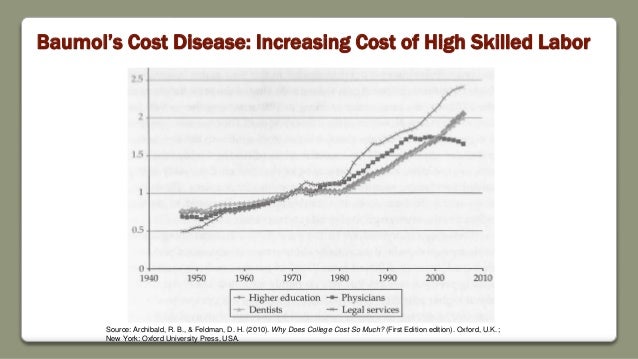
This is the crux of it that everyone needs to get over. Universality, High Quality, Low Cost. Pick two. By letting the government meddle you have guaranteed no one can afford college and will be long in debt to a loan they cannot discharge in bankruptcy. I'd rather have cheap college then universal access for every single person who wants a English Literature or Anthropology degree with low ROI. Colleges are now awash in money and they pump it into newer and fancier campuses to attract more of that government backed debt from all the masses, driving up cost significantly.
Or how about breaking the degree monopoly with something like equivalent certification programs and let private companies fill the gap. Similar to what Google is doing with its certificate program they are rolling out. 4 years for a piece of paper that includes 2 years of general education classes for "well roundness" is starting to look more and more ridiculous considering the cost of that "well roundness" is years of non-dis chargeable debt weighing you down during your best decades.