Hey, I've got one half-built! I was building mine in a line/row and trying to get it as tall as possible, but I could only reasonably get it to about 4 feet. I imagine it'll settle to ~2 feet in the end. It's about 3 feet wide at the base and about 45 feet long, mostly awaiting me to mound the dirt up.
Yeah, one of them that I built is hollow inside due to using lots of sticks and branches instead of logs, I assume it will settle in time and shrink considerably.
Traditional raised bed gardens don't hold water well and require artificial watering almost every day due to how they drain - At least in my experience.
Hugels hold water and slowly allow plants to wick the moisture when it is needed. They really start working well at year 2-3.
> Traditional raised bed gardens don't hold water well
You should probably dig (loose a little the soil) the base of the raised bed garden before build it, or maybe to choose better your species list to fit your climate.
I built my own little system yesterday that use no electricity.
An upsidedown 2L bottle sits above a reservoir and if the water gets too low it glubs out some more water. Air gets in, water comes out, now more air can't get in because the reservoir water is too high.
A set of aquarium tubes keeps the water level even between the reservoir and each plant. The plants are all in double planters, with water in the bottom one. Clothes strips wick the water up throughout the soil in the top planters, keeping the soil constantly moist.
It's been less than a day, so we'll see how it goes but the whole thing was cheap and simple.
I based this system off a large number of videos showing the double-bucket wicking system. Folks in those said they had lots of success using them. Does that only affect certain plant types?
Edit: some material I found suggests that because the surface soil stays dry, the fungus gnats have a hard time getting into the roots, propagating.
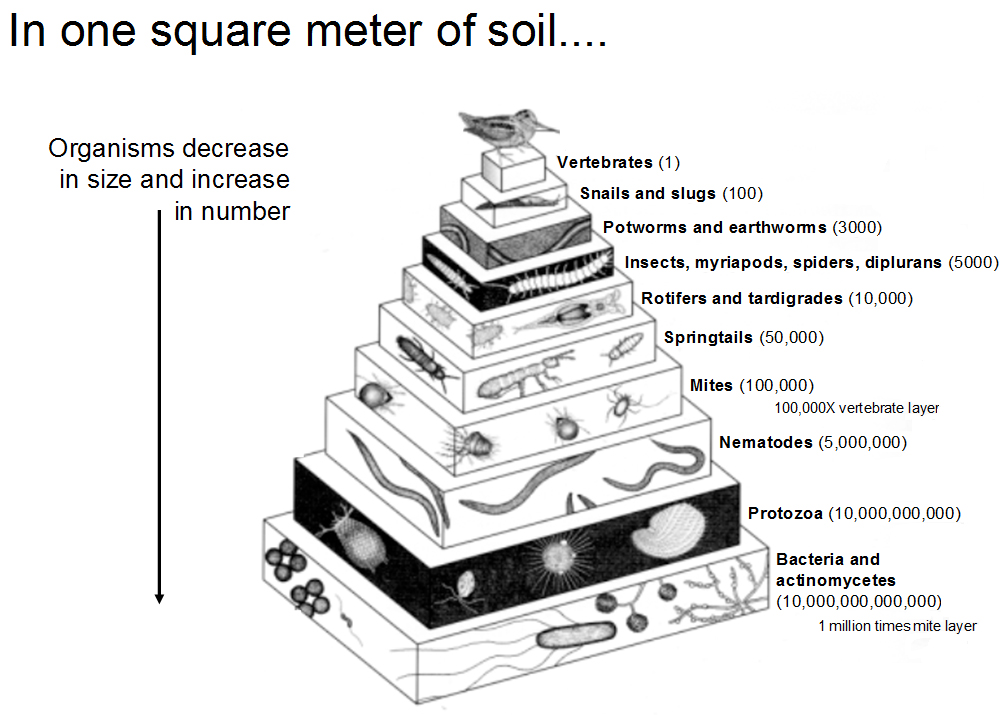
As the plant kingdom is diverse, there is no yes/no. Though you can say this is a general problem in common soil. You can imagine jungle/pond plants are more tolerant of wetness, but not of the possible pests... The ecosystem of any given soil is quite complex [0]; the environment, symbiotics, pests and predators keep things in balance.
Or just use a $2 Arduino clone, a 12V pump and a 50¢ TTL MOSFET.. And you'll even be able to add soil moisture sensors to compensate for external factors like air temperature/humidity
That's exactly the point, he got a reliable system with off the shelf components that is more reliable than your proposed solution (no water = burned pump, can mix anythig in the water, etc)
I'm thinking about something like this, thanks for posting your link.
My father's house has a greywater septic system. The treated water is sprayed on an "orchard". The trees don't get watered when people aren't in the house, so most the trees are gone. I'm going to plant raspberries. :)
Those normally work in 30min increments minimum, this stays on for 20 seconds, once a week. I already own a "smart outlet" so the cost for me would be less than $10 to build this, I just got into growing herbs and this would be a really awesome setup.
This wouldn't work if you want 1 minute a week (since the cycle repeats every 35 minutes), but for hydroponics sometimes you want a short duration with very frequent repetitions, and the electronic timers (which are preferable in most other ways) don't provide enough on/off cycles per day or week.
Interesting, I did some more searches and found this http://smile.amazon.com/Digital-Programmable-Socket-Energy-S... According to the Q&A you can get it down to second acuracy so you could do the 20 seconds. I'd much rather do this than a wifi switch that I need another system to toggle it.
I wonder if you could chain two timers, picking their periods and durations appropriately to get a much longer combined period with the correct duration.
Well, you could use 2 timers with the same period, if they are accurate.
You would plug in timer 1, so that its output (output 1) is on. You would set timer 2 so that output 2 would turn on as soon as timer 2 receives power. When there are only 30 seconds left in timer 1's on cycle, you would plug timer 2 into a separate outlet.
Since they are synced, but only overlap by 30 seconds, they will only both be on for 30 seconds. You would then need some kind of AND that would only turn on the pump if output 2 and output 1 are both on.
It may be possible, but perhaps not, to just lower the pump output so that it takes 30 minutes to water the plant. That might be too little output to work though, because that is 2 orders of magnitude longer.
"A Word on WiFi Sockets: They suck. They take the simplest operation of closing a circuit and abstract it in a shitty smartphone app that only works half the time."
Short interval timers are a bit harder to come by, as several others have mentioned, but they do exist and aren't very expensive. E.g. this one can go as short as one minute per week:
"I really don’t understand the physics that makes that system work, but it has a lot to do with water pressure..."
For those who are curious: In simple terms, pressure is proportional to depth. Assuming the air pump is outputting constant pressure, the pressure exerting on the top surface of the water would be constant. On the other hand, the amount of pressure experienced at a point near the bottom of the container depends on the its depth- the deeper the more pressure.
When there is more fluid, there is more pressure near the bottom due to the weight of the fluid itself, which allows greater output (water going into the soil). As the fluid's depth decreases, so will the pressure experienced by a point near the bottom.
So we have computers watering plants, and maybe feeding animals etc.
And that kind of makes me think we are implementing some sort of new, unnatural ecosystem where energy is expended by robots. But will it be self sufficient and sustainable?
These reasons are (casually) mentioned in the post:
* "the deeper your reservoir the more efficient the water gets pumped. As the water gets consumed, the pump gives less output"
* "If the reservoir runs dry the motor won’t catch fire. That apparently is a thing water pumps."
* "Since the water is only going through a simple tube and not an expensive motor, you can pump a nutrient solution. If you want to pamper your plants, we don’t."
An impeller driven pump moves a fixed amount of water per revolution.
There are very few pumps on the market nowadays (even the super cheap ones) that don't have run-dry protection. In any case, no pump is going to catch fire running for 20 seconds.
It is very common to add fertilizer to planted aquariums. It's dissolved in the water, and therefore makes no difference to the pump (it doesn't change the "pumping" properties of the water at all).
Worked on a similar concept during a hackathon. You could potentially connect plant watering to a system like Nest/Toon and get data from all your plants - track temperature, soil moisture, water and energy spending.
"Watering the plant would be too easy, we need a technological solution that will hydrate the plant and not require us to change our comfortable habit of neglect."
I agree. Plant watering really doesn't require any kind of electrical solution. There are oodles of self watering planters which rely on a reservoir and gravity.
But for the HNers with a slightly greener thumb: I have a big sanseviera which I use as a kind of alarm clock. Whenever it gets droopy, I know it's time to water all my plants. And because it's a big and hardy plant, it prevents me from overwatering my other plants.
I ran into an idiom last month. Something like food computing. A trendy name for everything about home automation regarding growing vegetables. Anybody can confirm ?